Table of Contents
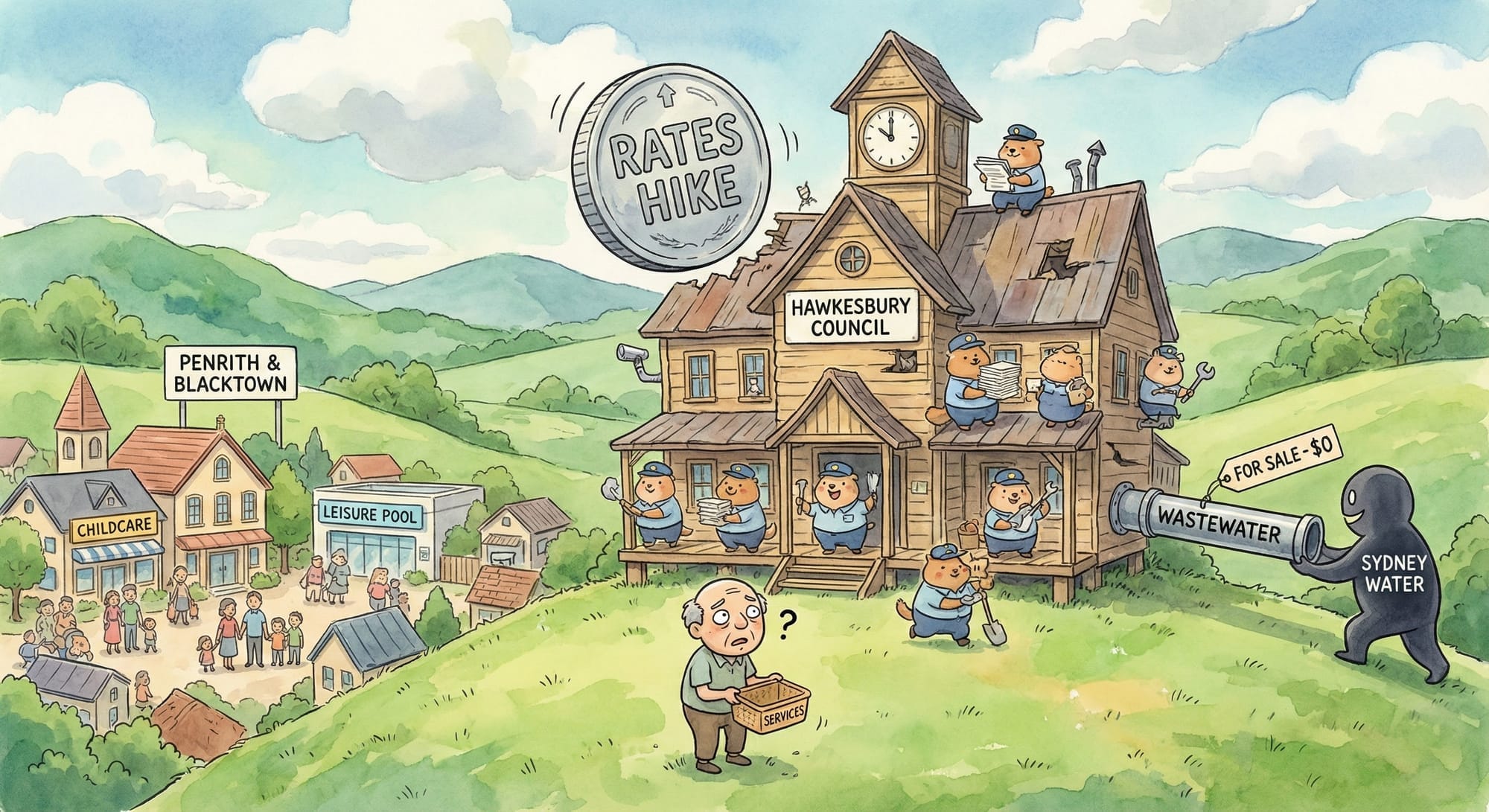
Hawkesbury City Council has voted at its November meeting to pursue a 40% rate rise, defying the unmistakable voice of its own residents. Council’s decision comes even after spending $80,000 on community polling that revealed 70% of residents oppose the increase; despite questions in the survey containing reportedly misleading assumptions such as the claim that the average Hawkesbury household pays only $1,000 in rates.
If that wasn’t enough to signal the public mood, a record 2,500 submissions flooded Council’s Have Your Say portal. The overwhelming majority rejected the proposal.
Still, the majority bloc of councillors voted in favour, insisting the increase is needed to tackle an “infrastructure backlog.”
Residents say they’ve heard this tune before.
RATE HIKES THAT DIDN’T FIX THE PROBLEM
Council used the same justification in 2017–18 during what many remember as a blanket “30% rate rise.” This rise was meant to future proof Council finances. The truth, however, was far more complex and far more punishing.
In 2017, Council radically restructured the way rates were calculated, lowering the base rate and shifting the burden onto land value. Many residents in Oakville, Pitt Town, Maraylya and other fringe rural zones bordering The Hills Shire areas where land values surged due to nearby suburban development saw rate increases exceed 100%, even though they were not allowed to subdivide or benefit from those rising valuations.
In 2018, Council secured IPART approval for a permanent 31% Special Rate Variation (SRV) added over three years.
The result was not a neat 30% rise but a turbulent mix of structural changes and permanent increases that hit different households in wildly different ways. And crucially: it did not solve the infrastructure backlog.
“If that increase didn’t fix the problem, why are we being asked for 40% more?” asked Helen a resident of North Richmond.
A GROWING COUNCIL WORKFORCE, SHRINKING SERVICE DELIVERY
What angers many residents is the mismatch between rising rates and declining Council performance. Council’s own workforce documents tell a stark story. In 2011, Council employed around 280 staff (271.6 full-time equivalent).
By 30 June 2024, that number had climbed to 420 employees. That is an increase of about 50% in a little over a decade. Yet over the same period community events have been cancelled due to resource constraints, maintenance backlogs have grown and major capital projects remain undelivered.
Residents are questioning why Council’s workforce has expanded so dramatically while its service levels have visibly deteriorated.
THE SEWERAGE FIASCO — A $152 MILLION WRITE-DOWN
The collapse of Council’s Windsor sewerage operation once a profitable business has left residents facing increased bills and an astounding $152.8 million asset write-down. The disposal of the business, announced just before Christmas, has been described by residents as “a Christmas present nobody asked for.”
THE $98 MILLION WESTINVEST FAILURE
The Hawkesbury is now on track to become the only council in NSW likely to deliver none of the capital works funded by the $98 million in WestInvest grants it received.
Incredibly, the Mayor and several councillors have argued that the NSW Government is to blame for giving the Hawkesbury money it “wasn’t capable of administering.” Greens Cr Danielle Wheeler has publicly supported this explanation.
For many in the community, this excuse raises deeper concerns about competence in senior leadership.
“If Council can’t manage its own staff, its finances, or its assets, how can it manage another 40% of our money?” says a resident and businessperson who does not want to be named for fear of reprisal “We’ve reached the point where the community has no confidence left. An administrator is the only path forward.”
THE GENERAL MANAGER’S PERFORMANCE REVIEW — NO TARGETS, NO ACCOUNTABILITY
Council’s financial and organisational challenges have sharpened scrutiny on the role of the General Manager whose position now costs ratepayers over $429,888 per year, or more than $8,269 per week. This is a rise of over $59,000 from the year before.
Yet at the mid-year performance review in June, conducted by Deputy Mayor Sarah McMahon and Mayor Les Sheather, Cr Mary Lyons-Buckett and Cr Amanda Kotlash, set no new measurable performance improvement targets and concluded that all issues facing Council stemmed from “external factors.”
Residents say this leaves them with leadership that is both highly paid and entirely unaccountable.
“During a cost-of-living crisis, when families and businesses are facing a depressed economic outlook, competent governance is essential to restore community confidence in our future. Hawkesbury Council must demonstrate that it can effectively manage its more-than-billion-dollar asset portfolio and at present, it is not. This is why we need an administrator: to restore efficiency, ensure accountability, and prevent our community from being left vulnerable to financial collapse or absorption by a wealthier neighboring council.” Fiona Germaine, Bells Line Road Business Council.
MP FOR HAWKESBURY OPPOSES THE RATE RISE
The Member for Hawkesbury Robyn Preston MP has joined residents in rejecting the 40% rate hike, in a Facebook video statement saying the community should not be forced to shoulder the consequences of poor internal decision-making.
CALLS FOR AN ADMINISTRATOR GROW LOUDER
Amid rising frustration and eroding trust, more residents and business groups including those historically supportive of Council are now openly calling for the NSW Government to appoint an Administrator.
They argue the organisation’s financial mismanagement, ballooning workforce, deteriorating services, and inability to deliver grant-funded projects show that the Council is no longer functioning effectively.
“With households and local businesses under severe cost-of-living pressure, our community needs absolute confidence that council operations are being managed transparently and effectively. Windsor residents want a council that protects our long-term assets, prioritises liveability, and plans responsibly for the future. We believe appointing an administrator would provide the stability and accountability needed to restore public trust and ensure the Hawkesbury is safeguarded for generations to come.” Says Gae Kelly of Windsor Liveability Group which brings together over 130 businesses.
So, this year, instead of asking for socks or a gift voucher, Hawkesbury residents are sending a simple, heartfelt plea to whoever is listening:
“All I want for Christmas is a new Council, a governing body that understands that accountability is essential for revenue, and that the effective management of $1.4 billion in assets requires competence, not just increased rates to fix past errors. Maybe then, we might finally get that "Future Proofing" we paid for in 2018.” Bob Gribbin Oakville resident
The Councillors who voted for the rate rise are Mayor Sheather, Deputy Mayor McMahon, Councillors Kotlash, Lyons Buckett, Wheeler, Reardon and Ryan.
Councillors who voted against the rate rise are Zamprogno, Creed, Veigel and Djuric.
The Hawkesbury Gazette will continue investigating the decisions and culture that have led to this moment.