Table of Contents
Governor Lachlan Macquarie left a profound mark on the Hawkesbury. He laid out flood-resilient towns, championed the region as New South Wales’ early food bowl, and dealt with the Hawkesbury’s Aboriginal peoples in ways both collaborative and violent, leaving a complex legacy that still resonates in local landscapes and lives today.
Standing on Windsor’s historic Thompson Square, a grassy public square that dates back to 1810, it’s easy to see why Governor Lachlan Macquarie chose this spot. Below, the Hawkesbury River winds through fertile flats that have long fed Sydney, but floodwaters regularly swallowed early farms. After a devastating flood in 1806 wiped out crops and even lives, Macquarie took action.
In December 1810, on his first tour of the district, he gathered local settlers for an after-dinner address. “After dinner I christened the new townships... I gave the name of Windsor to the town intended to be erected in the district of the Green Hills... the township in the Richmond district I have named Richmond...” he recorded in his journal.
Over a few days, the Governor formally marked out five “Macquarie Towns” Windsor, Richmond, Pitt Town, Wilberforce and Castlereagh deliberately set on high ground above reach of the flood.
Macquarie’s town plans were practical and bold. Each new township was surveyed into orderly streets, with a central square or common, sites earmarked for a church, school, inn and even a burial ground. In Windsor (then a rough riverside settlement known as Green Hills) he envisioned a proper civic centre on the ridge, safe from floodwaters.
The Governor even allotted every Hawkesbury settler a town plot “sufficient for a house, garden, yard and stockyard” proportional to their farm, so they could live on higher ground and visit their lowland fields by day.
In practice, it was an early exercise in disaster mitigation move the population out of harm’s way yet keep them close to their livelihood.
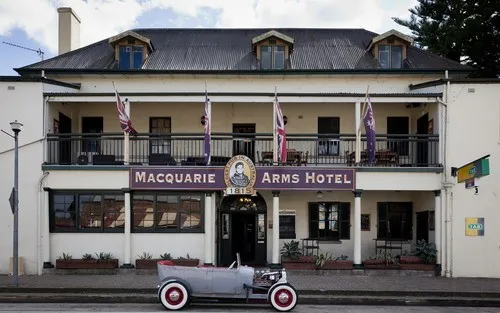
Macquarie’s public works mindset showed in the details: at Windsor he soon commissioned a sturdy brick schoolhouse and what is now Australia’s oldest mainland pub, the Macquarie Arms, which opened in 1815 and still stands on Thompson Square. Over in Richmond, he laid a foundation for St Peter’s church and set aside land for a market square. Two centuries later, these town centres remain the hearts of their communities, and during recent floods locals noted that Windsor’s Georgian-era core stayed dry even as waters surged nearby, a testament to Macquarie’s foresight.
Not everyone was convinced at first. The fertile Hawkesbury flats were hard to abandon; many farmers ignored Macquarie’s edict and kept living in riverside huts, only to suffer again when big floods hit in 1816 and 1817. Frustrated, Macquarie scolded them in a public proclamation, saying their losses might have been averted had they removed their residences from within the flood marks to the townships assigned for them on the highlands. His tone was equal parts sympathy and astonishment that “any People could be found so totally insensible to their true interests” as to remain on the floodplain. The message eventually sunk in. Over time, brick and stone buildings rose on the high ground, and the Hawkesbury’s main settlements have stayed where Macquarie pegged them.
Even so, Mother Nature can exceed expectations. An 1867 flood swept well above even Macquarie’s town sites, and today’s planners still grapple with making the region flood-resilient. The new Windsor Bridge, raised levees and evacuation roads all echo a truth Macquarie impressed on his era: the river will flood, so build wisely.