Table of Contents
THE GRANARY AND THE GATEWAY
Macquarie was not just an engineer of towns, but a strategist with an eye on the colony’s survival. In 1810 the Hawkesbury was already known as the “granary of New South Wales”, producing a huge share of the young colony’s wheat and corn. The Governor understood that Sydney’s food security and growth depended on this fertile valley. That’s why, beyond flood protection, he invested in its prosperity. Under Macquarie’s leadership the Hawkesbury thrived: he improved roads to connect Windsor with Sydney, encouraged ex-convict farmers and free settlers alike, and built infrastructure to store and mill grain.
When a group of Hawkesbury settlers wrote to him in late 1810 praising the rapid improvement of their district, Macquarie was delighted. He publicly replied that the Hawkesbury would “always be an object of the greatest interest” to his government. He meant it. In the following years, he appointed a resident magistrate to Windsor, funded schools and churches, and had colonial architect Francis Greenway design the grand St Matthew’s Anglican Church on Windsor’s rise its brick tower, visible for miles, symbolised law and stability on the frontier. By 1817 he was inspecting the nearly finished St Matthew’s and a new courthouse on his final tour of the region. The Hawkesbury, in Macquarie’s eyes, was the backbone of a growing colony, a region that needed structure and civility as much as it needed ploughs and harvests.
At the same time, Macquarie’s Hawkesbury vision went hand in hand with opening the west. In 1813, when explorers Blaxland, Lawson and Wentworth crossed the Blue Mountains, Macquarie wasted no time – he ordered a road built from the Hawkesbury to the newly discovered pastures beyond. That road, constructed by William Cox and completed in 1815, started just south of the Hawkesbury region and led to Bathurst, the colony’s first inland town. Hawkesbury’s farms fed the soldiers and labourers building that road, and Windsor became a launching point for further expansion.
Macquarie believed in an “ordered civil society” where even the frontier would be neatly arranged into towns, churches and schools. The Hawkesbury was his proof of concept. By planting durable towns here and quelling disorder, he aimed to secure Sydney’s food supply and create a springboard for settlement westward. It largely worked though not without human costs and conflicts that are only now being fully acknowledged.
WAR, DIPLOMACY AND THE DHARUG
When Macquarie arrived, the Hawkesbury region was not an empty frontier – it was Country, home to the Dharug people and their neighbours the Darkinjung, among others. The fertile river flats that drew colonial farms were the same hunting and camping grounds Aboriginal families had tended for countless generations. As farms spread, so did frontier violence. By the early 1810s, conflicts between settlers and Aboriginal warriors had escalated into cycles of raids and reprisals.
Governor Macquarie, seeking stability in this crucial district, tried initially to “conciliate the affections” of the Hawkesbury’s First Peoples. He met with Aboriginal leaders, issued them clothing and blankets, and in 1814 organised a “Native Feast” at Parramatta. One of those who attended was Yarramundi, a respected Karadji (healer) and elder of the Boorooberongal clan. Macquarie had come to regard Yarramundi as a key local leader – even a “friend and an ally” in the tentative negotiations over land and coexistence.
For a moment, it seemed like diplomacy might hold. Macquarie established the Native Institution, a school for Aboriginal children, and Yarramundi enrolled his young daughter there. In Macquarie’s eyes, Yarramundi was among the “natives of highest distinction”, a man he hoped to assimilate into the colonial project. The girl, later known as Maria Locke, went on to excel academically and build a remarkable bridge between cultures a hopeful symbol of Macquarie’s experiment.
But outside the classroom, the Hawkesbury was still in turmoil. Facing continued Indigenous resistance burning of crops, speared livestock, settlers killed – Macquarie’s patience waned. In April 1816, after several violent clashes on the Nepean and Hawkesbury frontiers, Macquarie changed tack dramatically. He convened his council and ordered a military crackdown. His directive was uncompromising: “To inflict exemplary and severe punishment.” Soldiers of the 46th Regiment marched into the Hawkesbury, Nepean and southwards to the Illawarra and Appin, with orders to capture or shoot any resisting Aboriginal people and to take others prisoner. The campaign was brutal. In the Appin massacre of April 17, 1816 one of the punitive raids Macquarie initiated – at least 14 Aboriginal men, women and children were killed when troops surprised their camp at night. On the Hawkesbury itself, similar raids were conducted; even some local settlers joined in the retaliation.
Macquarie’s own reports downplayed the bloodshed, noting only that “several Natives” had been “unavoidably killed” for not surrendering. But the reality was indisputable: the Governor who had sought to conciliate became the Governor who punished.
By late 1816, the Hawkesbury was quiet pacified by force and Macquarie seemed to recognise the harsh measures’ limits. He pivoted back to diplomacy, extending an olive branch once more. In 1817 he invited Aboriginal leaders, including Yarramundi (whom the records also call by the name “Yellomundy”), to another gathering at Parramatta. At this meeting Macquarie handed out brass medallions and certificates to a handful of men he dubbed “Chiefs” – an attempt to formalise alliances. Yarramundi again stood by the Governor’s side and received a bronze breastplate declaring him “Chief of the Richmond Tribe.” Historians interpret these events as Macquarie’s peace treaty of sorts. For the Dharug, it was a tenuous peace – a chance to protect what remained of their land and people by negotiating with the invaders. For Macquarie, it was a strategic reset, having learned that governing solely by the musket would not secure the frontier long-term.
WHAT REMAINS
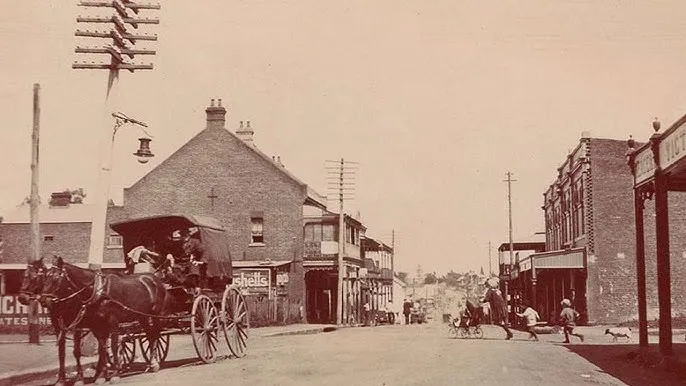
More than 200 years later, Lachlan Macquarie’s presence is still felt across the Hawkesbury. Drive through Pitt Town or Wilberforce and you’re tracing the grid he laid out in 1810. Stroll the Windsor riverfront and you can admire the Macquarie Arms Hotel and St Matthew’s Church, heritage landmarks born of his building zeal. In Windsor’s courthouse, Macquarie’s portrait gazes down from the wall a painting the locals commissioned as thanks when he left office and which has hung there since the 1820s. These are reminders of Macquarie the town planner and colony-builder, the man who improved New South Wales with an unprecedented program of public works.
Yet the land itself holds deeper memories. The Dharug people of the Hawkesbury, including descendants of Yarramundi and Maria Locke, still live in the area, their presence a quiet rebuke to the old prophecy that Aboriginal people would die out. Far from vanishing, they remain the custodians of stories and culture along the Hawkesbury. The duality of Macquarie’s impact is part of local lore. Ask a Hawkesbury old-timer, and they might praise Macquarie for our towns and historic buildings. Ask a Dharug elder, and you’ll hear about dispossession and survival amid those same towns. Both perspectives are true, and together they form the Hawkesbury’s story.
As the region marks Macquarie’s birthday on 31 January, there’s an opportunity to reflect clear-eyed and respectful. We can admire how Governor Macquarie’s foresight built a prosperous community on higher ground, even as we acknowledge the ground was not empty and the price of “civilising” a frontier was often paid in blood and loss. Macquarie’s Hawkesbury legacy invites us to remember that our comfortable towns were born of grand vision, hard work, and conflict and that understanding our past is the surest foundation for building a future, on high ground or low.