Table of Contents
Hawkesbury has been singled out in a major new economic and resilience report as one of the regions feeling the financial strain of rising insurance premiums linked to escalating climate risk.
The NSW State of the City 2026 report, prepared for the Committee for Sydney, identifies Hawkesbury as an example of how disaster-exposed communities across Western Sydney are facing mounting economic pressure as natural disasters intensify .
While much of the report focuses on Sydney’s economic strength, innovation growth and transport expansion, Hawkesbury appears in a very different context under the heading of resilience.
Insurance costs climbing
The report notes that natural disaster declarations across NSW have more than doubled in recent years, with economic losses from floods, storms and bushfires rising sharply .
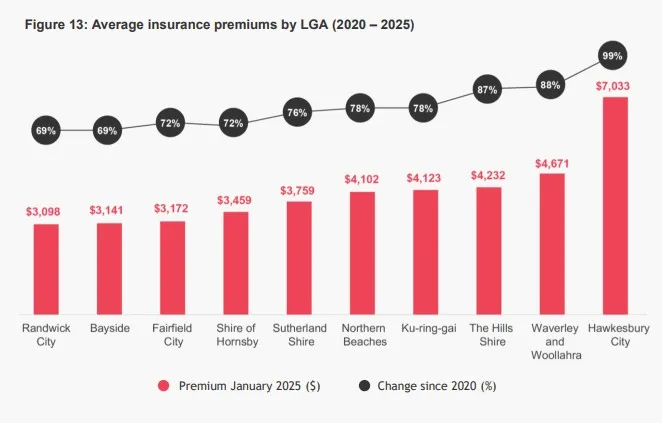
It identifies a clear trend emerging since 2020: insurance premiums are increasing most sharply in areas exposed to climate risk. Hawkesbury is specifically referenced as an example of an LGA already experiencing these premium pressures .
The broader data in the report shows that average insurance premiums across several Sydney LGAs have risen substantially since 2020, reflecting the higher cost of covering properties in flood-prone and disaster-affected regions. The report warns this trend could accelerate if mitigation and resilience measures are not strengthened.
For Hawkesbury residents many of whom live on or near the floodplain this comes as little surprise. Fire and repeated flood events in recent years have reshaped the local insurance market, with some homeowners reporting sharp premium increases, higher excesses, or difficulty obtaining coverage at all.
Economic ripple effects
The report makes clear that rising premiums are not just a household issue. Insurance affordability affects property values, small business viability, investment confidence, mortgage security and community stability the report summarises.
In areas like Hawkesbury, where agriculture, tourism and small businesses form a significant part of the local economy, sustained insurance escalation can create a drag on growth.
The report argues that without strategic infrastructure investment including flood mitigation, drainage upgrades and resilience planning, disaster-exposed LGAs may face compounding economic disadvantage .
Hawkesbury’s position compared to other LGAs
While the report does not rank LGAs in a formal league table, Hawkesbury is grouped among those experiencing noticeable premium increases since 2020 .
Unlike inner-city areas where insurance growth has been more moderate, outer metropolitan regions exposed to riverine flooding are highlighted as areas of concern.
The implication is clear: geography now plays a stronger role in financial risk than it did a decade ago.
What the report does not say
Notably, Hawkesbury does not feature in the report’s economic growth, innovation or transport infrastructure chapters.
There is no reference to local employment centres, industry clusters, data centre investment or transport connectivity improvements.
Instead, Hawkesbury appears solely in the context of climate exposure and resilience risk .
That framing matters.
It positions the region less as an economic growth node and more as a resilience challenge within the broader Sydney metropolitan story.
What this means locally
For Hawkesbury homeowners and businesses, the report reinforces what many already feel insurance is becoming a defining economic issue.
It raises several questions for policymakers, will there be targeted flood mitigation investment; can government-backed insurance reforms improve affordability; how can planning decisions reduce long-term exposure; what support is available for small businesses facing escalating premiums?
The report’s broader message is that resilience must sit alongside economic ambition. Sydney cannot maintain its growth trajectory if parts of the metropolitan region face rising uninsurable risk.
"For Hawkesbury, the warning is clear: without sustained investment in mitigation and infrastructure, insurance affordability may become one of the region’s most pressing long-term economic challenges." says President Hawkesbury Business Group Phil Bamford. "We need to identify, discuss, agree and implement in a timely manner disaster mitigation infrastructure."
And as climate impacts intensify, the cost of inaction may be felt not just in premiums but in confidence, growth and community security itself.