Table of Contents
Residents across the Hawkesbury region are being urged to prepare for a significant increase in aircraft noise once Western Sydney International Airport begins full operations with no legislated overnight curfew.
Local aviation noise campaigner Dr Billy Gruner says communities in the region should begin advocating for night-time protections now, warning they could otherwise face the same situation currently unfolding around Brisbane Airport.
Gruner, who has long campaigned on aircraft noise issues stemming from Sydney Airport flight paths, told the Hawkesbury Gazette that residents should pay close attention to developments in Brisbane.
“People in Western Sydney need to start pushing for a curfew now,” he said. “If we wait until the noise becomes constant, it will be much harder to change the system. Communities elsewhere are already showing what happens when night flights grow without limits.”
Lessons from Brisbane
Community groups around Brisbane have recently intensified their campaign for night-time restrictions on flights after an increase in aircraft movements following the opening of the city’s second runway.
Residents have organised through groups including the Brisbane Flight Path Community Alliance, arguing that overnight aircraft movements are disrupting sleep and affecting quality of life for large numbers of households.
At a recent community town hall, the alliance released a report by economist Professor John Quiggin from the University of Queensland examining the economic case for introducing a curfew at Brisbane Airport.
According to the analysis, the economic impact of a 10pm–6am curfew would be relatively small estimated at about $10 million per year or less. By contrast, the report estimates the wider community costs linked to night-time aircraft noise are far higher.
Health impacts associated with sleep disruption and chronic noise exposure are estimated at around $100 million annually, while broader impacts such as loss of amenity and potential reductions in property values could reach $200–$350 million each year.
The report also noted that only a small proportion of flights occur overnight, but these flights cause disproportionate disturbance because they interrupt sleep for hundreds of thousands of residents.
Professor Quiggin wrote that the longstanding argument that airports must operate without curfews to remain economically competitive is not supported by evidence.
“A curfew would not ground the economy, but it would finally let Brisbane residents sleep,” he concluded.
Curfews already exist elsewhere
Several major Australian airports already operate under legislated curfews, including Sydney Airport and Adelaide Airport. Restrictions also apply to operations at Essendon Airport in Melbourne.
Supporters of curfews argue these examples show that strong community protections can coexist with a functioning aviation sector.
Western Sydney International Airport, however, has been designed to operate 24 hours a day, a feature promoted by governments and aviation planners as critical to freight and future economic growth.
Growing concern in Western Sydney
As the airport moves closer to opening, community advocates say the time for public discussion about night-time noise is now.
Dr Gruner believes Western Sydney communities including parts of the Hawkesbury may not yet fully appreciate how frequently aircraft could pass overhead once operations expand.
“Once an airport is operating around the clock, it becomes much harder for communities to push back,” he said. “Residents need to understand what 24-hour aviation actually means for sleep, health and everyday life.”
Advocacy groups say the debate now facing Brisbane could become increasingly relevant for Western Sydney as the new airport grows.
Whether a curfew ever becomes part of that conversation may depend on how strongly communities across the region engage with the issue in the years ahead.
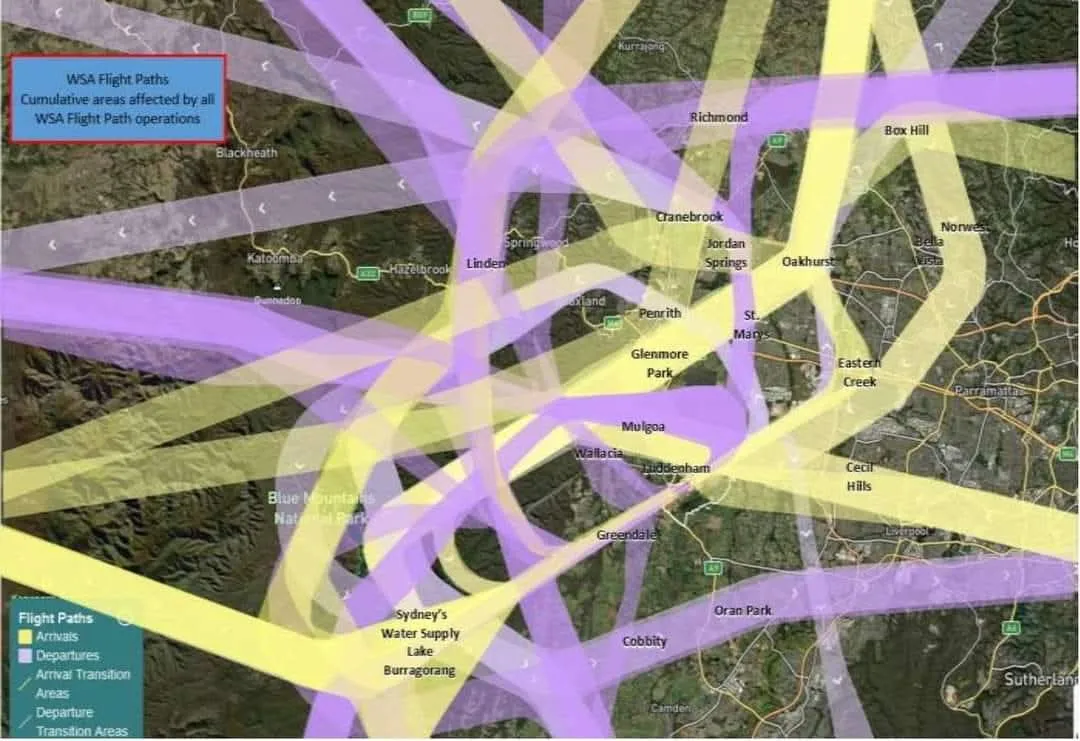
Further information can be found at the Western Sydney International (Nancy-Bird Walton) Airport Aircraft Overflight Noise Tool Tool https://wsiflightpaths.aerlabs.com/