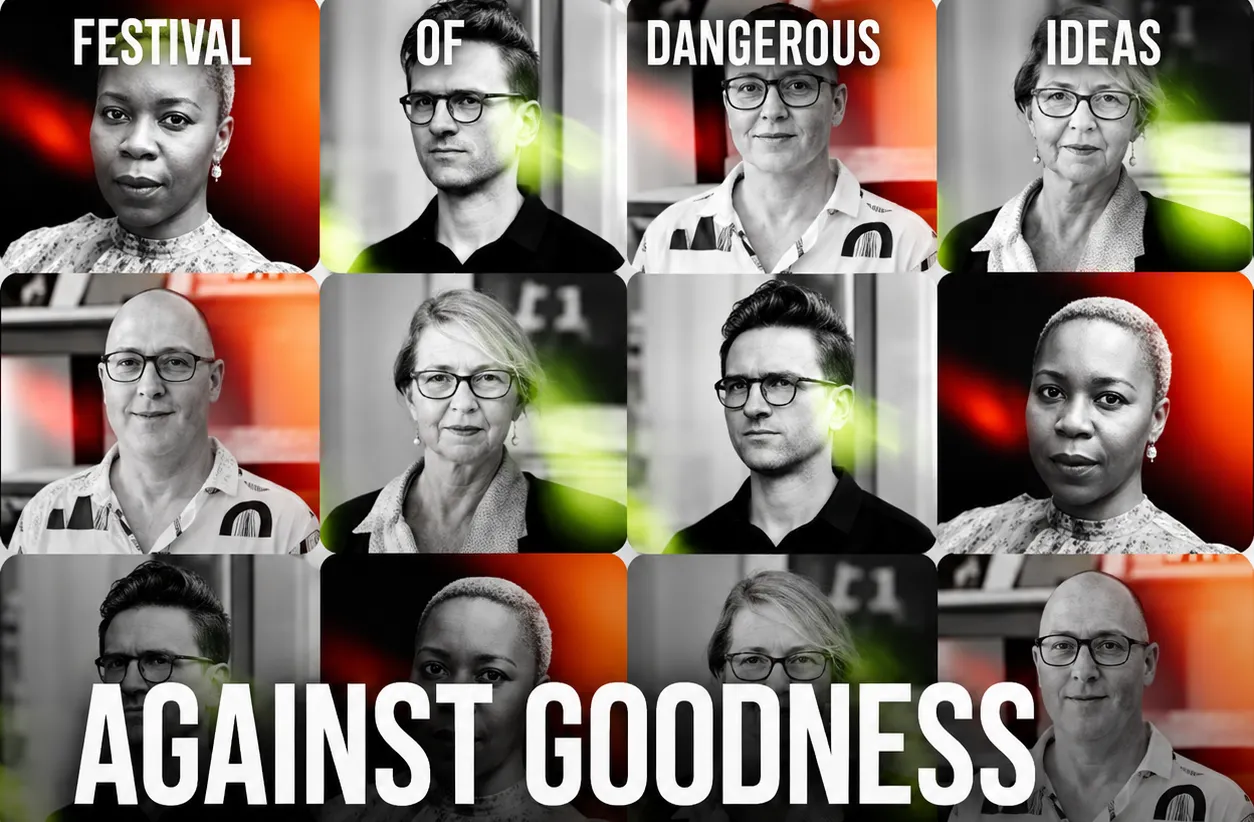
A provocative Festival of Dangerous Ideas discussion will challenge one of our most comforting assumptions, that people who believe they are doing good will necessarily produce good outcomes.
The session, Against Goodness, will be held at Carriageworks in Sydney on Saturday, August 22, as part of the 2026 Festival of Dangerous Ideas.
Rather than arguing that people should abandon morality, the panel will examine the dangers of moral certainty and the harm that can follow when individuals, institutions or political movements become convinced that they alone occupy the right side of an argument.
The session asks whether the problem is sometimes not that people fail to be good, but that they become too committed to believing they already are.
Festival organisers say moral certainty can reassure people that they are virtuous while encouraging them to divide the world into heroes and villains. That division can distort public debate, justify cruelty and remove the need to understand those with different views.
Good intentions do not guarantee good outcomes
History contains many examples of people causing serious harm while believing they were acting for a moral, religious, political or national cause.
That does not mean moral principles are unimportant. It means intentions alone cannot determine whether conduct is fair, humane or justified.
The discussion is likely to consider what happens when the pursuit of moral purity becomes more important than evidence, consequences, compromise or the humanity of an opponent.
It is a question with obvious relevance to contemporary politics, where disagreement is increasingly framed not as a difference of judgment but as a contest between good and evil.
Public figures, political parties, activists and institutions can all become trapped by a belief that their goals are so righteous that ordinary standards of fairness no longer apply.
Once that happens, criticism can be dismissed as disloyalty, opponents can be portrayed as morally defective and harsh treatment can be justified as necessary for a greater good.
A challenge from psychology, history and philosophy
The panel will bring together three international thinkers approaching the subject from different disciplines.
American psychologist and science writer Jesse Bering studies human behaviour, belief and morality. He is head of the Science Communication program at the University of Otago in New Zealand.
British historian Joanna Bourke has written extensively about violence, pain, fear and the ways societies define victims and perpetrators.
German-Dutch philosopher Hanno Sauer specialises in ethics and political philosophy and has examined the development of morality, cooperation, class and social status.
The discussion will be chaired by South African-Australian writer and political analyst Sisonke Msimang.
Together, the speakers will ask whether strong moral convictions always make people kinder or wiser or whether certainty itself can reduce curiosity, humility and compassion.
Lessons for local public life
The questions raised by Against Goodness are not confined to international politics or major ideological movements.
They also apply to councils, community organisations, local campaigns, political branches and media outlets.
Local disputes can quickly become moralised, with each side convinced it represents the public interest and the other side dismissed as dishonest, dangerous or selfish.
Once a debate reaches that point, evidence becomes secondary to identity. People stop asking whether a decision is effective or fair and instead ask whether it was made by the “right” people.
The lesson is not that communities should avoid strong convictions. Democratic life depends on people being willing to defend principles.
But conviction without self-examination can become self-righteousness. Institutions that believe their motives are unquestionably good may become less willing to explain their decisions, hear criticism or accept that they could be wrong.
The most responsible test of public conduct is therefore not simply whether decision-makers believe they are acting properly. It is whether their actions can withstand scrutiny, respect procedural fairness and produce defensible outcomes.
Festival built around uncomfortable questions
The Festival of Dangerous Ideas will run across Sydney from August 20 to 30, with its main weekend at Carriageworks on August 22 and 23.
Presented by The Ethics Centre, the festival describes itself as a curated forum for difficult discussions rather than provocation for its own sake.
Its 2026 theme is Revelation, focusing on what happens when hidden systems, assumptions and uncomfortable truths are exposed. The broader program covers morality, hatred, belonging, nationhood, faith, conspiracy and pluralism.
Against Goodness begins at 11am on Saturday, August 22, and runs for 60 minutes. General admission tickets are listed at $39, with concession and youth tickets available for $34. (Festival of Dangerous Ideas)
Its central question may be uncomfortable, but it is increasingly relevant: are people most dangerous when they know they are doing wrong or when they are entirely certain that they are doing good?
EXPLAINER: What is the Festival of Dangerous Ideas?
The Festival of Dangerous Ideas is a Sydney-based ideas festival that brings together writers, academics, artists, journalists and public figures to debate difficult and divisive questions.
The festival is presented by The Ethics Centre and describes itself as being driven by ideas rather than shock value. Its events examine subjects such as politics, morality, religion, identity, technology, violence, freedom and social change.
Unlike a conventional conference, the festival deliberately places controversial propositions before audiences and invites speakers to test assumptions that are often left unchallenged. Organisers say the program is carefully curated and is not intended to provide a platform for outrage simply for its own sake.
The festival was co-founded by The Ethics Centre and the Sydney Opera House in 2009. Its inaugural event opened with writer and commentator Christopher Hitchens delivering an address titled Religion Poisons Everything.
Over subsequent years, the program featured speakers including Julian Assange, Slavoj Žižek, Naomi Klein, Salman Rushdie, Steven Pinker, Germaine Greer, Stan Grant, Alicia Garza and Stephen Fry.
The festival remained at the Sydney Opera House until 2016 before adopting new formats and moving through venues including Cockatoo Island, Sydney Town Hall and Carriageworks. Its 2020 physical program was cancelled because of the COVID-19 pandemic, but organisers instead presented a series of digital discussions. The live festival returned in 2022.
Across 12 editions since 2009, the festival says it has presented more than 400 sessions and sold about 194,000 tickets.
The 2026 festival runs across Sydney from August 20 to 30, with its main weekend at Carriageworks on August 22 and 23. Its theme, Revelation, focuses on exposing hidden forces, assumptions and uncomfortable truths shaping society.