Bogong moths have begun their annual journey towards the Australian Alps, and Western Sydney University is asking people who spot them to help answer a question: what do the moths eat along the way?
Dr Eleanor Drinkwater, from the university’s School of Science, says the moths travel hundreds of kilometres from lowland breeding areas to cool alpine caves, where they spend the hottest part of summer. Each moth makes the journey to and from the mountains only once.
“If you see one of these wonderful animals in your garden, you know they’re on an amazing journey at the moment,” Dr Drinkwater said.
Research involving Professor Eric Warrant has found that Bogong moths use cues from the night sky and the Earth’s magnetic field to navigate. Dr Drinkwater said their ability to make the trip without having travelled the route before was extraordinary.
Their arrival in the mountains matters to another species. Bogong moths provide food for endangered mountain pygmy possums, including females raising young.
The university’s research team now wants to learn which plants the moths feed on while migrating. Dr Drinkwater is asking anyone who sees a Bogong moth feeding in a garden to photograph the moth on the plant and upload the observation to the Bogong Watch project on iNaturalist.
“That will help us get an idea about what kind of things they’re using on their migration,” she said. The findings could eventually help gardeners choose plants that support the moths.
Dr Drinkwater said Bogong moths are harmless to people and will move on, even if some find their way into houses. She said the full effect of light pollution on their migration is still being investigated.
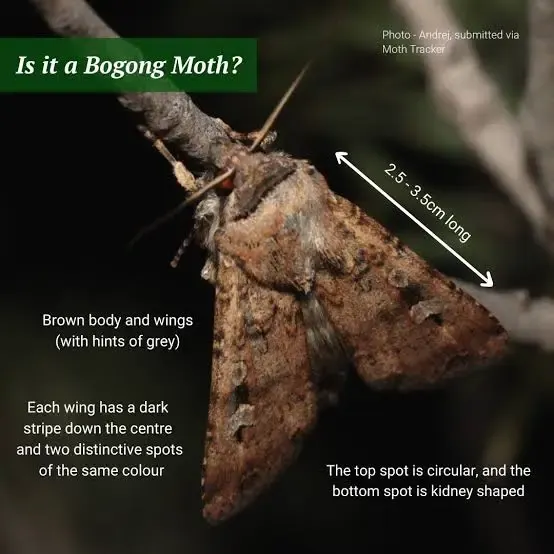
People identifying a moth should look for a distinctive dark stripe on the wing, with a round mark towards the top and a bean-shaped mark below it. Dr Drinkwater said another species, the granny’s cloak moth, has also been appearing and can be mistaken for a Bogong.
The team hopes to hold another tagging event in February to study the moths’ return journey. Anyone interested in observations or future research activities can find more information at Bogong Watch.
Source: Western Sydney University.