Boxing is enjoying renewed attention in the Hawkesbury, with professional fight nights, amateur contests and first-time competitors bringing the sport back before local crowds.
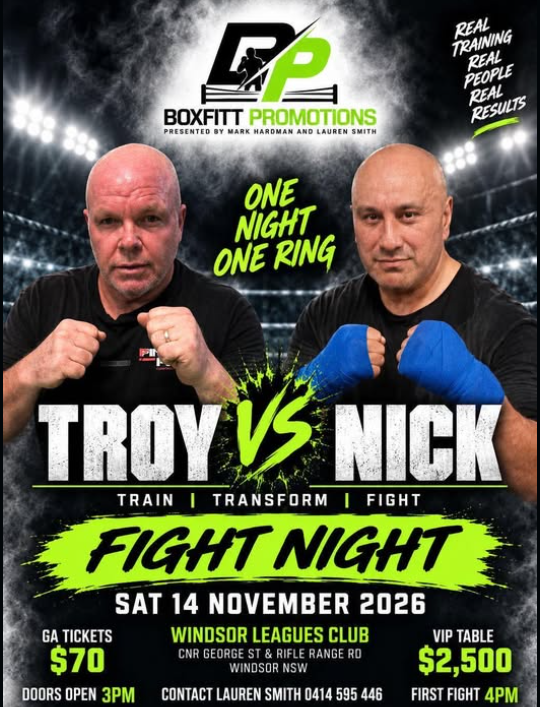
The latest announcement promotes a “Battle of the Masters” between Troy and Nick—two men preparing to enter the ring for the first time at 50 years of age.
“Two first-time fighters. One unforgettable night,” the promotional post says, describing their decision as proof that people are never too old to challenge themselves or pursue a long-held ambition.
The post supplied to the Gazette does not identify the event’s date, venue, promoter or sanctioning body. Those details will need to be confirmed before spectators make plans to attend.
The announcement follows the BoxFitt Fight Night held at Richmond Race Club on August 8. The Londonderry Road venue was transformed into a boxing arena for a program combining professional fights, amateur contests and opportunities for developing competitors.
BoxFitt also staged a Richmond fight night in March, while Windsor Leagues Club previously hosted more than 20 amateur bouts featuring Pacific Islander fighters. These events suggest boxing is again finding a substantial Hawkesbury audience.
A much older fighting history
Boxing in the Hawkesbury is not a new phenomenon.
One of the district’s earliest recorded prize fights occurred near Windsor in August 1836. George Gaudry fought James Bishop in a makeshift ring formed by spectators about two miles from town.
Historical accounts reproduced by Hawkesbury local historian Michelle Nichols indicate the contest lasted approximately an hour and involved substantial betting. Bishop became unconscious and died later that day.
Gaudry and several people involved in organising or supporting the fight subsequently faced the NSW Supreme Court. The judge condemned prize fighting as a brutal and unlawful practice, and prison sentences were imposed.
That tragic episode demonstrates how different early prize fighting was from properly regulated modern boxing. Nineteenth-century contests could continue for long periods, take place without effective supervision and be driven heavily by gambling and local rivalry.
Over succeeding generations, boxing moved into halls, gymnasiums and organised sporting programs. Formal rounds, weight divisions, referees, medical examinations and registration requirements progressively replaced the loosely controlled prize fights of the colonial period.
A modern challenge later in life
The Troy versus Nick contest reflects another change in the sport: boxing is no longer presented solely as a young professional’s pursuit.
Under Boxing Australia competition rules, masters boxing is available to competitors aged 41 and over. Matching rules consider age, weight and experience, with limits placed on the permitted age difference between opponents.
In NSW, regulated amateur and professional boxing also operates within the state’s combat-sports framework. Competitors may need to be registered and satisfy medical and event requirements appropriate to the contest.
The description of Troy and Nick as masters fighters does not, by itself, confirm which rules or sanctioning arrangements will govern their bout. The promoter should clarify those details when the full event information is released.
Beginning boxing at 50 remains a demanding undertaking. Training can involve cardiovascular conditioning, strength work, footwork, defensive movement and controlled sparring. It can give participants a clear goal while developing fitness, discipline and confidence.
It is not, however, without risk. Age does not eliminate the possibility of concussion, facial injury or other harm, making qualified coaching, appropriate matching and medical supervision essential.
The modern attraction lies partly in the personal journey. For first-time fighters, months of preparation can be as important as the result recorded on the night.
Troy and Nick are not being promoted as lifelong professionals. Their appeal comes from doing something difficult and unfamiliar at an age when many people assume new sporting ambitions should be set aside.
That message, challenge yourself, prepare properly and step beyond your comfort zone may explain why their prospective contest has attracted attention.
From an unlawful Windsor prize fight in 1836 to regulated promotions at Richmond Race Club and first-time fighters entering the ring at 50, boxing in the Hawkesbury has undergone an enormous transformation.
The crowds and excitement remain, but the modern emphasis is increasingly on structured competition, preparation, personal achievement and providing local fighters with an audience close to home.