One man’s determination to save disappearing buildings helped create one of the Hawkesbury’s most enduring attractions.
The Australiana Pioneer Village began with the vision of a Wilberforce publican who feared that an important part of the Hawkesbury’s colonial history was disappearing.
Dugald Andrew “Bill” McLachlan, an industrial chemist and proprietor of the Tropicana Hotel, began developing the idea during the 1960s. His ambition was to preserve threatened buildings and create a working village where future generations could experience the district’s early farming and community life.
The Tropicana Hotel, now trading under its original name again after many years as the Heritage Hotel, was therefore more than a neighbour to the Village. It was closely connected with the attraction’s creation.
The story began with McLachlan’s acquisition of Rose Cottage and its surrounding farmland in 1961 following the death of John Henry Rose, the last Rose family descendant to live on the property.
The land is part of one of the Hawkesbury’s earliest colonial grants, registered to William Mackay in 1797. Part of the property had come into the possession of Joshua Rose by 1809, beginning more than 150 years of occupation and farming by successive generations of the Rose family.
The Rose family was among the first group of free settlers brought to the colony aboard the Bellona in 1793. Thomas and Jane Rose and their children established themselves in the Hawkesbury, where Thomas’s farming experience contributed to the struggling colony’s food production.
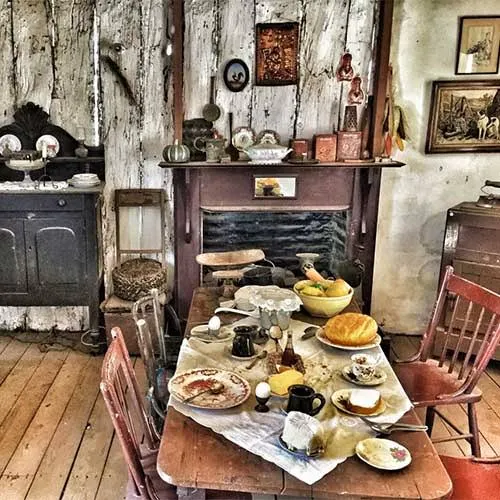
Rose Cottage is widely described as Australia’s oldest surviving timber dwelling still standing on its original site. The Village dates it to about 1811, although the precise construction date remains uncertain. Heritage assessments consider it likely to have been built during the 1810s or 1820s.
For McLachlan, the cottage became the natural centrepiece of a much bigger idea.
Saving buildings before heritage laws
By 1967, McLachlan was planning what would become the Australiana Pioneer Village.
This was before NSW had comprehensive heritage legislation capable of protecting historic buildings from demolition. Moving endangered structures was sometimes the only practical means of saving them.
Owners across the Hawkesbury and surrounding districts responded to McLachlan’s proposal by offering buildings that might otherwise have been demolished or left to deteriorate.
From late 1969 and throughout 1970, Kurrajong contractor Silvio Biancotti transported 12 buildings to Wilberforce by low-loader. Wherever possible, the buildings were kept structurally intact during their journey.
McLachlan’s employee Brian Bushell worked with local families and volunteers to remove, transport and reconstruct the buildings in their planned positions.
Perry House, an 1856 building from Richmond that had variously operated as a saddlery, residence, tailoring business and grocery store, became the first building moved intact to the site in 1969.
Bushell brought the small Bee House from McGraths Hill. Dating from 1879, it had once sold local honey and products under the names Box Gum and Salvation Jane.
Other buildings included the Riverstone General Store, the North Sackville Post Office, cottages, a school, a church, a blacksmith’s workshop and the former Kurrajong railway goods station.
Jack Greentree’s garage was transformed into a representation of the Bank of Australasia, complete with historic banking equipment.
Together, the buildings created a 19th-century streetscape showing how communities once worked, traded, worshipped, travelled and socialised.
The Village opens
The Australiana Pioneer Village was officially opened by NSW education minister Eric Willis on November 29, 1970.
It emerged during a period of growing public interest in open-air museums and heritage parks. Sovereign Hill in Victoria also opened in 1970, while Old Sydney Town at Somersby followed in 1972.
McLachlan died in 1971 at the age of 54, only months after seeing his vision become a reality. His ashes and those of his wife, Marie, were later interred near the church within the Village.
Before his death, Arthur and Jean Mawson purchased the Village, including the Tropicana Hotel as it was then known. Working with McLachlan, they continued developing the attraction.
The Riverstone Police Station was brought to Wilberforce in 1972. Originally opened in 1888, it had remained in police use for more than 80 years and came complete with a historic cell.
The Tropicana Hotel remained intimately connected with the precinct. It served visitors and stood beside Rose Cottage and the newly created Village.
In recent decades the hotel traded as the Heritage Hotel. Following extensive renovations, it returned to the Tropicana name in 2024–25 and is now commonly known as “The Trop”.
An uncertain future
The Mawsons sold the Village in 1980, but its subsequent private owners were unsuccessful.
Hawkesbury City Council purchased the property in December 1984 to preserve the Village, its buildings and its collection.
The Friends of the Australiana Pioneer Village was formed in March 1989. Its inaugural meeting attracted 24 people, but membership grew to almost 100 friends and workers by 1991.
Several private operators leased the site between 1995 and 2000 without achieving lasting success.
In February 2002, Council resolved to sell the Village. That decision was initially prevented because the land was classified for community use and could not be sold without being reclassified.
Community members responded by establishing Australiana Pioneer Village Ltd, known as the Business Group, to keep the attraction in community hands and protect its heritage and environmental character.
The Village remained closed to the public from 2002 while volunteers cared for its animals, maintained the grounds, cleaned its buildings and catalogued its collection.
Bob Nagle, Kerry Gannell and Marj Clarke undertook a major inventory that recorded approximately 1,500 artefacts.
Years of community campaigning eventually persuaded Council to grant the Business Group a lease in 2010, together with $100,000 for repairs.
Thousands return for reopening
The Village reopened on Australia Day 2011, attracting more than 4,000 visitors.
Its school education program was reinstated, allowing children to enter historic buildings and learn about blacksmithing, farming, household life, transport and trade.
The collection now includes the 1889 Marsden Park Public School, the Atkins Blacksmith Shop from Wilberforce, St Matthew’s Church from the Upper Macdonald Valley, the Kurrajong railway goods station and a floodboat used at Freemans Reach from 1912.
There are also farm machinery, horse-drawn vehicles, a shearing shed, working demonstrations and shops operating within historic buildings.
The buildings, their contents and the Village site were placed on the NSW State Heritage Register in 2004, providing formal protection for the collection.
Today, the Village continues to be operated with the support of its community organisation, committee and volunteers.
Its history demonstrates that heritage preservation does not happen by accident. The Village survived because a publican imagined it, local families helped move it, volunteers maintained it and the community fought to keep it.
More than half a century after opening, Bill McLachlan’s vision remains visible in every cottage, shop, stable and public building gathered at Wilberforce.
The renewed Tropicana Hotel next door provides another link to that story, a reminder that “The Trop” and the Australiana Pioneer Village were once parts of the same ambitious project to bring the Hawkesbury’s history to life.
The Australiana Pioneer Village is at 10 Rose Street, Wilberforce. It currently opens from 10am to 4pm on Sundays, public-holiday Mondays other than Anzac Day, and Wednesdays during most school holidays. Visitors should check the Village’s website for current arrangements before attending.
The Village principally interprets the Hawkesbury’s settler farming and community life of the 19th century. The colonial grant to European settlers was made on Dharug Country, part of a landscape with a much older Aboriginal history.
Sources: The Australiana Pioneer Village and the NSW State Heritage Inventory.