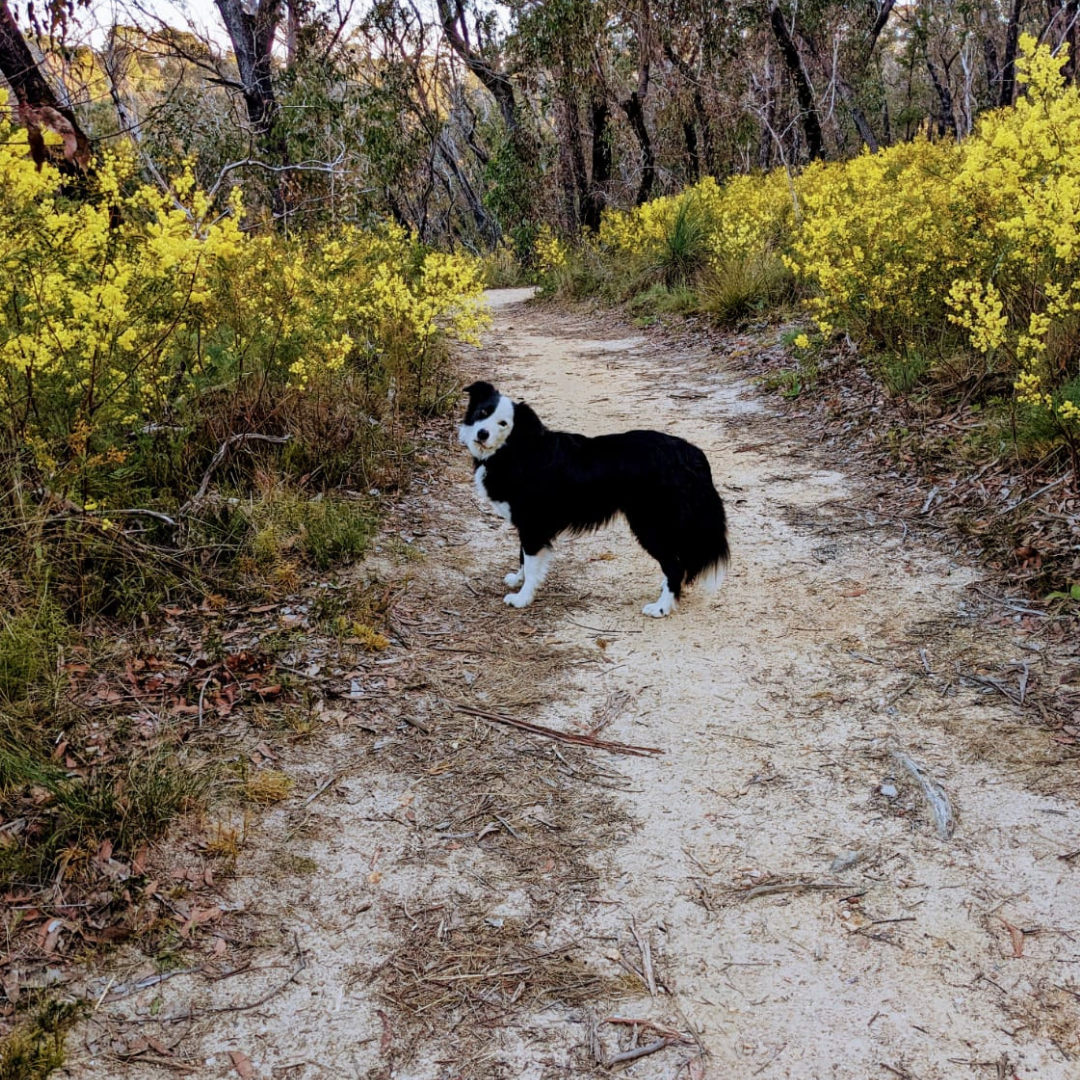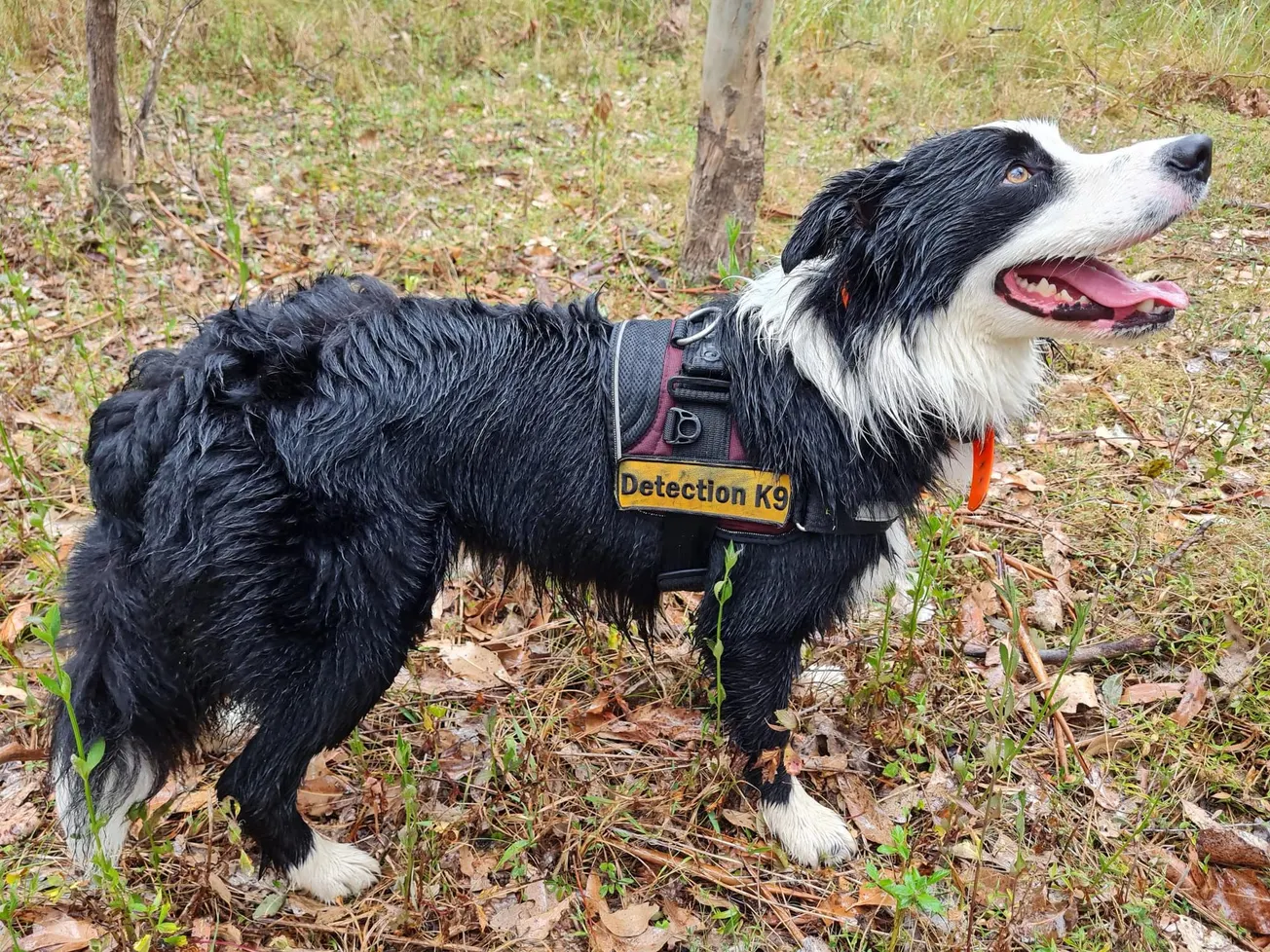
A four-legged conservation worker with a powerful nose will demonstrate how dogs are helping scientists locate and protect koala populations across the Hawkesbury and Greater Blue Mountains.
Groot, Science for Wildlife’s koala detection dog, will demonstrate his scat-sniffing skills at the National Trust’s Dogs Day Out at Norman Lindsay Gallery in Faulconbridge on Saturday, August 29.
The setting is particularly appropriate: the gallery was Norman Lindsay’s former home and studio, where he created his much-loved children’s book The Magic Pudding, featuring the koala Bunyip Bluegum.
Behind the light-hearted appearance, however, Groot has a serious conservation role.
Koalas were listed as endangered in NSW, Queensland and the ACT under federal environmental law in 2022. Habitat loss and fragmentation, bushfires, disease, vehicle strikes, dog attacks and climate change continue to place populations under pressure.
Following the evidence
Koalas can be difficult to find during conventional surveys. They may sit high in dense tree canopies, remain quiet for long periods and occur at low densities across vast areas of rugged bushland.
Their droppings, or scats, provide scientists with evidence that koalas are using an area, but the small pellets can be difficult for people to see among leaves, bark and forest debris.
That is where Groot’s extraordinary sense of smell becomes useful.
Trained to detect the scent of koala scat, Groot can search the forest floor much faster and more effectively than human surveyors relying on sight alone. His discoveries help ecologists establish where koalas are present and identify areas requiring more intensive investigation.
Scats can also be collected for laboratory analysis. Depending on their condition and the tests being undertaken, they may provide information about an animal’s genetics, sex, diet, health and relationship to other koalas.
Groot’s work can therefore help researchers move beyond an occasional sighting to build a more reliable picture of where koalas live, how populations are connected and which habitat should receive priority protection.
Hawkesbury koalas of national importance
The Hawkesbury forms an important part of the broader Greater Blue Mountains koala landscape.
Koalas have been recorded around Grose Vale, Kurrajong, Blaxlands Ridge, Bilpin and Colo Heights, while Science for Wildlife has identified populations across the Lower Blue Mountains and Hawkesbury–Wollemi region.
These should not necessarily be viewed as isolated “colonies” with clear boundaries. Koalas occur in populations spread across suitable forest and woodland, with individual animals moving through connected habitat to find food, shelter and breeding opportunities.
That connectivity is critical. Roads, housing development, vegetation clearing and other disturbances can divide habitat, leaving koalas in smaller and more isolated groups.
A national genomic study involving Science for Wildlife found that the sampled Blue Mountains population had the highest genetic diversity among 21 regions examined across Australia.
Genetic diversity gives a population a wider range of inherited characteristics. This can improve its ability to withstand disease, environmental change and other pressures, making the local koalas important to the long-term survival of the species well beyond the Hawkesbury.
The region’s large forests may also provide a significant refuge, but their size and rugged terrain make conventional koala surveys slow and difficult. A detection dog such as Groot allows scientists to cover more ground and locate evidence that could otherwise remain hidden.
This information can contribute to habitat mapping, population monitoring, bushfire recovery work and decisions about where wildlife corridors and other protections are most needed.
A difficult landscape to survey
About 71 per cent of the Greater Blue Mountains World Heritage Area was burnt during the 2019–20 Black Summer bushfires, according to an updated assessment provided to UNESCO.
Before fire reached a study site in Kanangra-Boyd National Park, Science for Wildlife evacuated koalas as an emergency measure. Thirteen animals were later returned to the wild.
Ongoing monitoring is essential because the presence of apparently intact forest does not automatically confirm that koalas have returned or are successfully breeding there.
By detecting scat, Groot can help researchers locate surviving animals, monitor their return to burnt habitat and identify previously unknown populations.
Conservation meets canine celebration
Science for Wildlife executive director Dr Kellie Leigh will attend with Groot and explain how wildlife detection dogs contribute to koala research.
The event will also include dog-training displays; talks and appearances by veterinarian Dr Rob Zammit of The Doggy Pod podcast; a dog talent competition; greyhounds available for adoption; therapy dogs; paw painting; stalls and other activities.
Visitors may bring their dogs, which must remain leashed and under effective control at all times. Dogs Day Out will be held at Norman Lindsay Gallery, 14 Norman Lindsay Crescent, Faulconbridge, from 10am to 4pm on Saturday, August 29, 2026.
Dogs Day Out will be held at Norman Lindsay Gallery, 14 Norman Lindsay Crescent, Faulconbridge, from 10am to 4pm on Saturday, August 29.
Event and booking details are available from the National Trust.
More information about the Greater Blue Mountains Koala Program and Groot’s conservation work is available from Science for Wildlife.