In 1789, English philosopher Jeremy Bentham helped popularise a principle that would shape centuries of public policy: the greatest happiness for the greatest number.
Economists subsequently developed more precise tests of public benefit such that projects could benefit some at the expense of others, provided the gains were large enough to theoretically compensate those who lost out.
The catch, of course, is that such compensation is of little comfort to those left bearing the actual costs.
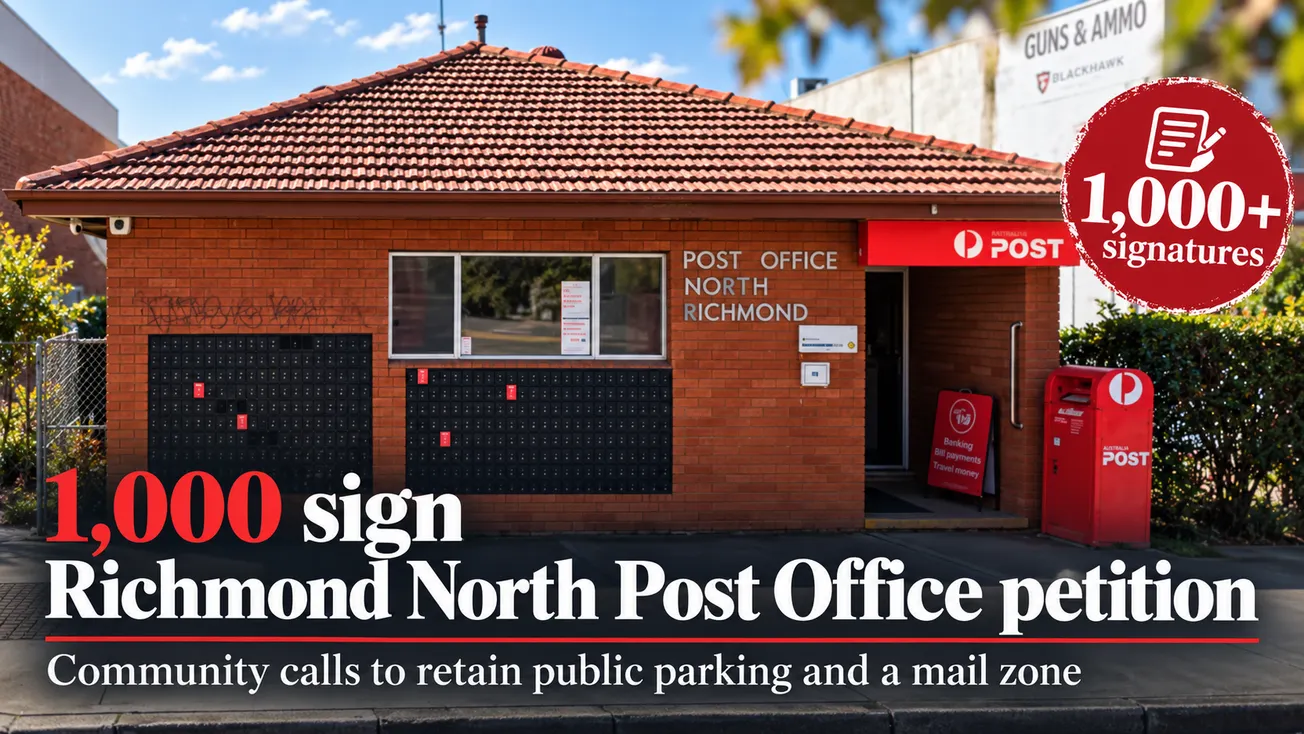
Consider Richmond North Post Office.
For decades, Richmond North Post Office has served residents collecting parcels, posting mail and checking their PO boxes. But its role extends well beyond delivering letters.
Residents can pay bills and access everyday banking services, including eligible cash deposits and withdrawals through participating banks. For older residents and small businesses, the post office is more than a convenience. It is part of the community's essential service network.
For years, customers and Australia Post delivery and collection vehicles have relied on short-stay kerbside parking outside Richmond North Post Office. The proposed removal of those spaces raises practical questions about how postal vehicles will continue servicing the outlet and how customers, particularly elderly residents and people with limited mobility, will retain convenient and safe access.
While the $658 million New Richmond bridge Stage 2 project promises much-needed improvements to traffic flow and flood resilience, its proposed removal of parking near Richmond North Post Office raises an uncomfortable question: who accounts for the consequences when a major infrastructure project threatens the accessibility and operation of an established community service?
Kumar Vikram Singh, licensee of Richmond North Post Office, welcomes the bridge project but fears that removing existing kerbside parking without providing a workable mail zone could severely disrupt postal operations and disadvantage the residents, small businesses and delivery workers who depend on the outlet.
Singh has launched the NSW parliamentary ePetition, Save Richmond North Post Office: Retain Public Parking and Mail Zone, attracting more than 1,000 signatures and drawing renewed attention to a fundamental question: can a major infrastructure project deliver benefits to the wider community without compromising the essential services already supporting it?
An earlier assurance
In May 2026, the Australian and NSW governments announced additional funding, bringing the New Richmond Bridge and associated road improvement program to $658 million. The announcement credited community feedback with the decision to deliver Stage 2 together rather than in separate phases.
A 2016 Roads and Maritime Services consultation report for earlier intersection improvements recorded 92 parking comments and a petition with 3,769 signatures. Responding to concerns about business access, the agency explicitly stated:
“Additionally seven 15 minute parking spaces will remain outside the Post Office in North Richmond.”
Yet TfNSW's December 2024 socio-economic assessment for the newer bridge project proposes removing 15 short-stay spaces along Bells Line of Road, replacing some of that parking with spaces further away on Beaumont Avenue. The assessment does not demonstrate how postal deliveries, collections or customer access would be maintained.
If TfNSW's predecessor recognised the importance of retaining parking outside the post office in 2016, why has the newer assessment not demonstrated how the consequences of its removal will be addressed?
More importantly, how will the post office continue serving residents and small businesses across its postal catchment if its operations and accessibility are compromised?
Singh says TfNSW has yet to present a documented, operationally workable solution, despite what he considers entirely foreseeable risks to both his business and the wider community.
The governments have already demonstrated a willingness to respond to community feedback on the broader project. Will that same responsiveness now extend to protecting the post office?
Community support needs a practical outcome
Across Sydney, community campaigns at Crows Nest and Milsons Point have highlighted the importance of accessible postal services. At Milsons Point, community advocacy and political intervention helped secure an agreement between Australia Post and TfNSW, demonstrating that practical solutions are possible when stakeholders work together.
Richmond North Post Office licensee Kumar Vikram Singh confirms receiving support from independent representatives, Nationals MP Paul Toole, NSW Member for Hawkesbury Robyn Preston and Federal Member for Macquarie Susan Templeman. Singh says both Preston and Templeman have written to Transport for NSW on his behalf.
Despite this support across political lines, a workable arrangement to protect postal operations and community access has yet to be secured.
The challenge now is to translate political representations and community concern into a practical solution. TfNSW has an opportunity to explain its decisions, address any shortcomings and work with stakeholders to protect the postal services on which local residents and businesses depend.
Singh says the question is not whether the Hawkesbury needs better roads, because it certainly does, but whether TfNSW can deliver those improvements while also fulfilling its responsibility to protect an established community service from avoidable disruption.
Singh believes, that responsibility raises two fundamental questions which TfNSW must answer.
- Can Richmond North Post Office continue to operate effectively without safe, practical parking and loading access for postal delivery and collection vans?
- And if the project compromises its operations or customer access, how will residents and small businesses across its postal catchment continue receiving the services they depend on?
The issue is not simply whether the post office remains open, but whether it can continue serving its community fully, reliably and accessibly.
More than 1,000 residents and regular use of postal services have formally voiced their deep concern. That level of support is numerically equivalent to approximately 1.4% of the Hawkesbury state electorate.
For Singh, the message is clear. The community has moved beyond seeking acknowledgements and is calling for a practical, agreed solution. He argues that TfNSW should engage constructively with elected representatives and local residents to ensure that the benefits of the infrastructure project do not come at the expense of essential postal services.
The ePetition closes on Monday, 2 November 2026, and is available through the NSW Parliament website.
The Gazette will continue reporting on this story, the actions taken by elected representatives across party lines, and whether the concerns raised by the community translate into a practical solution that protects postal services while allowing this important infrastructure project to proceed.