The controversy surrounding Hawkesbury City Council’s exclusion of the Hawkesbury Gazette and Hawkesbury Radio from Council premises has now escalated to the floor of the NSW Parliament.
In the New South Wales Legislative Councillor, Hon John Ruddick MLC has lodged a Notice of Motion condemning the Council’s actions and calling for the immediate reversal of the ban.
The motion, lodged ahead of World Press Freedom Day commemorations, states that all levels of government should respect “their commitment to freedom of the press.”
It goes on to strongly criticise the decision made on 28 April 2026 by Acting General Manager Will Barton and Mayor Les Sheather to prohibit representatives of the Hawkesbury Gazette and Hawkesbury Radio from attending Council premises and meetings for media purposes.
The Hawkesbury Council ban extends broadly to “all staff, agents or contractors of the Hawkesbury Gazette and Hawkesbury Radio.”
In particularly strong language, the Hon John Ruddick describes the ban as “outright fascism displayed by Hawkesbury City Council.”
The parliamentary motion also references Council’s Acting General Manager Mr Will Barton’s appearance on ABC Radio Sydney breakfast radio with Craig Reucassel on 6 May.
According to the motion, Mr Barton confirmed during the interview that there had been no physical altercations or anti-social behaviour by those excluded either on Council premises or during meetings; and Council’s concern related to the potential for psychological or psychosocial harm arising from the journalists’ presence.
The Hon. John Ruddick motion rejects that justification and calls on Hawkesbury City Council to immediately rescind the exclusion, apologise to those banned and apologise to the Hawkesbury community for what it describes as “an egregious attack on freedom of the press and public transparency.”
The motion also welcomes what it describes as a recently announced investigation into Hawkesbury City Council by Hon. Ron Hoenig, the NSW Minister for Local Government.
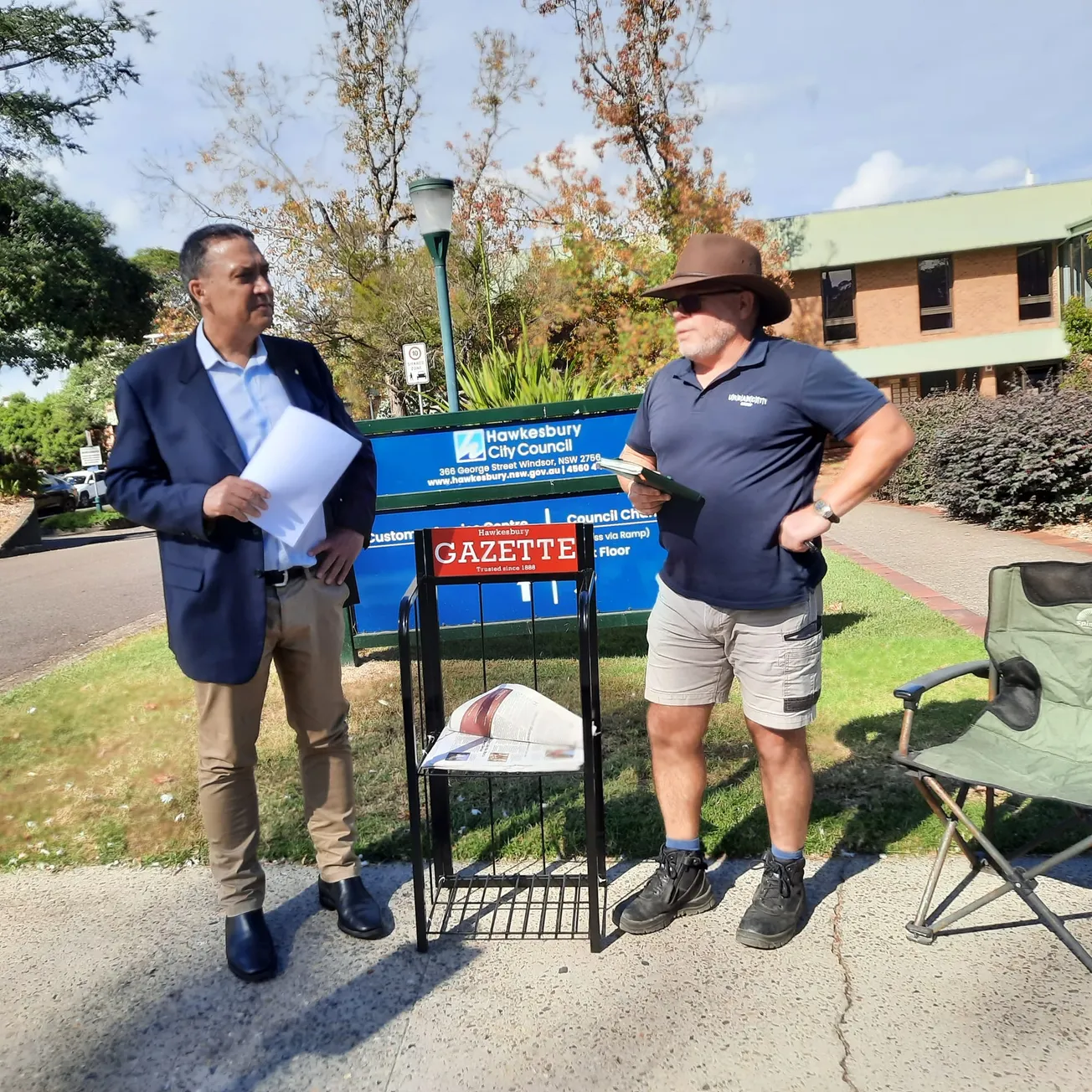
Meanwhile, the Hawkesbury Gazette says it has temporarily relocated its “Council Press Desk” from inside Council Chambers to the public footpath outside the building to continue covering Council proceedings while complying with the exclusion direction.
The Gazette says it is currently seeking advice regarding whether formal approval is required to conduct what may constitute a demonstration or protest activity on public land (the footpath), particularly in circumstances where Hawkesbury police may otherwise be asked by Council to intervene regarding trespass or access issues.
The publication says it intends to continue attending Council meetings externally to meet residents who address Council meetings and identify issues requiring further public-interest reporting and follow-up investigation.
“Council meetings are where residents raise matters important to them and where local journalism often begins,” Kooryn Sheaves Hawkesbury Gazette Publisher said.
The Gazette says that despite the exclusion, coverage of Council meetings will continue “from the footpath, if necessary,” including "during evening meetings, in the dark, with a head torch and a thermos of hot tea.”
The parliamentary intervention marks a significant escalation in what has rapidly evolved from a local dispute into a statewide debate about freedom of the press, public access to civic institutions and the extent to which workplace health and safety laws can be used to restrict physical media access to public meetings.
Council has consistently defended its position based on obligations arising under the Work Health and Safety Act 2011, arguing that the exclusion is a targeted risk-management response to alleged psychosocial hazards affecting councillors and staff.
However, critics continue to question whether sufficient statutory authority exists for an indefinite exclusion, the response is proportionate and whether less restrictive measures were adequately considered.
The matter has now drawn growing metropolitan media attention and is increasingly being viewed as a broader governance and democratic accountability issue rather than simply a local disagreement between Council and media outlets.
For many observers, the central question remains whether public institutions can lawfully restrict physical access to open civic forums without explicit legislative authority and what precedent that may set for local government transparency across NSW.
John Ruddick, a Libertarian Member of New South Wales Legislative Council is interviewed by Troy Myers regarding the recent ban of The Hawkesbury Gazette & Hawkesbury Radio Online from all Council Meetings & Premises.