Table of Contents
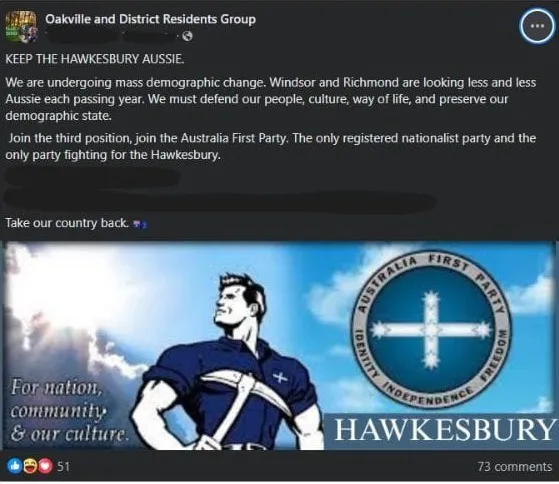
Concerns have been raised after a far-right political organisation used a local Facebook community page to promote recruitment targeting young people in Oakville.
Screenshots provided to The Hawkesbury Gazette show posts on the Oakville Residents Facebook page encouraging users to join a “youth movement” linked to the Australia First Party.
The Australia First Party, founded in 1996, has been widely characterised by political researchers and anti-extremism organisations as a fringe far-right nationalist group, citing its long-standing opposition to immigration and multiculturalism.
The organisation has a history of youth outreach through groups such as the Patriotic Youth League and later the Eureka Youth League, which drew national attention in the early 2000s over links to extremist networks.
The Oakville post, published on 13 January 2026, quickly circulated among residents, sparking concern about the use of a trusted local platform to reach younger audiences.
One local resident, who asked not to be named, said the situation was particularly troubling given the purpose of the page.
“This is a space families rely on for school updates, lost pets and local information,” they said. “To see it used to target young people with political recruitment like this is really concerning.”
The incident has also raised broader questions about moderation and oversight of large community-run social media pages, which increasingly function as key local information hubs.
Growing concern about youth radicalisation
The issue comes amid increasing national concern about young people being drawn into extremist movements.
Recent reporting shows:
- Around 230 people across Australia are currently involved in counter-extremism intervention programs
- Approximately one-third are under the age of 18
These figures point to a growing focus by authorities on early intervention and the risks of online radicalisation among young Australians.
Councillor Nathan Zamprogno, who is one of the admins of the Oakville Residents Facebook page says
“Public pages on social media platforms serve a number of purposes. Political discourse is one of them. The question of whether an admin should act as the censor to determine what speech is acceptable and what is not is fraught. My own view is that individuals are entitled to be treated with respect and dignity, but their political and religious worldviews are not." says Councillor Zamprogno
"The way we beat bad arguments is to let people see them lose in a fair fight, in the public square, and not through censorship. It is possible to have difficult conversations about Australia's level of migration, social cohesion and national identity without a recourse to unkindness, but there are limits. When I see overtly racist, trolling or unkind posts, I have been known to remove comments or very rarely, ban posters.
This is especially the case when it is clear that the posts originate from elsewhere, don’t represent the views of Hawkesbury residents, and have not been made in good faith. Australians traditionally have a keen 'BS filter' because we lean into our national qualities of egalitarianism and irreverence."
Councillor Zamprogno explained why televangelists, multi-level marketers, new-age wellness merchants, crypto bros, young-earth creationists and political demagogues who gain large audiences in the U.S, generally get short shrift here.
That’s a good thing. I sincerely hope we do not go down the American path, which is why I have been involved professionally with initiatives that seek to confront misinformation, fundamentalist or radicalised ideologies.”
Councillor Zamprogno is on the Board and is the national treasurer of the Rationalist Society of Australia, which has operated since 1906 and which has retired Justice Michael Kirby AC CMG as its patron.
Community Facebook groups across the Hawkesbury region are commonly used to share local information and connect residents, but they can also become platforms for political messaging.
Experts who study extremist movements say recruitment efforts by fringe political groups increasingly take place online, often through local social media communities where messages can reach young audiences.
The situation highlights growing concerns among researchers about how fringe political movements use local social media spaces to expand their reach.
How do I know if a FB post is promoting an extremist organisation?
A good starting point is to search online for the source of the information. This is the approach the Gazette took. Review the information available online and consider whether it is from a credible and reliable source. You can also raise the issue with the Facebook page or group moderator to seek clarification.
If you remain unsure about what to do, you can contact the National Security Hotline for advice.
WHAT TO DO WHEN YOU ENCOUNTER EXTREMIST MATERIAL
If someone encounters promotional material from extremist groups (posters, flyers, online propaganda, recruitment messages, etc.), the safest approach is to report it to the appropriate authorities or platforms rather than engaging with it directly.
1. National Security Hotline
- Run by the Australian Security Intelligence Organisation (ASIO) in partnership with the government.
- Report suspicious extremist activity, propaganda, or recruitment efforts.
- 📞 1800 123 400
- 🌐 Online reporting form via the National Security Hotline website.
- You can report anonymously.
2. eSafety Commissioner
- The eSafety Commissioner can handle certain harmful online content and may help escalate reports.
Reporting helps authorities track recruitment networks and remove harmful content.
Here’s a clear, balanced explainer you can use for the Hawkesbury Gazette, written in an accessible, community-focused tone:
EXPLAINER: What are “far-right” political groups?
The term “far right” in its simplest, it refers to political groups or movements that sit beyond mainstream conservative politics, holding more extreme views about society, government and national identity.
While not all groups are the same, researchers and governments tend to identify several common features.
1. Strong nationalism: Far-right groups often promote the idea that a country should prioritise its own people above all else sometimes defined by ethnicity, culture or religion.
2. Anti-immigration views: Many advocate for strict limits on immigration and may oppose multiculturalism, arguing that national identity needs to be protected.
3. “Law and order” and authoritarian ideas: Some support strong, centralised leadership and tougher laws, sometimes with fewer checks on government power.
4. Populism: Far-right movements often frame politics as a struggle between “ordinary people” and a “corrupt elite”
This messaging can be powerful in times of economic or social change.
5. Exclusionary beliefs: At the more extreme end, some groups promote ideas that certain groups of people are superior or should be kept separate views widely criticised as racist or discriminatory.
It’s important to distinguish between different types:
- Radical right groups: Operate within democracy but push hardline policies (e.g. strong anti-immigration platforms)
- Extreme right groups: May reject democracy entirely and, in some cases, support violence or authoritarian rule.
In Australia, security agencies use the term “right-wing extremism” for groups that support violence to achieve political goals, including ideologies such as white supremacism or neo-Nazism.
Why it matters locally
Understanding political labels like “far right” helps communities:
- make sense of national and global debates
- recognise different viewpoints
- engage in informed, respectful discussion
For regional communities like the Hawkesbury, where infrastructure, growth, and identity are often front of mind, these debates can shape how people think about the future.