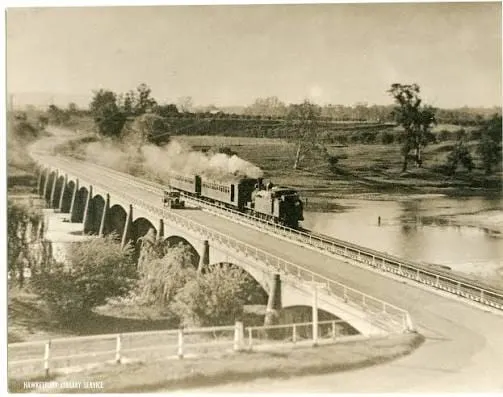
A century after a small steam train began carrying passengers, schoolchildren and farm produce between Richmond and Kurrajong, the Hawkesbury will celebrate one of its most affectionately remembered transport stories.
The Richmond–Kurrajong railway, better known as the Pansy Line commenced regular passenger services on November 8, 1926.
Its official opening followed on November 20, meaning November 2026 marks the centenary of the railway that connected communities west of the Hawkesbury River with Richmond and the wider Sydney rail network.
The Kurrajong-Comleroy Historical Society will commemorate the centenary with a special event at Panthers North Richmond on Sunday, November 22.
Beginning at 1pm, the event will feature an illustrated presentation about the building, operation and history of the railway. The presentation is expected to run for approximately one hour.
Participants will then walk to see the remains of the railway bridge across the Hawkesbury River.
Copies of the Historical Society’s book, Pansy: The Richmond to Kurrajong Railway, will also be available for purchase.
A little train with a big place in local memory
The Pansy operated for only 26 years, from 1926 until 1952, but its place in Hawkesbury history has endured for almost three-quarters of a century after its closure.
The regular passenger service generally consisted of a small Z20-class steam tank locomotive pulling two carriages.
The little engine and its train became affectionately known as “Pansy”, a name generally associated with its modest size and limited pulling power. Over time, the nickname came to describe the railway itself.
It was not a fast journey. The approximately 11-kilometre trip between Richmond and Kurrajong usually took between 30 and 35 minutes, with additional time required when mixed passenger and goods services had to shunt wagons at North Richmond or the Nepean gravel siding.
The normal speed limit was approximately 20 miles per hour—about 32 kilometres per hour with trains slowing further through Richmond.
Despite its size, Pansy performed an important social role. It carried schoolchildren into Richmond, connected families with shops and services, brought visitors to the river and Kurrajong guesthouses, and transported fruit and other produce from farms in the foothills.
For many older residents, Pansy was not simply a railway. It was part of everyday life.

Decades of campaigning
The railway was the result of more than 40 years of lobbying by Kurrajong orchardists, landholders and community leaders.
The railway from Blacktown had reached Richmond in 1864, but communities west of the Hawkesbury River remained dependent on horse-drawn transport to reach the railhead.
By the 1880s, the Kurrajong district had become an important producer of citrus fruit, vegetables, timber, firewood and other agricultural goods.
Local growers wanted the railway extended across the river so their produce could reach the Sydney markets more quickly and reliably.
Proposals were discussed from at least 1883 or 1884, but the cost of constructing a railway across the flood-prone Hawkesbury River repeatedly delayed the project.
There were also questions about whether the agricultural and passenger traffic available west of the river would ever justify the expense.
Parliament eventually authorised the extension in 1919. The first sod was turned on June 2, 1923, and construction continued for more than three years.
The line arrived at an awkward moment in transport history.
When the campaign began, railways were the principal means of moving substantial quantities of people and produce over long distances. By the time Pansy opened, roads and motor vehicles were improving rapidly.
The delay would ultimately help determine the railway’s fate.
Through Richmond Park and down to the river
Pansy departed from a rear platform at Richmond station.
The train crossed East Market Street at a level crossing, where a railway employee protected the movement with a red flag or lamp.
It then passed across the corner of Richmond Park and travelled beside March Street before leaving the town and descending through a cutting towards the Hawkesbury River floodplain.
The railway’s route through Richmond Park was controversial even before the first service ran. Trees and vegetation were removed to make way for the line, prompting protests over the loss of part of the historic park.
Once beyond the town, the line crossed the flat, flood-prone land approaching the river.
A small platform opened near the eastern bank in 1928. Initially called Nepean Bridge despite being beside the Hawkesbury River it was renamed Phillip in 1934 in honour of the colony’s first governor, Arthur Phillip.
Phillip became a popular stop for swimmers, picnickers and day visitors. During busy summer periods, the platform was reportedly so short that the train had to stop more than once to allow passengers to board or leave different carriages.
Across the Hawkesbury
One of the line’s defining features was its crossing of the Hawkesbury River between Richmond and North Richmond.
Provision for a railway had been considered when the North Richmond road bridge was constructed in the early 20th century. The railway crossing used extensions of the concrete piers supporting the neighbouring road bridge.
After crossing the river, Pansy faced one of the most difficult sections of its journey.
The line climbed steeply through the western riverbank, crossed Bells Line of Road near what is now the Grose Vale Road intersection and entered North Richmond station.
North Richmond had a passenger platform, shelter and goods facilities. From there, the line continued through farms, orchards and grazing country towards the Kurrajong foothills.
A pioneer railway
The Richmond–Kurrajong extension was constructed as what was known as a “pioneer line” a relatively inexpensive railway intended to open up a developing rural district.
Parts of the route were unfenced. Second-hand rails were laid on wooden sleepers, with ash used for ballast.
The lightweight construction reduced the initial cost but limited the speed, weight and reliability of trains using the route.
Stopping places developed between North Richmond and Kurrajong, including Kemsleys, Thompsons Ridge and Duffys. Other names associated with the route included Red Cutting and Nurri.
Some were little more than rural halts serving nearby properties.
Local recollections describe passengers being collected at informal stopping points, with the guard lowering a ladder to help them board.
As the railway approached Kurrajong, cuttings and embankments became more prominent. The terminus was carved into the hillside below the village.
Kurrajong station had a platform, a concrete station building, a run-around loop that allowed the locomotive to change position, and a goods siding with a shed and hand-operated crane.
A railway for orchards
The principal economic argument for constructing the line had been the transport of farm produce.
Kurrajong and the surrounding districts were known for citrus orchards, vegetables and other crops. Supporters expected large quantities of produce to be carried by rail from Kurrajong through Richmond and on to the Sydney markets.
Pansy did carry fruit and other goods, but the anticipated freight business did not fully materialise.
Road transport offered orchardists several advantages.
A truck could collect fruit directly from a farm, carry it to market and return with fertiliser, packaging, equipment and other supplies. Rail freight required produce to be moved from the farm to the station, loaded onto a wagon, transferred through Richmond and unloaded again in Sydney.
For small growers, trucks could be faster and more flexible.
By the time the railway opened, the commercial advantage had already begun shifting towards the road.
Gravel for the Harbour Bridge
One important freight operation was established closer to Richmond.
A siding served the Nepean Sand and Gravel operation near the Hawkesbury River. Gravel trains carried material used in major construction work, including the Sydney Harbour Bridge.
These heavy trains required larger locomotives than the small engine normally associated with the Pansy passenger service.
The gravel operation demonstrated that the branch could carry substantial freight, but most of that traffic originated near the river rather than from the orchards around Kurrajong.
Schoolchildren, tourists and holiday crowds
Although the railway struggled commercially, it became an important passenger service.
Children travelled to school in Richmond. Residents used it to reach shops, government services and connections to other trains.
Visitors from Sydney used Pansy to reach swimming and picnic areas along the Hawkesbury River, as well as guesthouses and walking areas around Kurrajong and the lower Blue Mountains.
During the 1920s and 1930s, the Kurrajong district had a thriving guesthouse industry. Its mountain air, views, orchards and bushland offered an accessible country escape from Sydney.
The normal Pansy service consisted of two carriages, but trains of up to five carriages reportedly operated on public holidays and other busy occasions.
Carriages could be detached at Kurrajong and collected on later journeys when demand was high.
In 1941, the branch was brought within Sydney’s metropolitan fare arrangements, making discounted off-peak and weekend family travel more accessible.
A line repeatedly threatened by floods
The Hawkesbury River crossing was both the railway’s greatest engineering achievement and its principal vulnerability.
Floods regularly interrupted services. When the river rose, trains could not operate safely across the floodplain and bridge approaches.
Heavy rain during June 1952 again caused the Hawkesbury to flood. Railway services were suspended, as had occurred during previous floods.
This time, however, the damage was more serious.
Further rain and flooding followed. A cutting near Kurrajong collapsed, destabilising and buckling the track.
A bus service was introduced on the Kurrajong side, while contemporary accounts describe passengers being taken across the flooded river by boat.
Repairing the damaged cutting would have required prolonged dry conditions and significant expenditure.
The railway authorities were faced with a difficult calculation: invest more money in a lightly patronised branch line that had never returned a profit, or make the temporary closure permanent.
Pansy would not run again.

A closure without warning
The final service was not promoted as a ceremonial last train. There was no planned farewell and no opportunity for residents to prepare for the loss of their railway.
Flooding stopped the trains before the community knew the suspension would become permanent.
The line is generally recorded as closing on July 26, 1952.
Railway authorities subsequently confirmed that the branch would not reopen. Its annual revenue was reportedly lower than the estimated cost of repairing the flood and landslip damage.
The decision produced what contemporary newspapers described as a “storm of protest”.
Public meetings were held and local residents campaigned for the service to be restored, but the government did not reverse its decision.
Road transport replaced the little train that had itself arrived too late to overcome the growing popularity of trucks, buses and private cars.
What survives today
Most of the rails were lifted after the closure, but Pansy has not disappeared entirely from the Hawkesbury landscape.
At Richmond station, remnants of the former Kurrajong siding remain as evidence of the branch line.
Richmond station is listed on the State Heritage Register, with the surviving Kurrajong siding recognised as part of its historical significance.
A pathway and signs in Richmond Park commemorate the railway’s former route across the park, although questions have been raised about the precise accuracy of the interpreted alignment.
Old cuttings, embankments, culverts and sections of formation can still be found along parts of the route between Richmond, North Richmond and Kurrajong.
Remnants are visible around Redbank, including parts of the formation approaching the Hawkesbury River crossing.
The former Kurrajong station site is near the shopping area now known as Pansy Junction, keeping the railway’s affectionate name alive in the village.
The old Kurrajong goods shed was relocated to Australiana Pioneer Village at Wilberforce, where it survives as one of the most tangible structures associated with the line.
The former concrete passenger station building was relocated to the Zig Zag Railway.
Remembering the people as well as the train
The Pansy story is not solely about a locomotive, rails and stations.
It is the story of orchardists who campaigned for decades for better access to market; workers who constructed the line across difficult and flood-prone country; railway employees who operated a small rural service; and generations of children and families who depended on it.
It also tells a larger story about how transport changed during the first half of the 20th century.
The railway was conceived in the age of horses and steam but opened in the age of trucks and motorcars. It was built to solve a genuine problem, yet the long delay in securing approval meant another technology was already overtaking it.
Its closure after flood damage reflected both the vulnerability of infrastructure built across the Hawkesbury floodplain and the economic pressure facing small rural branch lines.
Centenary celebration
The Kurrajong-Comleroy Historical Society’s centenary commemoration will be held at Panthers North Richmond on Sunday, November 22, 2026.
The illustrated presentation will begin at 1pm and will explore the construction and history of the Richmond–Kurrajong railway.
After the approximately one-hour presentation, participants will walk to view the site of the railway bridge over the Hawkesbury River.
Visitors can have lunch at the club bistro before the presentation, and copies of the Historical Society’s Pansy book will be available for purchase.
The Society was established in 2001 to research, preserve and promote the heritage of the Kurrajong district. It has spent years collecting photographs, memories and records associated with Pansy and has previously conducted tours of the railway’s surviving route.
The centenary provides an opportunity not simply to indulge in nostalgia, but to recognise the importance of preserving what remains.
Pansy operated for only a quarter of a century. It has now been gone for almost three times as long as it ran.
Yet a hundred years after its first passengers climbed aboard, the little railway remains part of the Hawkesbury’s identity—a line defeated by economics and floodwaters, but never erased from local memory.
EVENT DETAILS
What: Centenary of the Richmond–Kurrajong Railway—the Pansy Line
When: Sunday, November 22, 2026, from 1pm
Where: Panthers North Richmond
Program: Illustrated presentation followed by a walk to view the remains of the Hawkesbury River railway crossing
Organiser: Kurrajong-Comleroy Historical Society
Information: www.kurrajonghistory.org.au/pansycent.php