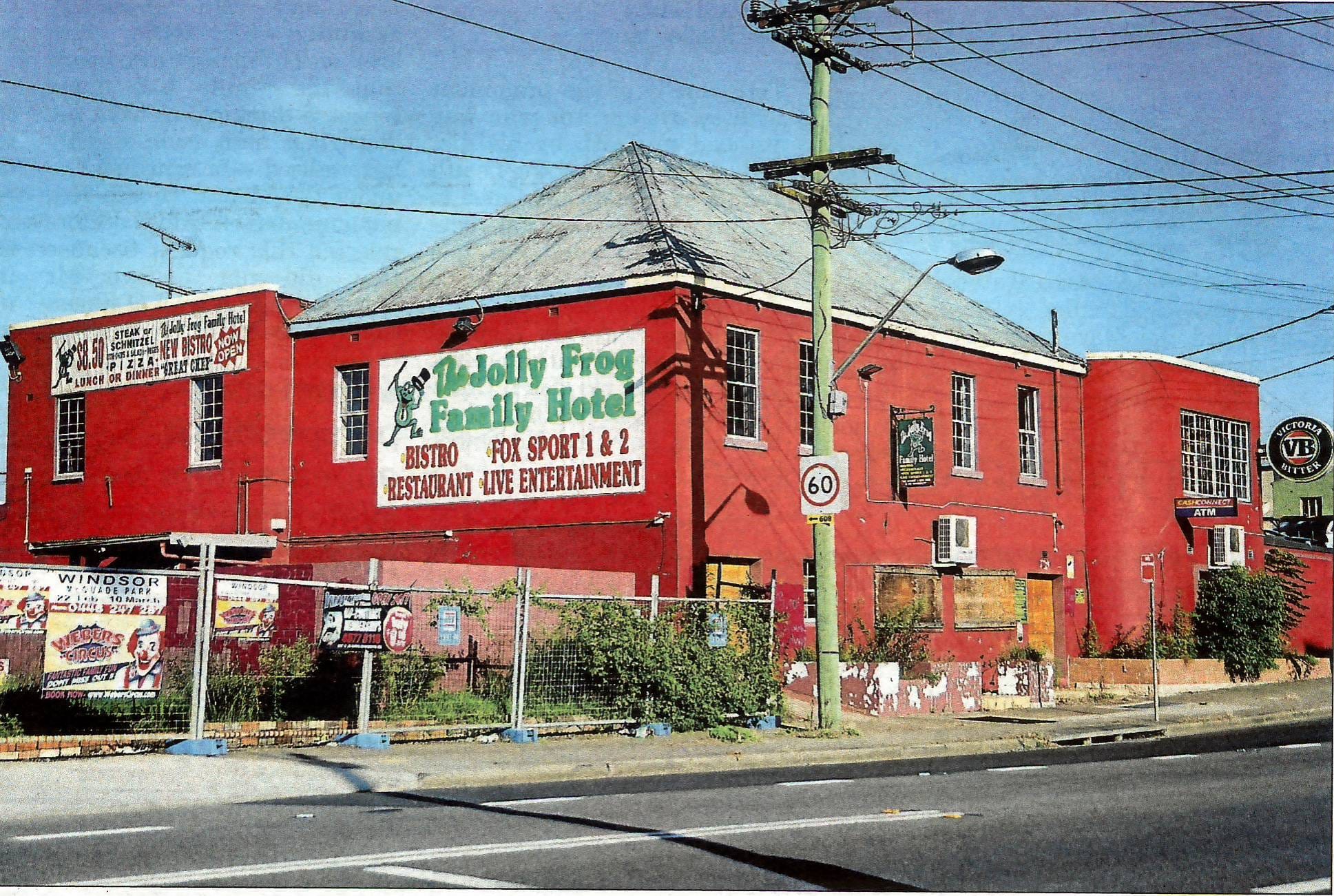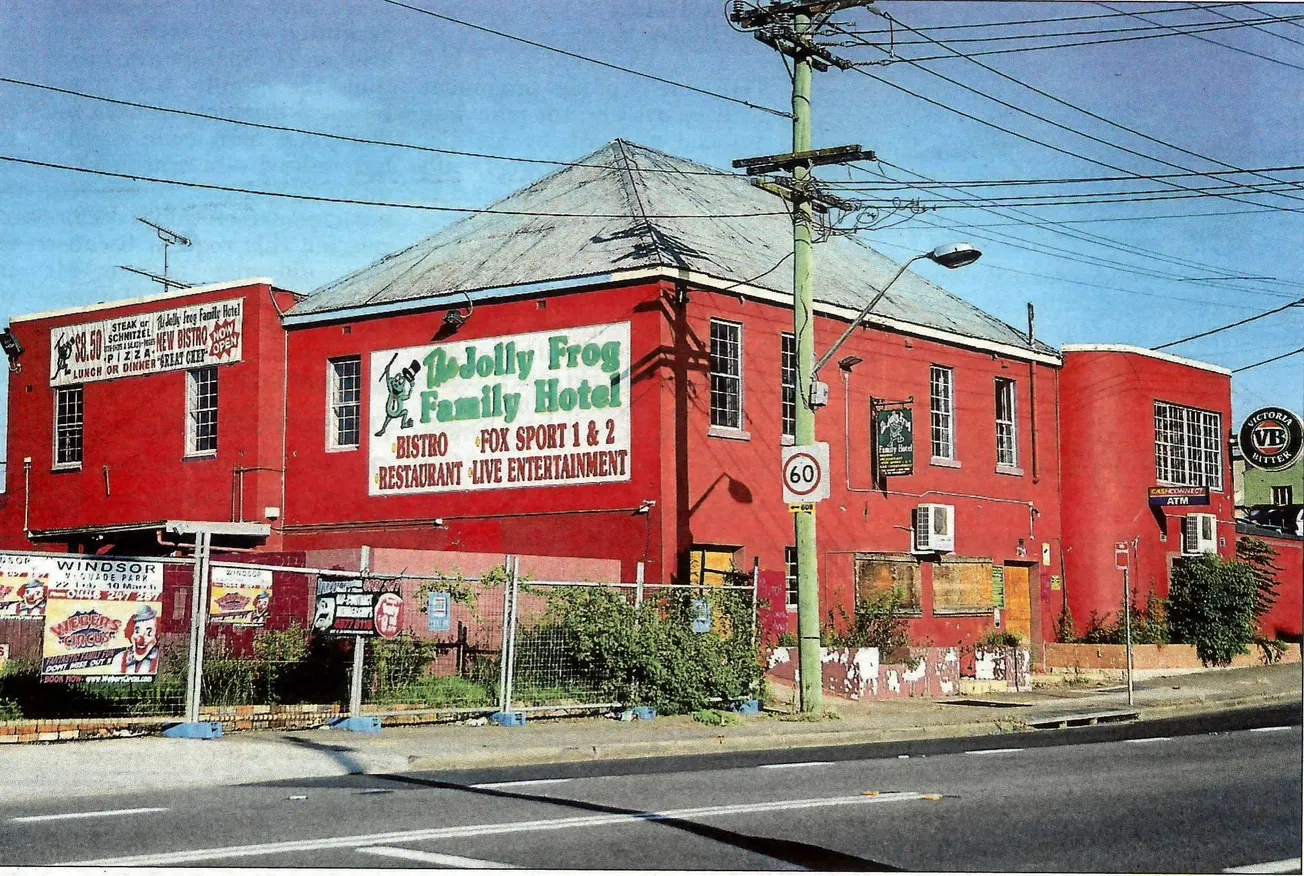
For generations of Hawkesbury residents, the Jolly Frog was more than an unusually named pub at the entrance to Windsor.
It was a live-music venue, meeting place, flood landmark and familiar sight beside South Creek. Before becoming the Jolly Frog, the site had already served travellers and residents under several names stretching back to the earliest decades of colonial Windsor.
The building has now stood silent for years, its future repeatedly caught between heritage protection, commercial redevelopment and the immense task of rebuilding after a devastating fire.
A $7.8 million redevelopment has been approved by the NSW Land and Environment Court, potentially clearing the way for the hotel to reopen. However, more than two years after the Court’s decision, there is still no publicly confirmed construction timetable or opening date.
For Windsor, the question remains: will the Jolly Frog finally rise again?
A hotel site dating to 1833
The Jolly Frog stands at 25–27 Bridge Street, near the corner of Macquarie Street and beside Fitzroy Bridge over South Creek.
Its position made it one of the most visible buildings encountered by people entering Windsor from the south. It also placed the hotel directly in the path of the town’s recurring floods.
The documented hotel history of the site begins in 1833, when an inn known as the Currency Lass opened.
“Currency” was a term used in colonial Australia for locally born people, distinguishing them from those born in Britain. A “currency lass” was therefore an Australian-born woman.
The Currency Lass operated from 1833 until 1848. Its early licensees reportedly included James Cullen, James Gosper, Margaret Gosper, John Shearing and Michael Egan.
Historical accounts indicate the building was later used as a school and private residence.
The property has also been associated in later histories with the names Harp of Ireland and the wonderfully memorable Done with the Olive Branch after the Flood. The precise sequence of those names requires further checking against original licensing records, but they reflect the site’s long connection with Windsor’s hotel trade and its repeated encounters with floodwaters.
The great flood of 1867
The hotel’s location beside South Creek brought trade, visibility and access—but also danger.
During the catastrophic 1867 flood, surging water from South Creek severely damaged the former Currency Lass building.
The flood was one of the most destructive in Hawkesbury history. Homes, farms, businesses and public infrastructure were inundated, and many lives were lost across the district.
The damage to the hotel site foreshadowed a pattern that would continue for more than a century. Again and again, floodwater would enter the building, force its closure and require repairs.
Yet the hotel continued to return.
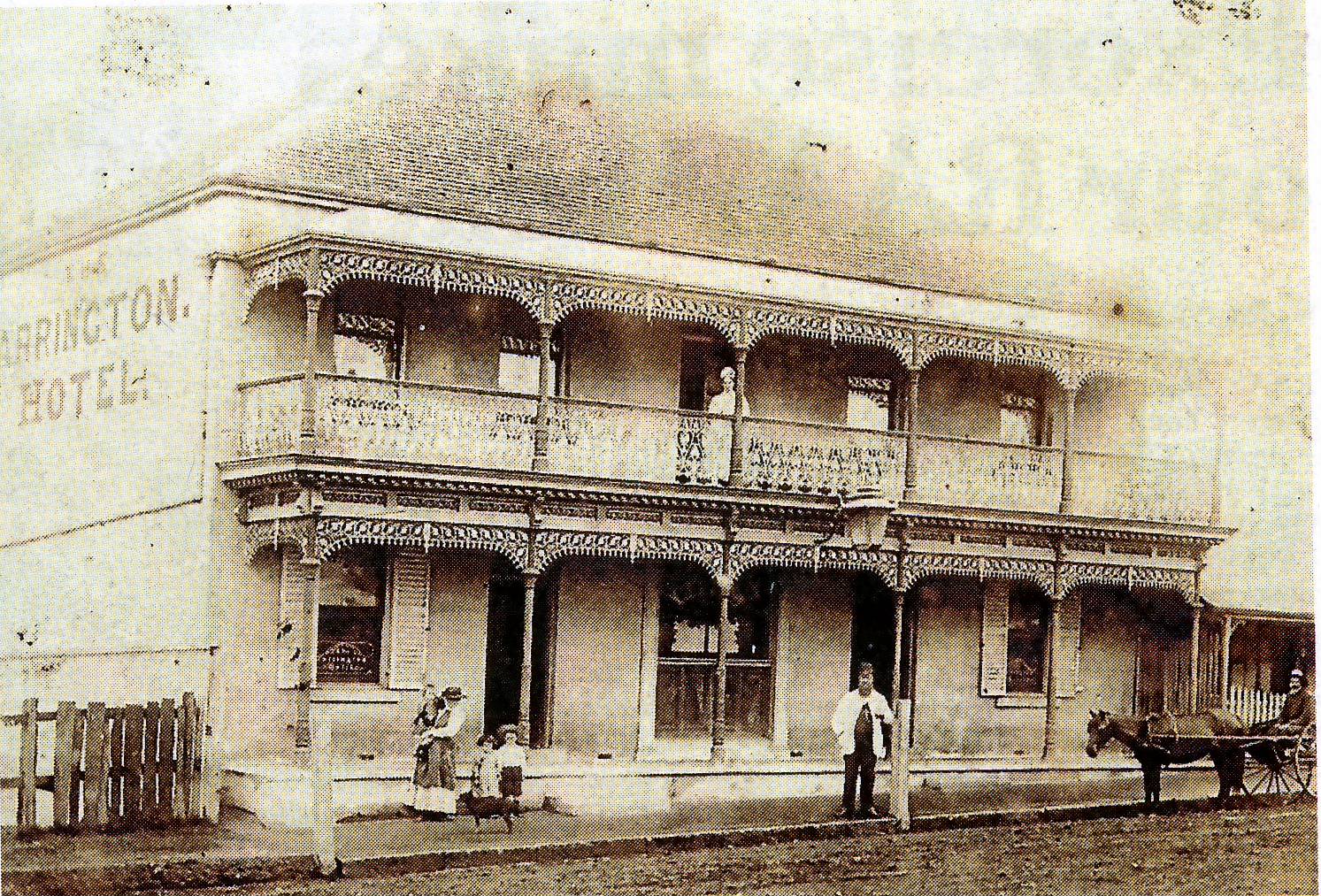
The Carrington Hotel under the ownership of Robert and Emily Huggins. Hawkesbury Gazette, 18 February 2015.
The Carrington Hotel
A new era began when Robert Huggins acquired the property and an adjoining allotment.
The existing premises had fallen into disuse and required substantial work. Huggins undertook extensive renovations and reopened the establishment as the Carrington Hotel in 1886.
The name honoured Charles Robert Carrington, Lord Carrington, who served as Governor of NSW from 1885 until 1890.
The Carrington was more than a public bar. Like many country hotels of its period, it offered accommodation, meals, stabling and a social meeting place for travellers and residents.
Huggins operated the hotel until his death in 1900. His widow, Emily, continued the business until 1902.
Historical accounts describe the Carrington as a well-run establishment that offered comfortable accommodation to travellers and a welcoming environment for local residents.
The name remained for more than half a century, surviving changes of owners and licensees from 1902 until 1955.
Its proximity to the road, creek and town centre made it an important stopping place. It stood at a gateway between Windsor and the roads leading towards Parramatta, Sydney and the surrounding Hawkesbury settlements.

Podesta’s Hotel
By the 1950s, the Carrington’s Victorian appearance was considered old-fashioned.
In 1956, the building underwent modernisation and reopened as Podesta’s Hotel.
Frank John “Don” Podesta and his family became closely associated with the hotel. Contemporary advertising promoted accommodation, meals and traditional hotel hospitality.
Don Podesta came from a family with Italian roots. His wife, Freda, was from Balmain.
Running a hotel beside South Creek remained difficult. Floodwaters repeatedly surrounded and entered the premises, and photographs of Podesta’s amid the floods became part of the visual history of Windsor.
Don Podesta died suddenly at the hotel in 1965, aged only 40.
From 1967, Albert and Margaret Hill leased and managed Podesta’s before moving to another hotel in 1971.
The Jolly Frog is born
The Jolly Frog name appeared in 1973.
No single explanation for the unusual name has become universally accepted, but it was memorable and it endured even through later attempts to trade under other names.
The hotel was damaged once again during the major Hawkesbury flood of 1978.
Despite the destruction, it reopened in September that year.
During the 1980s, the premises was also known as the Hawkesbury Tavern. In its later years, it traded at times as the Windsor Tavern.
For the community, however, it remained the Jolly Frog.
A home for live music
The Jolly Frog became one of the Hawkesbury’s best-known live-music venues.
Its strongest period is remembered as the 1970s and 1980s, when the suburban and regional pub-rock circuit provided emerging bands with places to perform and build an audience.
Rock, blues and heavy-metal acts appeared at the venue. For local young people, it offered access to live music without travelling into central Sydney.
Generations of residents remember nights at the Frog, meeting friends, watching bands and gathering after work or on weekends.
It was a traditional working pub, but its significance extended beyond the sale of alcohol. It provided a social space in a district where public transport was limited and entertainment venues were scarce.
The memories attached to the hotel explain why its long decline has attracted such strong community concern.
The Holden years
Hawkesbury Valley Holden acquired the site in 2001 as part of plans to expand its adjoining motor dealership.
Norma Needham owned both the hotel and dealership and displayed proposals for the combined site in 2004. Those plans were only partly realised.
For a period, the premises traded as the Verandah Restaurant and Bar.
In 2006, it reopened as the Jolly Frog Family Hotel following a refurbishment reportedly costing approximately $1 million.
The renewed hotel offered food, entertainment and family facilities, but the revival did not last.
Accounts differ slightly on the final trading date. Some histories say it closed in 2007 under the Windsor Tavern name, while others indicate it remained active until about 2011. What is clear is that it had been unoccupied for a considerable period before the fire that would transform the debate over its future.
Image source: ABC News
The fire
Shortly after 10pm on January 20, 2014, fire broke out in the vacant hotel.
Emergency crews arrived to find the building well alight. Streets around the site were closed while firefighters worked to contain the blaze.
It took more than an hour to bring the fire under control.
No one was injured, no evacuations were required and firefighters prevented the flames from spreading to surrounding buildings.
The Jolly Frog itself suffered devastating damage.
The blaze destroyed the roof and first floor of the original hotel. Later additions were also extensively damaged.
NSW Police established a crime scene, but no publicly available finding has been located conclusively identifying the cause or a person responsible. Although the fire has frequently been described as suspected arson, it is safest to say that it was treated as suspicious at the time and that its cause has not been publicly established.
The building had already been listed as an item of local heritage significance under the Hawkesbury Local Environmental Plan in 2012.
That listing meant the fire did not simply clear the way for demolition. The surviving heritage fabric still had to be assessed, protected and incorporated into any future development where possible.
Saving the walls
The fire left Windsor with a difficult problem.
The remains were unsafe, exposed to weather and affected by asbestos. At the same time, the surviving sandstock-brick walls represented one of the town’s oldest hotel sites.
Council’s heritage records described the property as containing a two-storey sandstock-brick inn that had stood there since before 1840.
In 2015, a development application was lodged to undertake partial demolition and stabilisation.
The proposal sought to retain and brace the four surviving walls of the original hotel while removing unsafe later additions, fire-damaged material and asbestos.
Council approved the work in February 2016.
The conditions required the external brick walls to be supported as work progressed, the destroyed roof and ceilings to be removed, later internal linings and aluminium windows to be removed and a heritage architect to be consulted before repairs to significant fabric.
The archaeological areas under and around the building also had to be protected.
The objective was not simply to leave a façade standing. It was to preserve enough of the historic building to allow a meaningful reconstruction and reuse.
Plans to revive the Carrington
In 2017, the owner indicated that the rebuilt hotel would return to its historic Carrington Hotel name.
The surviving historic section was proposed as the centrepiece of a landscaped garden bar and restaurant, with a live-music stage acknowledging the site’s later identity.
Stabilisation and rebuilding work reportedly commenced, but progress stalled by about 2019.
The ruined building remained at Windsor’s gateway, partly protected, partly reconstructed, but still unused.
For residents who had campaigned to save the Jolly Frog, the slow progress became increasingly frustrating.
The redevelopment dispute
A more substantial proposal was eventually prepared to restore and redevelop the site as a modern hotel.
The plans included conservation of the surviving heritage structure, alterations and additions, a car park and landscaping.
Hawkesbury City Council refused the development application on October 28, 2022.
The applicant appealed to the NSW Land and Environment Court under the Environmental Planning and Assessment Act.
The matter was recorded as Hawkesbury City Council ats MM Atelier Architects, case number 2023/130958.
The parties participated in a conciliation process and ultimately reached an agreement.
On July 4, 2024, the Court upheld the appeal and granted development consent subject to conditions.
The decision did not amount to the Court finding that Council had acted improperly. It reflected an agreement reached between the parties after the proposal was amended and assessed through the Court process.
Council’s legal costs
Hawkesbury City Council’s 2023–24 annual report records that it incurred $55,680.04 in legal costs in the Jolly Frog appeal.
The applicant was ordered to pay $20,000 towards Council’s costs.
That left a substantial balance borne by Council, although the figure may include work associated with assessing the amended proposal and resolving the proceedings.
The appeal is now recorded as upheld and closed.
The approved hotel
The Court-approved proposal was reported to have an estimated value of approximately $7.8 million.
It provides for a new two-storey hotel incorporating the retained parts of the fire-damaged heritage building.
The proposed venue includes:
- ground-floor dining and hotel areas;
- gaming and wagering facilities;
- an upper-level bar and veranda;
- a function room capable of accommodating approximately 100 people;
- a beer garden;
- new amenities;
- landscaping;
- on-site parking; and
- conservation and interpretation of surviving heritage fabric.
The plans seek to combine a modern commercial hotel with the remains of the Carrington and Jolly Frog.
They promise a venue capable of again providing dining, entertainment, employment and a place for community interaction.
Approval is not construction
The Court decision was a major step, but development consent does not guarantee that construction will begin immediately.
A project of this scale may still require detailed construction documentation, building approvals, financing, contractor appointments, heritage supervision and compliance with conditions imposed by the Court.
As of August 2026, there has been no widely publicised announcement confirming a construction completion date or when the hotel will reopen.
It is also unclear what name the finished venue will use.
The historic Carrington name would connect the project with its 19th-century identity, while the Jolly Frog name carries strong community recognition and decades of personal memories.
There may be room to acknowledge both.
A building at Windsor’s gateway
The hotel occupies an unusually important site.
It sits near the junction of Bridge and Macquarie streets, beside South Creek and close to the principal approaches into Windsor.
For visitors, the condition of the Jolly Frog contributes to their first impression of the town.
A restored hotel could become an anchor at the eastern end of the town centre, drawing visitors, creating jobs and supporting surrounding businesses.
A stalled or deteriorating building creates the opposite impression.
That explains why the Jolly Frog debate has never been limited to one private property. It is bound up with wider concerns about Windsor’s heritage, tourism, economic renewal and the condition of prominent entry points to the town.
Flooding remains a challenge
Any future hotel must also confront the hazard that has shaped the site since the days of the Currency Lass.
South Creek can rise rapidly during major Hawkesbury-Nepean flood events. The hotel has been damaged repeatedly, including in 1867, during the Podesta years and again in 1978.
Modern building standards, evacuation planning, flood-compatible materials and restrictions on lower-level uses will be essential to any safe redevelopment.
The site’s repeated survival is part of its history, but that history also provides a warning.
What happens next?
The development approval gives the owner a legal pathway to restore and reopen the hotel.
The unanswered questions are now practical:
- Has a construction certificate been issued?
- Have all pre-construction heritage and engineering conditions been satisfied?
- Has a builder been appointed?
- What work has been undertaken since the Court approval?
- Is the $7.8 million cost estimate still current?
- Will the finished venue be called the Jolly Frog, the Carrington Hotel or another name?
- Will live music form part of its future operation?
- When is construction expected to be completed?
- When will the doors reopen?
The Gazette has sought updated information about the project’s status and will publish any response received.
More than a pub
The Jolly Frog’s importance cannot be measured solely through its architecture.
Very little of the original Currency Lass building may remain in a form that its first customers would recognise. The hotel has been rebuilt, remodelled, flooded, renamed, modernised, abandoned and burned.
Its heritage lies partly in its surviving bricks, but also in the continuity of use and memory attached to the site.
It tells the story of colonial travellers, 19th-century publicans, Italian-Australian hotel operators, flood recoveries, suburban pub rock and generations of Hawkesbury social life.
Almost 190 years after the first inn opened beside South Creek, Windsor is still waiting to see whether its most resilient pub has one more life ahead of it.