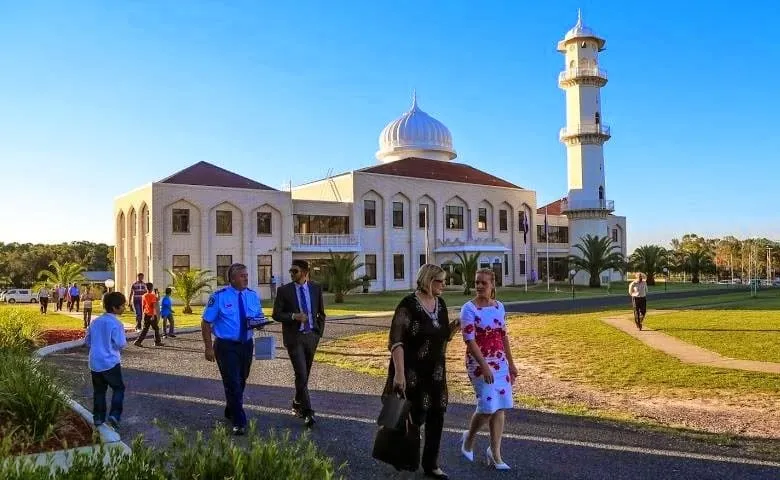
For thousands of Hawkesbury residents, it is one of the most recognisable landmarks on the drive towards Sydney.
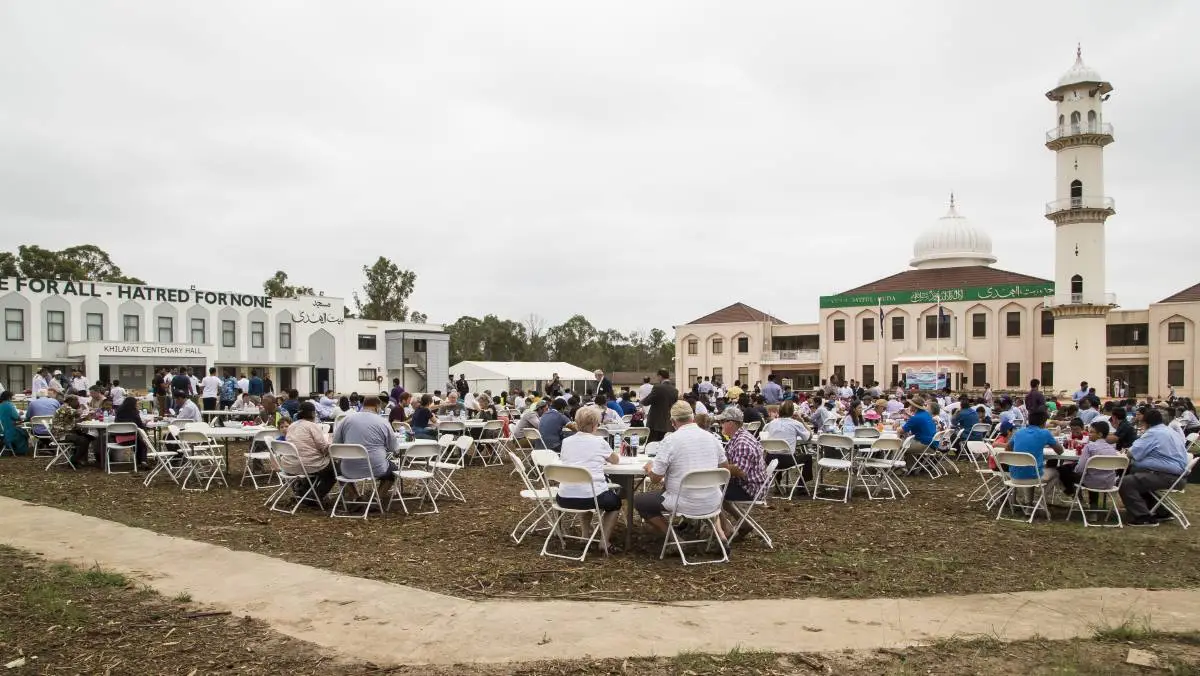
Travelling south along Richmond Road, motorists pass a distinctive mosque at Marsden Park, its frontage lined with Australian flags and displaying a simple but striking message:
"Love for All, Hatred for None."
Many people have driven past it for years, but few know the history of the mosque or the community that built it.
The building is Baitul Huda Mosque, meaning House of Guidance. It is the national headquarters of the Ahmadiyya Muslim Community in Australia and has stood just beyond the Hawkesbury boundary for more than four decades.
A vision that began in the 1980s
The story of the mosque began in 1983, when the Ahmadiyya Muslim Community purchased the Marsden Park property. At the time, the surrounding district was still largely rural, long before the housing estates that now stretch across Sydney's north-west.
Later that year, during a visit to Australia, the Fourth Caliph of the Ahmadiyya Muslim Community, His Holiness Mirza Tahir Ahmad, laid the foundation stone for what would become Australia's first purpose-built Ahmadiyya mosque.
After almost six years of construction, Baitul Huda Mosque was officially opened in 1989.
Today it serves as the national headquarters of the Ahmadiyya Muslim Community in Australia, hosting daily prayers, Friday worship, educational programs, youth activities, community open days and charitable initiatives.
Who are the Ahmadiyya Muslim Community?
The Ahmadiyya Muslim Community was founded in 1889 in Qadian, India, by Mirza Ghulam Ahmad.
Its members regard themselves as Muslims and follow the Qur'an and the teachings of the Prophet Muhammad.
The community differs from mainstream Sunni and Shia Islam in one important respect. Ahmadis believe that Mirza Ghulam Ahmad was the promised Messiah and Mahdi foretold in Islamic tradition. Most other Muslim denominations do not accept this belief, making the Ahmadiyya Muslim Community a distinct branch within Islam.
Today the movement has members in more than 200 countries and territories and is widely recognised for promoting peace, education, interfaith dialogue and community service.
In some parts of the world, particularly Pakistan, Ahmadis have faced legal restrictions and persecution because of their beliefs. In Australia, however, the community has been able to practise its faith freely while actively participating in civic and community life.
A message seen by thousands
For Hawkesbury motorists, it is often the appearance of the mosque that captures attention.
Rows of Australian flags line the frontage, while the large sign proclaims:
"Love for All, Hatred for None."
The phrase has become the worldwide motto of the Ahmadiyya Muslim Community.
It reflects the movement's belief that faith should inspire compassion, respect, religious freedom and service to all people, regardless of their religion or background.
The mosque has become known nationally for expressing both its religious identity and its Australian identity.
It regularly hosts Australia Day celebrations, ANZAC Day commemorations, interfaith forums, blood donation drives, food collections and Clean Up Australia Day activities. In 2025, it attracted national attention after raising what organisers described as Australia's largest Australian flag at a mosque.

A changing region
When the property was purchased in 1983, Marsden Park and Riverstone were small rural communities.
Today they are among Australia's fastest-growing urban areas, with new suburbs extending towards the Hawkesbury.
Many Muslim families living in Richmond, Windsor, Pitt Town, North Richmond, Kurrajong and surrounding districts now attend Baitul Huda Mosque because it is their nearest major place of worship.
The Hawkesbury itself has also become increasingly culturally diverse over recent decades, with residents from many faiths and backgrounds now calling the district home.
More than a landmark
For many local residents, Baitul Huda Mosque remains simply a familiar building glimpsed through the car window on the way to Sydney.
Yet behind its distinctive dome, its line of Australian flags and its message of "Love for All, Hatred for None" lies more than forty years of history.
It is the story of a community that chose to build its national home on Sydney's rural fringe in the early 1980s and has since become part of the landscape familiar to generations of Hawkesbury residents.
For many motorists, the mosque has long been a landmark. For others, it is an opportunity to better understand one of the communities that contributes to the rich cultural and religious diversity of north-west Sydney.
EXPLAINER: What is the Qur'an?
As the Hawkesbury becomes increasingly diverse, many residents are curious about the beliefs and traditions of their neighbours.
One question often asked is: What is the Qur'an?
The Qur'an (sometimes spelled Koran) is the holy book of Islam. Muslims believe it is the word of God (Allah) revealed to the Prophet Muhammad over approximately 23 years beginning around AD 610.
For Muslims, the Qur'an is the primary source of religious guidance and is regarded in much the same way Christians regard the Bible and Jews regard the Torah—as the central sacred text of their faith.
Originally revealed in Arabic, the Qur'an contains 114 chapters, known as surahs. While translations are widely available, many Muslims continue to read and recite the original Arabic text during prayers.
What does the Qur'an teach?
The Qur'an covers a wide range of subjects, including:
- belief in one God;
- prayer and worship;
- compassion and forgiveness;
- honesty and justice;
- caring for the poor and vulnerable;
- family life;
- business ethics; and
- personal responsibility.
It also contains stories about many figures familiar to Christians and Jews, including Adam, Noah, Abraham, Moses, David, John the Baptist and Jesus.
Muslims honour Jesus (known as Isa in Arabic) as one of God's greatest prophets and the promised Messiah. However, unlike Christians, Muslims do not believe Jesus is the Son of God.
More than a book
For Muslims, the Qur'an is more than something to be read.
It is recited during the five daily prayers, studied throughout life and memorised by many believers. Around the world, millions of Muslims have committed the entire Qur'an to memory.
The month of Ramadan, when Muslims fast from dawn until sunset, is also a special time for reading and reflecting on the Qur'an.
A growing local connection
While the Hawkesbury has historically been shaped by its Christian churches, today's community includes people from many faiths.
Understanding what the Qur'an is, and what it means to Muslims helps build greater appreciation of the diverse cultures and beliefs that now form part of life in north-west Sydney.
EXPLAINER: What is Sharia?
Few religious terms generate more discussion, or more misunderstanding, than Sharia.
The word is often translated as Islamic law, but Islamic scholars point out that its meaning is much broader.
In Arabic, Sharia means "the path" or "the way." It refers to the religious and ethical principles that guide Muslims in their daily lives.
For many Muslims, Sharia is about how to live according to their faith rather than a legal code.
Where does Sharia come from?
Sharia is traditionally derived from four principal sources:
- the Qur'an, Islam's holy book;
- the Sunnah, which records the teachings and example of the Prophet Muhammad;
- scholarly consensus; and
- legal reasoning, used to apply established principles to new situations.
Because scholars interpret these sources differently, there is no single version of Sharia followed throughout the world.
What does it cover?
For many Muslims, Sharia provides guidance on everyday matters such as:
- prayer and worship;
- charity and helping those in need;
- fasting during Ramadan;
- family relationships;
- ethical business practices;
- dietary rules, including halal food; and
- personal behaviour.
In this sense, Sharia functions as a framework for religious and moral living rather than simply a set of laws.
Why is it controversial?
Public discussion of Sharia often focuses on criminal punishments applied in a small number of countries.
However, these laws reflect particular interpretations adopted by individual governments and are not representative of how most Muslims experience Sharia in their daily lives.
Muslim-majority countries have very different legal systems.
Some rely mainly on civil law, others combine civil law with aspects of Islamic family law, while a small number make Sharia the principal basis of their legal system.
What about Australia?
Australia does not have Sharia as part of its legal system.
All Australians, regardless of their religion, are subject to the Australian Constitution, Commonwealth legislation, state laws and the decisions of Australian courts.
Like followers of other religions, Muslims are free to observe religious practices that are consistent with Australian law.
For example, Muslims may choose to:
- eat halal food;
- fast during Ramadan;
- attend mosque;
- participate in Islamic marriage ceremonies; or
- give charitable donations as part of their faith.
These religious practices do not replace Australian law.
Understanding rather than assuming
As Hawkesbury's cultural diversity continues to grow, understanding terms such as the Qur'an and Sharia can help replace misconceptions with informed discussion.
Whether someone is Muslim, Christian, Jewish, Hindu, Buddhist, Sikh or has no religious belief, Australia provides freedom of religion while maintaining one legal system that applies equally to everyone.