Opinion
There's a strange phenomenon playing out in conversations across the Hawkesbury this election season, and it deserves more scrutiny than it's getting. Talk to enough people about their voting intentions and you'll find something that shouldn't make sense.
Disillusionment with the major parties has grown so pronounced that some voters are now turning to the very movements that once cast them as the enemy – embracing a party to represent their interests today, in spite of a track record built on excluding people like them.
An gay man planning to vote One Nation in favour of the party's anti-Islam rhetoric, apparently unbothered that Pauline Hanson has spent three decades opposing the social progress that allows him to live openly; a Muslim small business owner (who also happens to be an immigrant), drawn by promises to slash social services and roll back legal immigration pathways, seemingly untroubled that the same political brand has been built on suspicion of people who look and worship like him and ignoring the fact that his mere presence in this country would not have been possible under the proposed One Nation "policies"; a retail worker doing it tough on rising costs, backing One Nation as the party that will finally look after "ordinary Australians" – despite its stance on wage increases and employee protections and knowing that the party's biggest financial backers and closest affiliates include some of the wealthiest and arguably most politically incentivised people in the country.
These aren't isolated quirks. They're a pattern, and political scientists have a name for it: coalition-building through shared enemies rather than shared policy. Pressed further on their reasoning, each of these voters converged on the same underlying theme: a sharp, personal frustration with the current government and the major parties more broadly, who they felt had broken promises and failed to represent the values and everyday priorities that matter most to them. Whether Hanson's policies become a reality following a victory at the polls is another question altogether, and is, in many ways, irrelevant. She is different, and that's what matters to these voters.
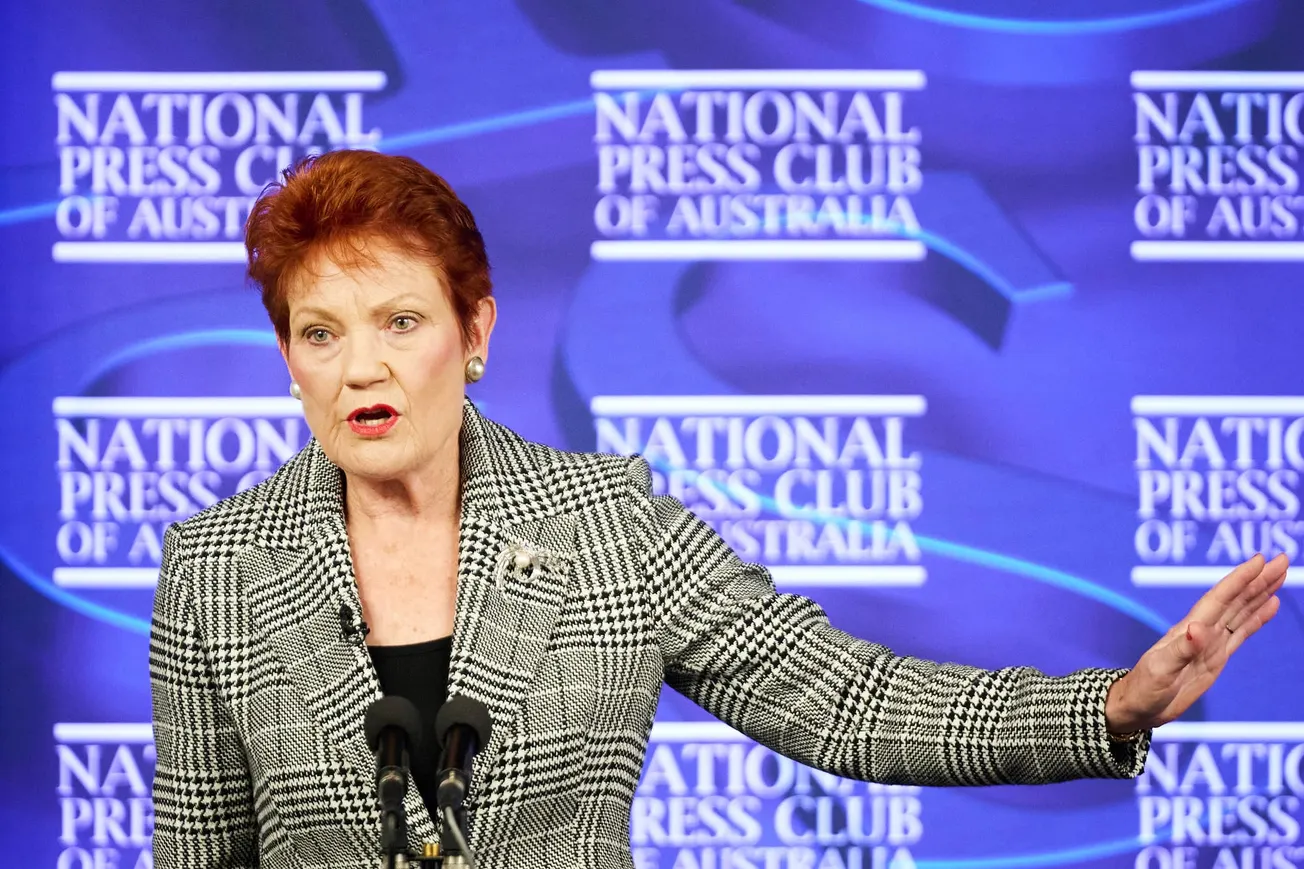
The record makes the contradiction concrete rather than rhetorical. On LGBTQ+ rights: Hanson refused to accept the 2017 marriage equality postal survey result, calling it "a sham." On Islam: she's called for a "Muslim ban," said in February 2026 there are "no good Muslims," and told the National Press Club in June that Australia "cannot be" a multicultural society.
And on the "battler" branding itself: One Nation has voted with the Coalition on welfare cuts, and Hanson has publicly opposed minimum wage rises, with its donor base telling the real story. In 2026, mining billionaire Gina Rinehart gifted the party a $1.5 million aircraft; two of her Hancock executives donated $500,000 each; and a Sydney stockbroker committed $1.1 million to Hanson's campaign - all legal, all on the AEC's public record, and hard to square with a platform pitched at people worried about the cost of living.
None of this is buried. It's on the public record, in Hansard, in AEC filings, in the party's own policy documents. Which makes the disconnect even more interesting. These aren't voters who haven't heard the news; they're voters who've decided one issue outweighs everything else on the ledger.
A vote for Pauline Hanson functions, for many of her supporters, as a vote against the system itself rather than for any particular policy – a rejection of the political establishment more than an endorsement of what would replace it. That distinction matters, because it explains why the appeal survives contact with contradiction. If the goal is disruption rather than a specific set of outcomes, then evidence that the party's record doesn't serve you isn't necessarily disqualifying - it can even read as proof the party is genuinely outside of the system, rather than a reason for caution.
The major parties, in this framing, become a kind of common enemy: not because every voter wants the same thing, but because the establishment is the one grievance broad enough to hold together people who otherwise want very different, sometimes incompatible, things. It's a coalition built on what its members are against, which is a far easier thing to agree on than what they're for.
One Nation, like most populist movements, doesn't really sell a coherent policy platform. It sells a feeling – that someone is taking something from "ordinary" people and that the major parties are too captured or too soft to stop it. The specifics of who's doing the taking shift depending on who's listening. Immigrants, elites, bureaucrats, politicians, "welfare queens" – basically, whoever the listener already resents. That the party is simultaneously courting the very billionaire class it rhetorically positions itself against is not a contradiction its base tends to examine closely, for the same reason the LGBTQ+ voter and the Muslim voter don't examine the rest of the platform: the emotional payoff on the one issue that matters to them is doing all the work.
This is the mechanism, not a flaw in it. A movement that stays deliberately vague about who the enemy is can recruit almost anyone who has an enemy - including, it turns out, people the party's actual policy record would otherwise hurt. It asks for very little intellectual consistency from its supporters. You don't need to agree with the whole platform. You just need one issue that burns hot enough to override everything else.
That's worth sitting with, because it's not actually irrational at the individual level, even though it produces incoherent outcomes collectively. A voter motivated overwhelmingly by one grievance is making a perfectly logical calculation, provided that grievance matters more to them personally than anything else on offer. The problem isn't stupidity or unabashed ignorance. It's that populist movements are built to be agnostic about everything except the resentment they're harvesting—and supporters are not necessarily examining the rest of what they're signing up for until the consequences show up on their own doorstep.
This is where political reporting — in the Hawkesbury and more broadly — has a responsibility it isn't meeting. We cover elections as if voters arrive at their choices through careful comparison of platforms. Increasingly, they don't. They arrive through slogans, vibes, and the feeling of being heard on the one issue that matters to them, while the rest of the platform, and the rest of the funding, goes unexamined.
None of this is unique to One Nation; major parties run milder versions of the same play. But minor parties built on grievance, with thin policy substance behind the slogans, are especially exposed to the contradiction – there's less material to scrutinise, so the one loud issue drowns out everything else.
To be fair to the people caught in this bind: politics asks more of voters than most have time to give. Reading every Hansard record, AEC filing and policy document before an election isn't how most people engage with politics, and voting on instinct, or on a single issue, or on whoever seems to be "telling it straight," isn't a moral failing. It's how democracy actually functions for most of the electorate, most of the time.
But it's worth a moment of discomfort before the ballot is filled in. If you're voting for a party because of how it treats one group you belong to or care about – or because you believe it's on your side economically – it's worth asking, honestly, what that same party's record and its donor register say about people like you elsewhere. The answer might not change your vote. But you should know what you're buying before you buy it.
Sources: Hansard parliamentary records; Australian Electoral Commission Transparency Register (transparency.aec.gov.au); Pauline Hanson's One Nation official policy platform (onenation.org.au); SBS News; Wikipedia (cross-referenced against primary sources); Reuters/Jerusalem Post reporting on 2026 donor shift.
Bindi Corpe is a contributor to the Hawkesbury Gazette. The views expressed in this article are her own.