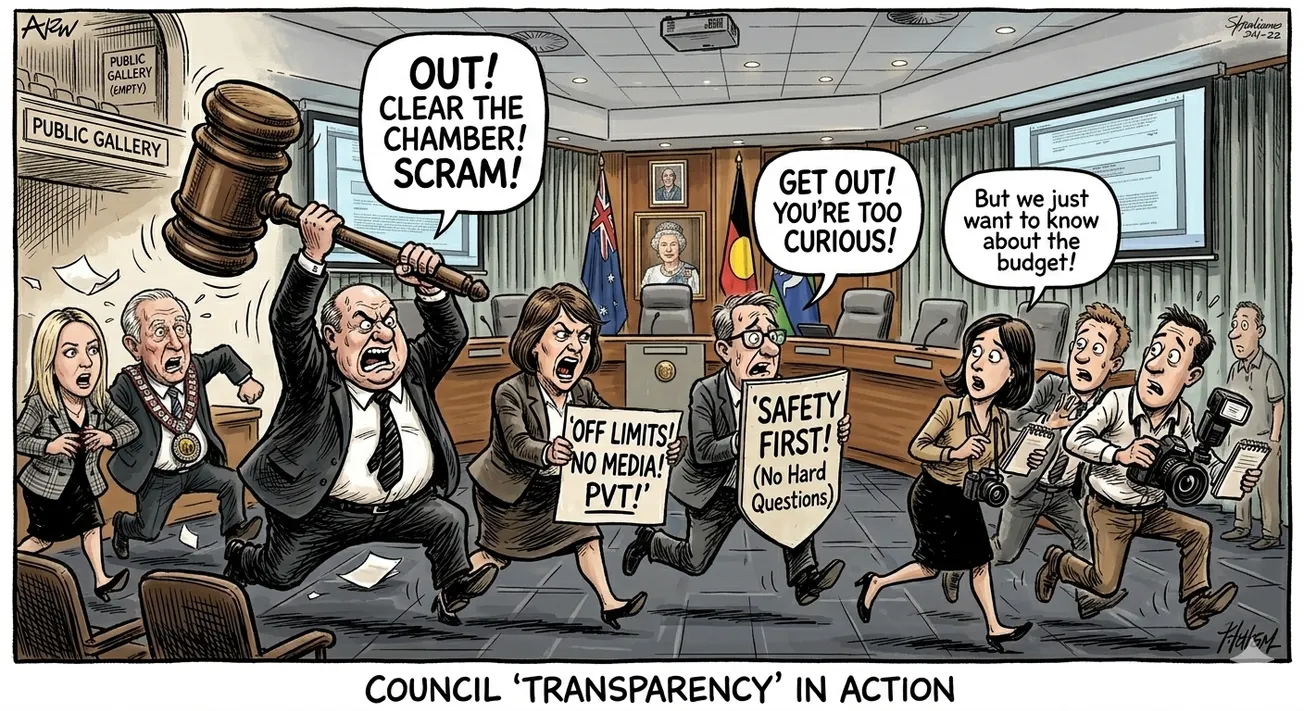
As journalists around the world gathered today to celebrate the fundamental right to report without fear or favour, Hawkesbury City Council quietly contributed its own chapter to press freedom history by banning the region's largest newspaper from every single building it owns.
We are, in our own way, making history.
A Brief History of the Day
World Press Freedom Day has its roots in a remarkable moment of courage. In 1991, sixty-three journalists from thirty-eight countries gathered in Windhoek, Namibia, and produced what became known as the Windhoek Declaration — a foundational statement that a free, independent, and pluralistic press is not a luxury, but the bedrock of democracy. The UN General Assembly agreed, formally proclaiming 3 May as World Press Freedom Day in 1993. Each year since, the day has served as a reminder to governments of their obligations — a day of solidarity with media under pressure, and a solemn remembrance of journalists who have paid for their work with their lives.
The UNESCO prize awarded on this day is named for Guillermo Cano, a Colombian journalist assassinated outside his own newsroom in 1986 after his reporting made the drug cartels very uncomfortable.
The spirit of the day, in short, is this: powerful institutions do not get to silence the press simply because the press is inconvenient.
Into this global conversation steps Hawkesbury City Council.
Council's Contribution to the Free Press
By letter dated 28 April 2026, signed by Mayor Les Sheather and Acting General Manager Will Barton, the Hawkesbury Gazette, trusted in this community since 1888, was formally banned from every Council meeting and every Council premises. The stated reason: the Work Health and Safety Act 2011. The Gazette, apparently, is a hazard.
The ban covers not just the paper's reporters but also its employees, agents, and contractors. It covers ordinary Council meetings. It covers committee sessions. It covers, and this point deserves its own sentence, Richmond Swimming Pool.
Should any journalist associated with the Hawkesbury Gazette attempt to attend a public meeting of their local council to report on public decisions made with public money, they may be treated as a trespasser. Police could be called.
What terrible journalism prompted this dramatic escalation? The Gazette had, among other things, reported on a $340,000 payout to the outgoing General Manager; asked questions about a Deputy Mayor's trade delegation to India; and — most grievously — dared to question Council's optimistic spin on the Richmond Swimming Pool redevelopment, suggesting it might become a financial sinkhole for ratepayers.
The swimming pool story, it seems, contributed to the pool ban. There is a certain poetry in that.
Safety First
One must engage seriously with the safety argument, briefly, before moving on.
The Work Health and Safety Act is a piece of legislation designed to protect workers from things like faulty scaffolding, toxic chemicals, and workplace violence. It has not, until now, been widely deployed against community newspapers attending public meetings. That Hawkesbury City Council has identified a journalist's notepad as a category of occupational risk on par with asbestos is, to put it gently, a novel legal interpretation. Specific details of the alleged incidents were not provided with the letter.
The Council did confirm that written correspondence may still be submitted. So: no attending meetings, no entering premises, no pool. But letters? Letters are fine. The fourth estate may continue to send mail.
The Bigger Picture
The Windhoek Declaration was written by journalists in a region where the press had been systematically crushed by governments that found accountability threatening. They wrote it because they understood what happens when no one is left to ask the questions. The UN made it a global day of observance because the lesson applies everywhere — not just in authoritarian states, but in every room where power is exercised and scrutiny is unwelcome.
According to UNESCO's latest World Trends Report, self-censorship among journalists has grown by more than 60%, driven by fear of reprisals, online harassment, judicial intimidation, and economic pressure. The methods vary. The effect is the same: fewer questions asked, fewer answers given, less that the public knows about what is done in their name. Unipd-centrodirittiumani
Hawkesbury City Council has not imprisoned anyone. It has not sent anyone to a conflict zone. It has issued a banning order backed by a threat of trespass against a community newspaper, using a workplace safety law as the instrument.
But the logic is recognisable. The press is asking uncomfortable questions. The press must be removed from the room.
The Gazette's Stance
The Hawkesbury Gazette has been reporting on this community since 1888 through floods, fires, wars, and at least several other councils that presumably found it inconvenient. It has, over 138 years, developed what might be called a professional habit of asking where the money went and what exactly is happening with the swimming pool.
This is, of course, precisely what a local newspaper is for. It is also, apparently, precisely what a local council under pressure finds most alarming.
World Press Freedom Day exists to remind us that unflattering, persistent, or even annoying journalism is not a threat to good governance. It is the thing that makes good governance possible. Councils that welcome scrutiny tend not to need banning orders. Councils that issue banning orders tend to have given scrutiny something to work with.
Hawkesbury City Council has, whether it intended to or not, made the case for press freedom rather vividly this week.
The Gazette will keep reporting. It just won't be doing it poolside.
Happy World Press Freedom Day. Stay curious. Ask questions. Bring a towel.
The Gazette remains committed to reporting. It will simply be doing so from outside the building.