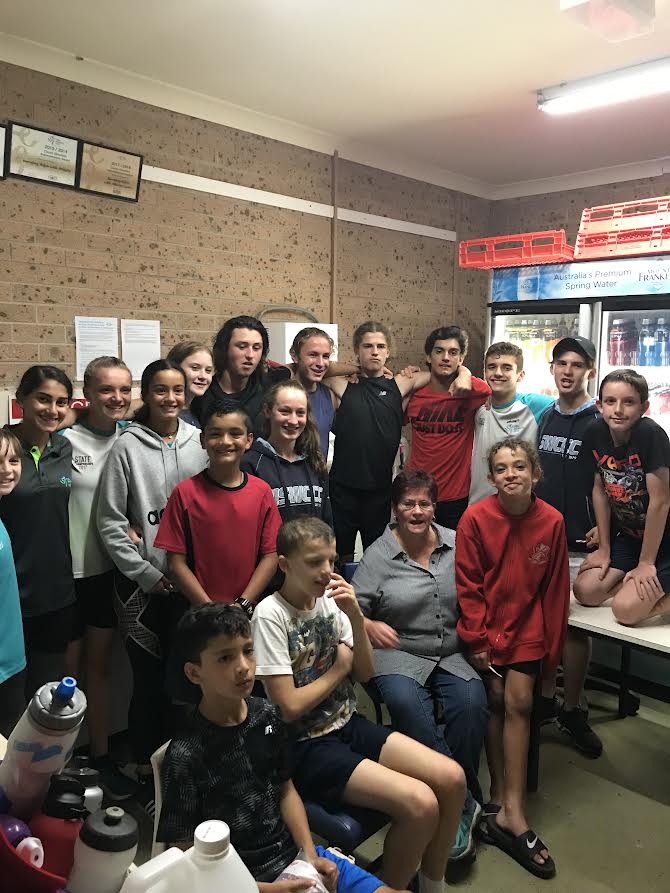
Marilyn “Maz” Pearson may be preparing to step away from active coaching, but the generations of athletes whose lives she has shaped will ensure her contribution is never forgotten.
For more than four decades, Marilyn Pearson has stood beside running tracks, jumping pits and throwing circles, quietly helping young athletes become champions and helping them grow into confident young adults.
The highly qualified Level 4 High Performance Coach began active coaching in 1984. Since then, her athletes have competed at state, national and international level, representing Australia at world championships, Commonwealth Games, World University Games, Pacific Games and Pacific School Games.
For Hawkesbury athlete Luca de Burnay Thompson and his family, however, Pearson has been much more than an athletics coach.
Luca’s father, Garth Thompson, said Pearson had coached his son for nine years, beginning when Luca was a nine-year-old Little Athletics competitor.
Now 18, Luca has qualified for national-level competition every year in at least one of his three disciplines long jump, triple jump and high jump. On two occasions, he qualified in all three events.
Under Pearson’s guidance, Luca has won two national gold medals, three silver medals and one bronze. He has also collected 30 state medals and more than 40 medals through Little Athletics competitions.
His World Athletics profile records his achievements across long jump, triple jump, high jump and sprint events.
“Marilyn has not just been a coach for my now 18-year-old son, but a mentor and second mother figure to him,” Mr Thompson said.
“Maz, as she is known by most, is faultless in the training and programs she sets for Luca and so many others.”
Awards shared between athlete and coach
Luca’s achievements were recognised last year when he received two prestigious School Sport Blue Awards.
The first was a Sydney West School Sport Blue Award, recognising his representation of Sydney West in athletics from 2022 to 2025 and his age championship in 2022.
The second was a NSW Combined High Schools Sports Association Blue Award, an honour previously received by athletes who later represented Australia, including Olympic high jumper Brandon Starc, swimming champion Ian Thorpe and former Australian cricket captain Allan Border.
For Mr Thompson, those honours belong as much to Pearson as they do to his son.
“They are as much Marilyn’s awards as they are Luca’s,” he said.
Behind every competition result were years of carefully designed programs, technical corrections and countless hours spent at training.
Pearson’s contribution also extended well beyond performance. She offered encouragement through injuries, disappointment and the pressure that accompanies elite junior competition.
That combination of technical expertise and personal commitment is why so many families regard her not simply as a coach, but as a lifelong mentor.
From the Hawkesbury to the Commonwealth Games
Luca is one of many athletes Pearson has guided to the highest levels of competition.
Her coaching has extended across jumps, throws, race walking, middle-distance running and hurdles.
Among her best-known athletes is 400-metre hurdler Ian Dewhurst, who represented Australia at the 2014 and 2018 Commonwealth Games.
Dewhurst also won gold at the 2019 Pacific Games in Apia, Samoa, setting a Games record of 50.86 seconds, a result recorded by World Athletics.
Over the years, Pearson has shared stories of being in competition call rooms with two of Australia’s most celebrated track athletes, Cathy Freeman and Melinda Gainsford-Taylor.
She was also presented with an opportunity to coach future Olympic high jumper Brandon Starc while working at The Hills Sports High School. Unable to make the necessary commitment at that time, she recommended another of her athletes, coach Alex Stewart.
Stewart went on to guide Starc through three Olympic Games and remains one of Australia’s most respected athletics coaches.
The episode reflects another dimension of Pearson’s influence: her capacity to recognise talent and connect athletes with the people best placed to help them succeed.
A record spanning more than 40 years
According to a career profile supplied to the Gazette, Pearson’s coaching achievements include:
- 17 athletes selected for Australian teams competing at world championships, with five selected for more than one team;
- two athletes qualifying for Commonwealth Games competition;
- four athletes qualifying and three being selected for World University Games teams, including one bronze medallist;
- two athletes representing Australia at the Melanesian Championships and winning gold and silver;
- 39 athletes selected for the Pacific School Games, winning 23 medals and setting five records;
- 30 Australian champions, including athletes who won titles in multiple events;
- three athletes achieving Australian records; and
- 10 athletes achieving NSW records.
The profile credits athletes coached by Pearson with more than 250 Australian championship medals, 23 Pacific School Games medals and more than 1,000 NSW medals.
Her athletes are also credited with 12 medals at world championship competitions.
The figures tell only part of the story. Every medal represents early mornings, difficult training sessions, travel, setbacks and the trust established between an athlete and coach.
Recognition for a lifetime of service
Pearson’s contribution has been recognised repeatedly at local, state and national level.
She was named NSW Little Athletics Coach of the Year in 1996 and again in 2000, and also received recognition from the NSW Track and Field Coaches Association.
She received Hawkesbury Dedication to Sport awards in 1999, 2001 and 2003, and Hawkesbury Sports Medals in 2003 and 2009.
Pearson was named Hawkesbury Coach of the Year in 1998, 2004, 2006, 2012 and 2018. In 2000, she received the Australian Sports Medal for her contribution to coaching.
Yet her greatest legacy cannot be measured by medals, records or awards.
It can be found in the hundreds of young athletes who learned discipline, resilience and self-belief under her guidance, and in families such as Luca’s, who came to regard “Maz” as one of their own.
Marilyn Pearson may be nearing the end of her active coaching career, but her influence will continue every time one of her athletes steps onto a track, approaches a jumping board or passes on something she taught them to the next generation.
She may be retiring, but she should never be forgotten.