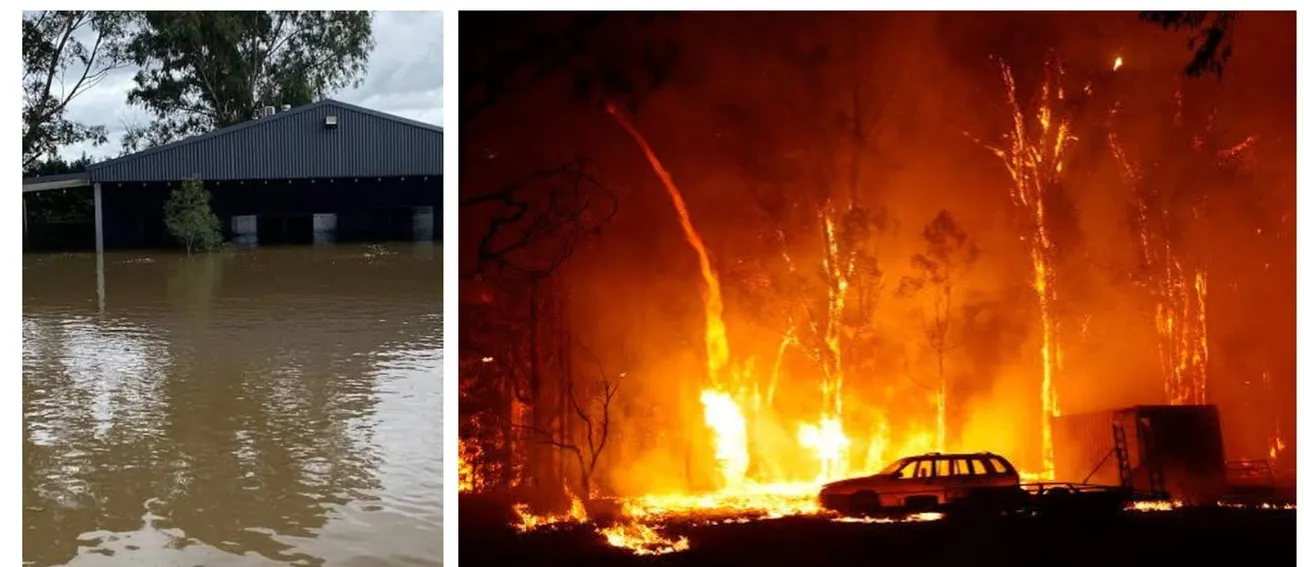
The rising cost of repairing and rebuilding homes after floods, bushfires, storms and hail could add further pressure to insurance premiums in disaster-prone communities such as the Hawkesbury.
New analysis from the Insurance Council of Australia shows national building costs rose about 30 per cent in the five years to March 2026, outstripping consumer price inflation of approximately 24 per cent.
Although the analysis does not provide Hawkesbury-specific premium or rebuilding figures, its findings have clear implications for a district repeatedly affected by floods and bushfires. The broader Hawkesbury-Nepean Valley is also the subject of continuing government scrutiny over flood risk, evacuation capacity and future development.
According to Cotality’s Cordell Construction Cost Index, some of the largest price increases occurred in materials and trades commonly needed after natural disasters. Roof-tile prices rose 77 per cent over five years, more than three times the rate of inflation while windows, plaster, plywood, copper piping, structural steel, cement and concrete increased by between 37 and 48 per cent.
The Insurance Council’s Catastrophe Resilience Report 2025–26 estimates that the cost of constructing its model standard home in NSW increased by 40.36 per cent between 2021 and 2026.
Between 2022 and 2026, insurers received 409,094 claims associated with declared catastrophes and significant weather events, with a combined insured cost of $11.3 billion. Most affected properties were repaired rather than completely rebuilt, but the work drew on the same limited pool of tradespeople and materials required for new housing.
In 2025, declared events generated repair or rebuilding work affecting 145,392 homes, compared with 172,657 new dwellings completed nationally during the year.
For Hawkesbury homeowners, rising reconstruction costs may increase underinsurance risk if a policy’s sum insured is based on an outdated rebuilding estimate. Rebuilding costs can extend beyond the structure itself to demolition, debris removal, professional fees, regulatory requirements and updated building standards.
The Insurance Council’s Catastrophe Resilience Report 2025–26 estimates the cost of constructing a standard home in NSW increased by just over 40 per cent between 2021 and 2026.
These rising costs have consequences extending far beyond the immediate repair bill.
Every home requiring extensive repairs after a disaster draws on the same limited pool of builders, roofers, electricians, plumbers, glaziers and construction materials needed to build new homes.
Between 2022 and 2026, insurers received more than 409,000 claims relating to declared catastrophes and significant weather events. Those claims carried a combined insured cost of $11.3 billion.
In 2025 alone, declared disasters damaged 145,392 homes—almost as many as the 172,657 new homes completed across Australia during the entire year.
The figures highlight an increasingly difficult cycle: governments are seeking to accelerate housing construction while disasters repeatedly return thousands of existing homes to the building and repair queue.
For Hawkesbury residents, higher reconstruction costs may also increase the risk of underinsurance.
A policy based on an outdated rebuilding estimate may no longer provide enough money to completely reconstruct a house after a fire or flood. Rebuilding expenses can include demolition and debris removal, professional fees, council requirements, upgraded building standards and the additional costs of construction in difficult or remote locations.
Higher repair and replacement costs are also contributing to rising premiums, with pressure generally greatest in communities exposed to repeated natural hazards.
Seven declared events during 2025–26 generated more than $3.98 billion in insured losses an increase of more than $1.7 billion on the previous year.
The most expensive event was the series of storms and hailstorms that struck Queensland and NSW last November, producing more than 95,600 claims with incurred costs of approximately $2.2 billion.
Insurance Council chief executive Andrew Hall said escalating building costs were adding pressure to premiums each year.
“Every insurance claim draws on the same builders, trades and materials needed to deliver new housing, stretching an already constrained construction sector even further,” Mr Hall said.
He said sustained labour shortages, higher electricity prices and rising costs for particular building materials were contributing to construction inflation.
Additional demand associated with artificial-intelligence data centres and preparations for the 2032 Brisbane Olympic Games could place still more pressure on the construction sector.
Mr Hall said Australia needed a long-term strategy addressing both housing resilience and housing costs, particularly as some of the country’s fastest-growing communities were also highly exposed to extreme weather.
“Resilience investment, stronger homes and smarter planning decisions, combined with producing more skilled labour, are critical to bringing downward pressure on these costs,” he said.
“Resilience investment is not just good disaster policy, it’s good housing policy that stacks up economically.”
The findings strengthen the case for governments to invest in flood mitigation, bushfire protection, resilient infrastructure and construction standards that reduce the extent of damage when disasters occur.
They also raise difficult planning questions for rapidly growing areas such as the Hawkesbury-Nepean Valley, where new housing demand must be balanced against severe flood risk, evacuation capacity and the long-term affordability of insurance.
“Australia will not tackle the housing shortage while disasters keep pushing existing homes back into the repair queue,” Mr Hall said.
The full Insurance Catastrophe Resilience Report 2025–26 is available through the Insurance Council of Australia.