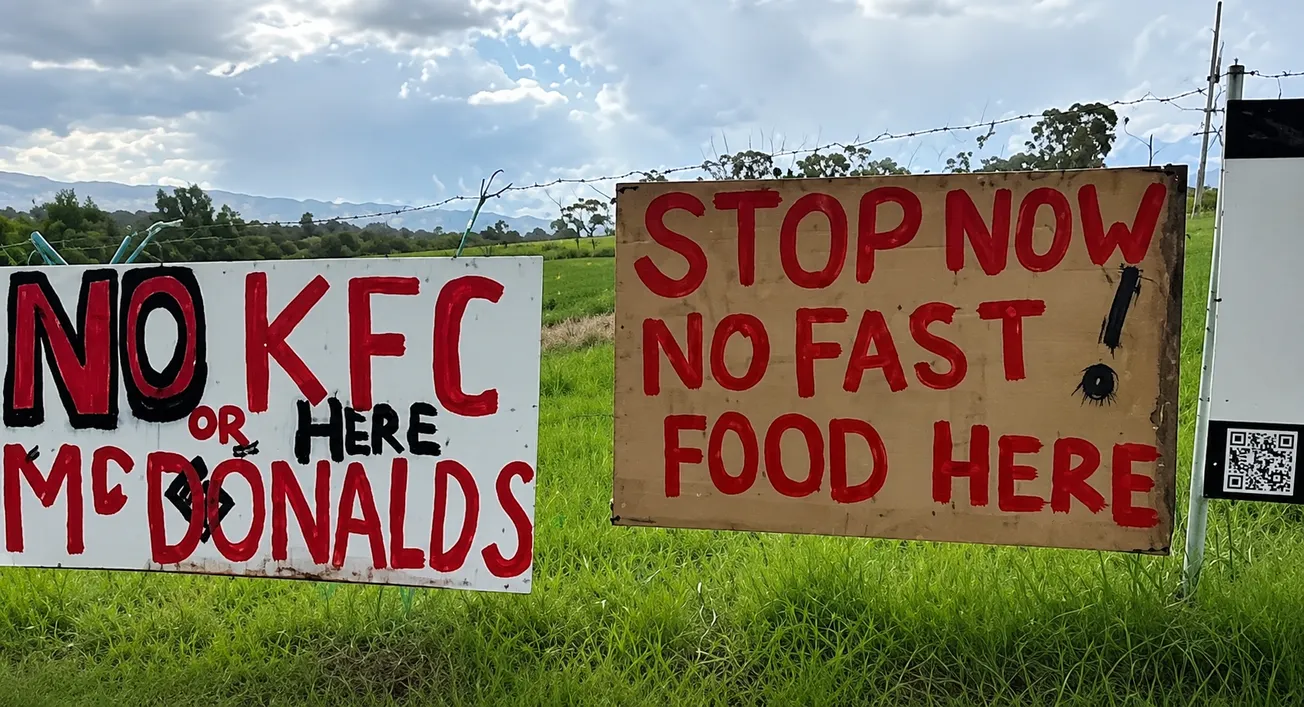
The battle over a proposed fast food and childcare development at Yeomans Lane, North Richmond has taken a significant turn, with the applicant launching an appeal in the NSW Land and Environment Court after Hawkesbury City Council failed to determine the application within the statutory timeframe.
The court action raises questions about why Council is continuing with a Local Planning Panel process that some critics argue can no longer influence the outcome, while also reigniting debate about the decade-long delay in updating the Hawkesbury's planning rules.
Court Appeal Overtakes Planning Panel Process
Since the Gazette first published this story on the proposed development on 2 March 2026, the proposed fast food and childcare development at Yeomans Lane have entered a new phase.
The development application was deemed refused on 12 May 2026 after the statutory assessment period expired without a determination by Hawkesbury City Council.
The applicant subsequently exercised their rights under planning legislation and lodged an appeal in the NSW Land and Environment Court.
The appeal means the Court will ultimately determine the application unless the matter is resolved through mediation or agreement between the parties.
Planning Panel?
Despite the appeal already being before the Court, Hawkesbury City Council has arranged for the proposal to be considered by a Local Planning Panel.
Councillor Mary Lyons-Buckett has posted on social media encouraging residents concerned about the development to view the panel meeting.
However, questions have been raised about the practical effect of the panel process now that the matter is before the Land and Environment Court.
Under the appeal process, the Court is not bound by any recommendation or determination subsequently made by Council or the Planning Panel. The Court will consider the evidence before it and make its own decision.
The convening of a Local Planning Panel can cost several thousand dollars, with estimates commonly reaching up to $10,000 once panel member fees, administration and associated costs are considered.
Outdated LEP allows fast food development in rural areas.
Critics have questioned whether those resources would be better directed towards completing the decade long-delayed review of Hawkesbury's Local Environmental Plan (LEP).
“These applications are being lodged under an LEP passed in 2012. Since then, Council should have produced at least two further LEP’s which ensures communities develop in accordance with changing expectations and needs. Council’s failure to do this basic function is what has led us to this point.” Says Troy Myers Urban City Group.
The LEP is the primary planning document that determines what types of development are permitted in locations. Had provisions restricting fast food outlets in rural settings been included within the LEP, opponents argue such proposals may never have arisen in the first place.
The review of the Hawkesbury LEP has been under discussion for more than a decade with Council claiming that delays have been caused by NSW Planning and visa versa.
Supporters of stronger planning controls argue that unless the LEP is updated, similar proposals will continue to emerge across the Hawkesbury’s rural landscape, leaving communities to fight developments on a case-by-case basis rather than addressing the issue through strategic planning.
“If Council did its job and updated the LEP, life for businesses and residents would be much easier” says Troy Myer.
Relates story: A quiet track through Hawkesbury history to fast food outlets https://www.hawkesburygazette.com/a-quiet-track-through-hawkesbury-history-to-fast-food-outlets/