Three years after Aboriginal men Yellomundee and Gombeeree shared food and camped beside Governor Arthur Phillip’s expedition near Bardonarang Creek on the Hawkesbury-Nepean River, British settlers began occupying the fertile Hawkesbury flats. Within little more than a year, colonial official David Collins was describing the district as being in “open war”.
Read Part 1: Before the Hawkesbury Wars https://www.hawkesburygazette.com/before-the-hawkesbury-wars/
In April 1791, Marine officer Watkin Tench recorded a remarkable encounter beside the river.
Gombeeree and Yellomundee approached Phillip’s expedition, exchanged gifts, shared food, demonstrated traditional skills and spent the night beside the Europeans’ camp.
There was curiosity. There was diplomacy. There was no battle.
Three years later, however, the colony began establishing farms on river flats that had sustained Aboriginal communities for tens of thousands of years.
Sydney’s need for food was increasingly coming into conflict with Aboriginal communities’ existing dependence on and responsibility for Country.
The rich river flats that had sustained Dharug communities for almost 2000 generations were becoming some of the most valuable agricultural land in the struggling British colony.
And two societies increasingly found themselves relying on the same land for survival.
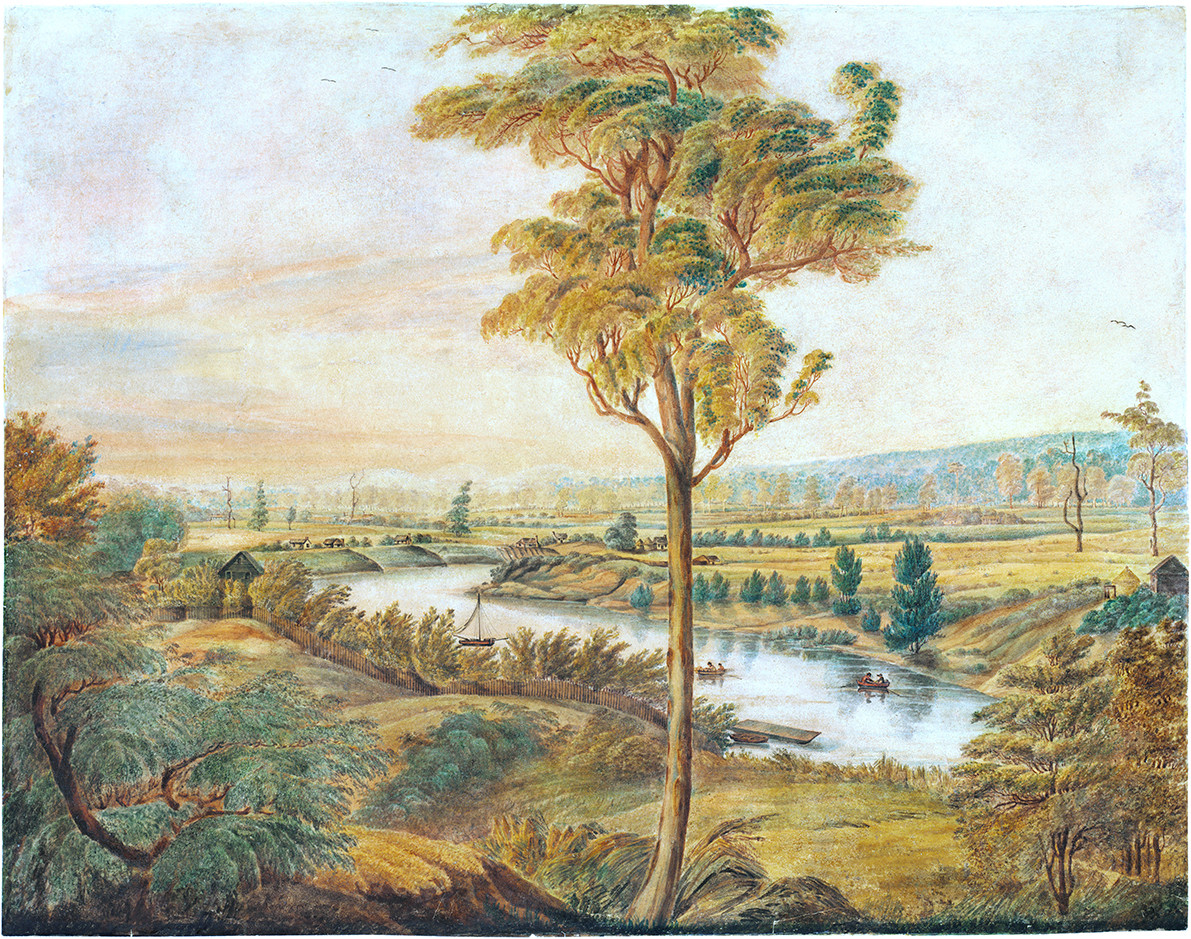
Sydney needed food and the Hawkesbury had it
By 1794, the colony established at Sydney Cove was still struggling to produce enough food.
The Hawkesbury offered an extraordinary solution. The river’s fertile alluvial flats could grow crops far more successfully than much of the land closer to Sydney.
In 1794, emancipated convicts and other settlers began being established on small farms along the Hawkesbury.
The district was initially known to the Europeans as Mulgrave Place and Green Hills, before Windsor developed as its principal settlement.
Hawkesbury City Council’s historical research records that the first 118 settlers established on the river found exceptionally fertile soil.
Settlement expanded with remarkable speed. By June 1795, only about a year later, the Hawkesbury settlement had a European population of around 546. The farms stretched for kilometres along both sides of the river.
Within several years the Hawkesbury-Nepean district would become one of the colony’s principal sources of grain. For the British settlement, the Hawkesbury was becoming indispensable.
For Aboriginal people, the consequences were profound.
The farms were not being established on empty land
The fertile river flats were already occupied, used and understood.
They provided Aboriginal communities with food, water, fishing grounds, hunting areas, gathering places and cultural sites. Among the important foods growing along the river were native yams.
Historical research commissioned by Hawkesbury City Council identifies the destruction of these yam beds as one of the causes of the first serious conflict.
As European cultivation spread, existing food-producing areas were ploughed up and replaced with corn and other crops.
Access to lagoons used for fish, eels and waterbirds was increasingly restricted. Game was killed or driven away. Places that had supported Aboriginal families were being fenced, cultivated and claimed as individual farms.
The British saw farms.
The Dharug saw Country on which people already had rights, responsibilities and relationships extending back countless generations.
Those completely different understandings of land were now colliding.
Corn replaces the yams
The immediate struggle was often over food.
With traditional food resources disappearing, Aboriginal people began taking corn and other produce growing where their food sources had previously existed.
The settlers regarded this as theft.
Aboriginal people could reasonably have understood the situation very differently: newcomers had occupied their food-producing country, destroyed existing resources and were now denying them access to the food growing in their place.
Some settlers maintained comparatively peaceful relationships with Aboriginal people. Others responded violently.
Contemporary and later records describe Aboriginal people being driven from farms and, in some cases, shot.
Aboriginal groups retaliated by attacking farms, destroying crops and killing settlers. A cycle of attack and reprisal began.
The peaceful possibilities glimpsed during Phillip and Tench’s expedition were rapidly disappearing.
1795: “open war”
By 1795 the conflict had become serious.
David Collins, Judge Advocate of the colony and one of the men who had travelled with Phillip and Tench in 1791, described the situation on the Hawkesbury as an “open war” between Aboriginal people and settlers.
Settlers had been killed and others wounded.
Aboriginal people were also being killed, although colonial records frequently failed to record their names or even the number who died.
Acting Governor William Paterson became concerned that the Hawkesbury settlement itself could be threatened.
The stakes for the colonial government were enormous. If settlers abandoned the river, Sydney risked losing one of its most productive sources of food. The government responded with military force.
In May 1795 a detachment of more than 60 soldiers from the New South Wales Corps was sent to the Hawkesbury.
Historical records describe their purpose as driving Aboriginal people away from the farms and securing the settlers’ occupation of the river flats.
David Collins recorded orders to destroy Aboriginal people encountered by the military party and to display the bodies of those killed as a warning.
The Australian truth-telling project Towards Truth describes the operation as the first recorded massacre of Aboriginal people by the military in Australian history.
The Battle of Richmond Hill
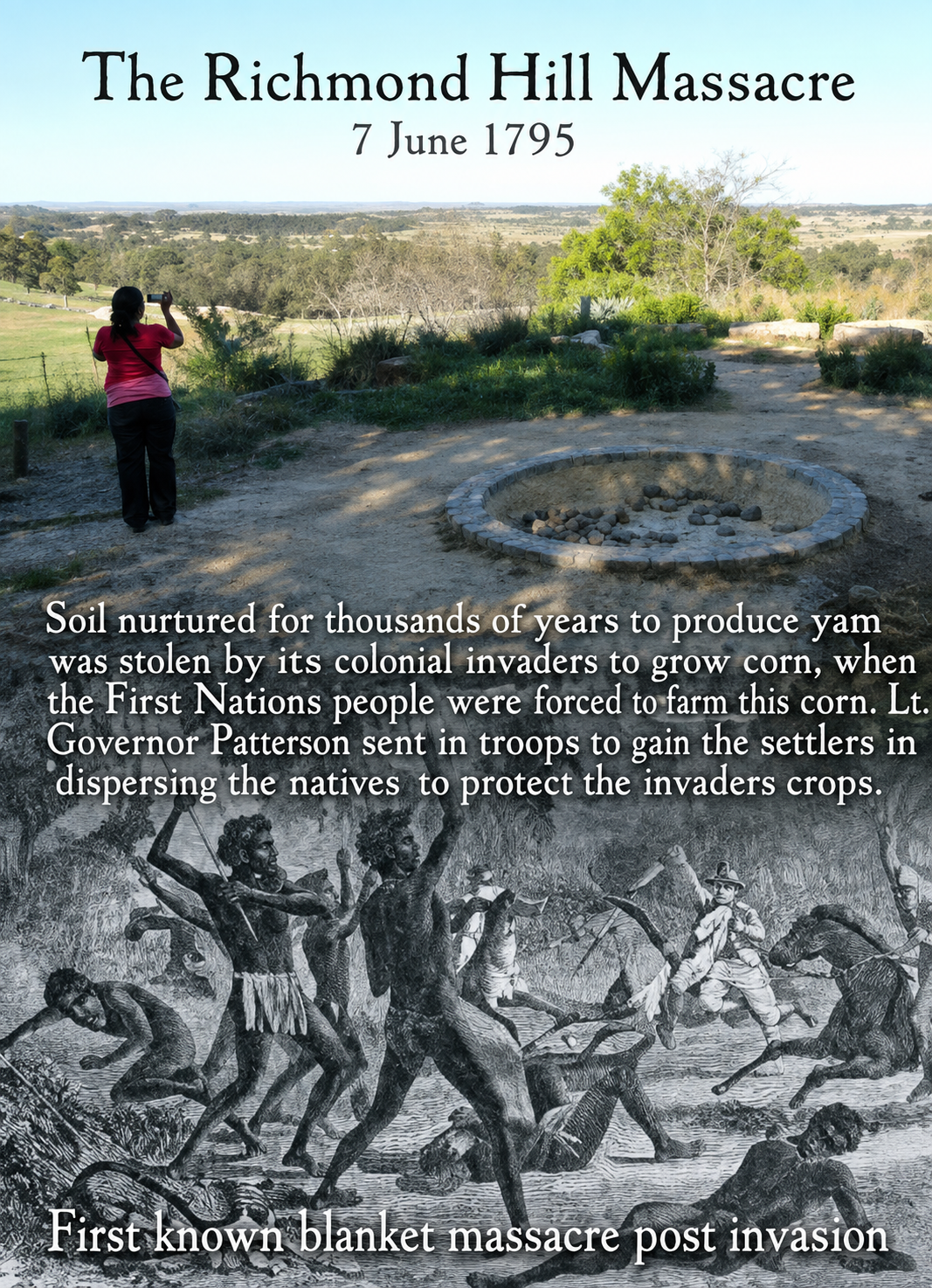
The events of 1795 are now commemorated locally as the Battle of Richmond Hill.
A memorial was established at North Richmond to recognise the conflict and the Aboriginal people who resisted dispossession.
Accounts differ on some details of exactly where particular confrontations took place and how many people were killed. That uncertainty is itself part of the problem confronting historians.
Colonial deaths were generally recorded by name. Aboriginal casualties frequently were not.
What is clear from the surviving records is that armed soldiers were deployed to the Hawkesbury and Aboriginal people were killed as colonial authorities attempted to secure European possession of the river flats.
A military presence subsequently became a permanent feature of the developing Hawkesbury settlement.
Why did Aboriginal people resist?
For generations, older versions of Australian history often described attacks on farms as unexplained hostility or criminal behaviour.
Modern historical examination asks a different question. What had happened to the people already living there?
Within only a few years they had experienced introduced disease, expanding settlement, destruction of food resources, occupation of river flats and violence.
The farms were not simply neighbouring developments. They were replacing the economic foundation on which Aboriginal life depended.
Heritage NSW describes the broader pattern clearly: as settlers moved west, traditional Aboriginal hunting grounds and food resources were absorbed into farms.
During shortages and drought, Aboriginal people used the crops and livestock that had replaced their traditional resources.
Settlers regarded this as theft and sometimes responded by shooting people.
Reprisals followed.
Violence created more violence.
Conflict did not end in 1795
The deployment of soldiers did not resolve the underlying dispute. Settlement continued. So did resistance.
Hawkesbury City Council’s thematic history records repeated clashes between Aboriginal people and settlers from around 1800 onwards.
Conflict spread across the wider Cumberland Plain and Hawkesbury-Nepean system. The violence was not constant. There were periods of relative peace, trade and cooperation.
Aboriginal people worked for settlers, acted as guides and maintained relationships with European families. Some settlers maintained friendships with Aboriginal communities.
The frontier was never simply two uniform groups permanently at war. But the underlying struggle over land remained unresolved.
As the colony expanded, Aboriginal people had fewer places from which to obtain food and fewer areas beyond European control.
Drought and desperation
By 1814 the conflict again intensified. A severe drought placed additional pressure on food resources.
Along the Hawkesbury and Nepean, Aboriginal people increasingly took crops and livestock. Settlers responded.
Killings occurred on both sides.
Heritage NSW records that the drought between 1814 and 1816 contributed to escalating violence because Aboriginal communities found traditional food resources increasingly unavailable while European crops and livestock occupied the same country.
The colonial government interpreted attacks on farms primarily as crimes against settlers and property.
Aboriginal resistance can also be understood as resistance to occupation and dispossession.
Macquarie sends in the military
Governor Lachlan Macquarie initially cultivated a reputation for attempting a more conciliatory relationship with Aboriginal people.
But in 1816 his approach changed dramatically.
Following attacks on settlers along the Hawkesbury-Nepean and elsewhere, Macquarie ordered military expeditions into the interior.
His own diary records the decision.
Three military detachments were ordered to operate across an enormous area extending from the Kurrajong country north of the Hawkesbury through the Nepean and Cow Pastures.
One detachment began operations from Windsor.
Macquarie's instructions authorised soldiers to take Aboriginal people prisoner and to fire if people resisted or refused to surrender. His diary went further.
The bodies of Aboriginal people killed during resistance were to be hung from trees in an attempt to terrorise survivors.
Macquarie wrote that his objective was to clear Aboriginal people from areas of European settlement and drive them beyond the mountains.
Raids in the Hawkesbury
The military operations were not confined to the better-known campaign around Appin.
Hawkesbury City Council historical material records raids within the Hawkesbury district, some involving prominent settler and magistrate William Cox.
Military detachments operated around the Hawkesbury, Grose and Nepean.
At Appin, south of the Hawkesbury, at least 14 Aboriginal men, women and children were killed during the April 1816 campaign.
The State Library of NSW describes the killings as a dark stain on Macquarie’s record.
Although Appin lies outside the Hawkesbury, the massacre formed part of the same military operation ordered in response to frontier conflict across the Hawkesbury-Nepean and adjoining districts.
Ten people declared outlaws
Macquarie escalated the campaign again in July 1816.
A government proclamation named ten Aboriginal people as wanted outlaws.
A reward of £10 each was offered for their capture or killing.
The proclamation also instructed settlers along the Hawkesbury and Nepean rivers to organise themselves into associations capable of defending one another with firearms.
Three military detachments were to be stationed near the Nepean, Grose and Hawkesbury.
The language of the proclamation reveals just how dramatically relations had changed since Phillip's expedition 25 years earlier.
In 1791 the strangers beside the river exchanged hatchets and food.
By 1816 the colonial government was offering money for the capture or death of Aboriginal people and stationing soldiers along the same river.
November 1816: government declares the campaign over
On November 1, Macquarie issued another proclamation. The Governor announced that organised military operations would cease from November 8.
He said enough Aboriginal people had been killed or taken prisoner to deter further attacks and offered pardons to surviving people on the July outlaw list if they surrendered before the end of December.
The proclamation did not restore Aboriginal possession of the river flats. By then the colonial occupation of the Hawkesbury was firmly established.
Farms, roads, settlements and government institutions increasingly dominated the landscape. Organised resistance had been severely weakened.
The Hawkesbury fed Sydney but there was another cost
The agricultural success of the Hawkesbury is rightly recognised as an important part of Australian colonial history.
The fertile river flats helped feed a settlement that had struggled repeatedly with hunger. Farms grew. Windsor developed. Roads were constructed. Agriculture became the economic foundation of the district.
But there is another side to that story.
The land that made the Hawkesbury so valuable to the colony was valuable precisely because it had already supported Aboriginal people for generations.
The same river flats celebrated for their agricultural fertility contained Aboriginal food resources, travel routes, camps, cultural places and communities.
The success of one society increasingly came at the expense of another.
From Gombeeree's gifts to soldiers on the river
That is what makes Watkin Tench’s account of April 1791 so important.
It allows us to see that violent conflict was not inevitable from the moment Aboriginal people and Europeans met on the Hawkesbury.
Gombeeree approached Phillip. He offered stone hatchets and spears. Phillip offered European hatchets and bread. Yellomundee demonstrated healing knowledge. The groups shared a fire. They slept beside one another.
And when morning arrived, they parted peacefully.
Three years later settlers began occupying the river flats.
Within another year soldiers had been deployed.
By 1816 military detachments were operating through the Hawkesbury-Nepean and Aboriginal people were being hunted as outlaws.
The critical change was not simply that two cultures had encountered one another.
It was that one began taking possession of the other's land.
A history still beneath our feet
Today the names Windsor, Richmond, Pitt Town, Wilberforce, Kurrajong and North Richmond describe familiar Hawkesbury communities.
But beneath the roads, farms and townships lies a much older landscape.
The river flats that helped save the early colony from hunger were Aboriginal Country before Europeans arrived.
The Hawkesbury's colonial history cannot be understood without recognising both achievements and consequences.
Settlers struggled against floods, isolation, hunger and an unfamiliar environment to establish farms and communities.
Aboriginal people were simultaneously struggling to retain Country, food, culture and their independence.
Both stories belong in the history of the Hawkesbury.
And the distance between the peaceful meeting recorded by Watkin Tench in 1791 and the military campaigns of 1795 and 1816 tells us something fundamental about what happened here.
The frontier war did not begin because Gombeeree and Yellomundee rejected the newcomers when they first appeared beside the river.
Their first recorded response was conversation, exchange and hospitality.
The conflict came as settlement expanded across the land that sustained them.
More than 230 years later, understanding that distinction is essential to understanding the history of the Hawkesbury.
.