ANALYSIS | From the White House to Windsor, governments are increasingly attempting to decide who qualifies as legitimate media and who may enter the public buildings where decisions are made.
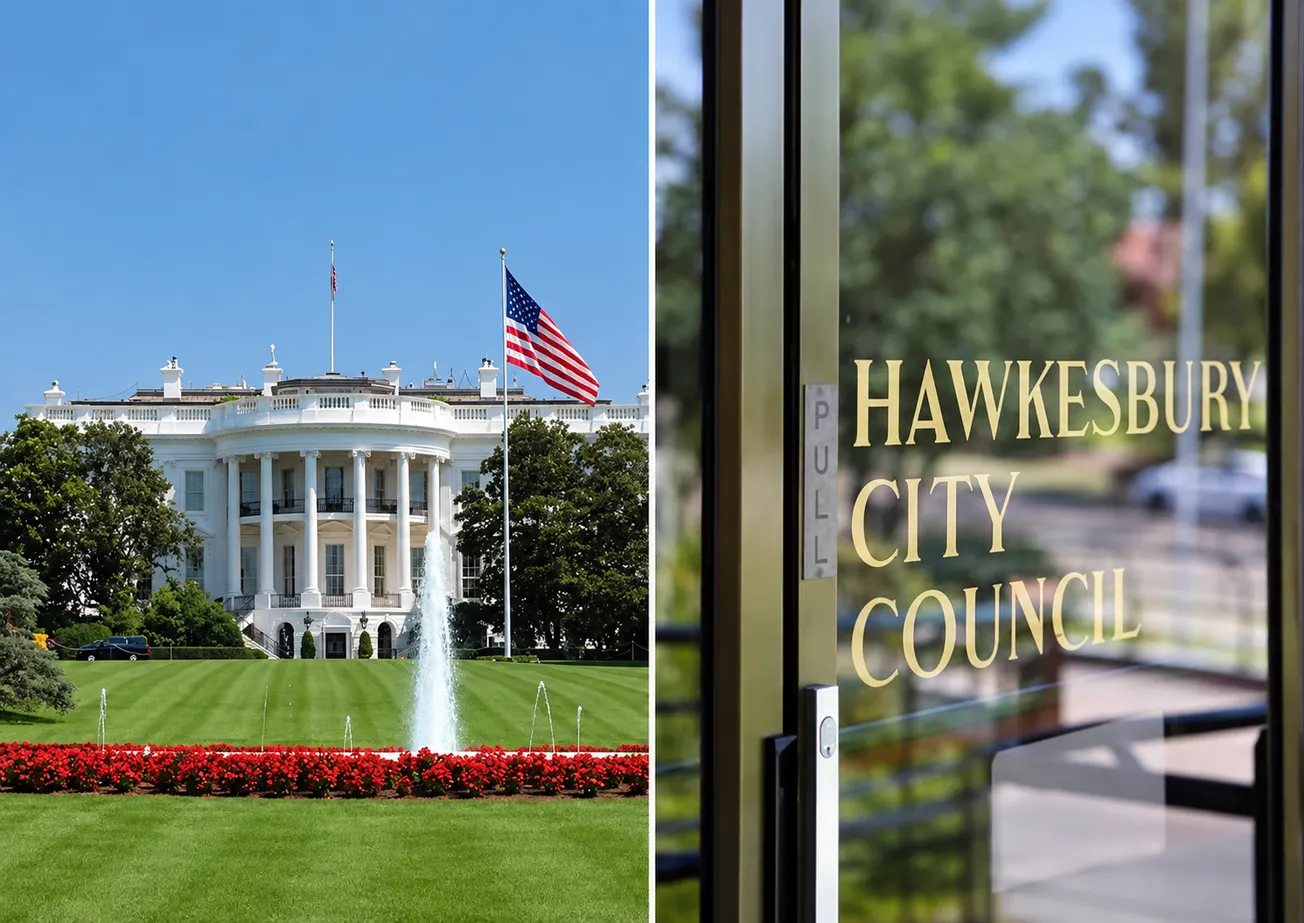
US President Donald Trump appears to have taken a leaf from Hawkesbury City Council’s book, announcing that three major news organisations would be banned from the White House because he objects to their reporting.
Trump said CNN, MS NOW and Politico would be excluded “effective immediately”, accusing them of publishing “fake news” and deliberately producing negative coverage of his administration.
He also suggested that other organisations, including The Washington Post and The New York Times, could face similar treatment.
Trump did not cite security or operational concerns. He expressly linked the exclusions to his objections to the organisations’ reporting.
On Saturday, September 19, the administration began enforcing the prohibition. White House reporters from CNN, MS NOW and Politico were denied entry, with credentials disabled and, in several cases, confiscated. The three organisations said they would defend their First Amendment rights and called for their journalists’ access to be restored.
CNN described the decision as unconstitutional, while the White House Correspondents’ Association said excluding journalists because of their reporting was an attack on press freedom and the public’s right to information.
The controversy has an uncomfortable local parallel.
From Windsor to the White House
On April 28, 2026, Hawkesbury City Council banned the Hawkesbury Gazette, Hawkesbury Radio and people associated with the two organisations from entering Council premises or attending Council meetings for media purposes.
The direction was signed by then mayor Les Sheather and acting general manager Will Barton.
Council has alleged disruptive conduct, harassment, social-media activity and reporting it regarded as inaccurate or defamatory. The Gazette disputes those allegations and says Council has not provided it with particulars or evidence identifying a specific incident that triggered the prohibition.
Council said the restriction is imposed under its workplace health and safety obligations under the WHS Act because the organisations allegedly presented a psychosocial risk to staff.
However, when questioned by the Gazette and other media outlets, Council was unable to identify any recorded workplace health and safety incident involving the newspaper or radio station that had prompted the ban. It described the action as preventative.
Council lifted Hawkesbury Radio’s restriction on July 1. By that time, the station was no longer broadcasting The Common Point, a political-commentary program that had criticised Council. No public evidence has been presented establishing whether the program’s removal formed part of Council’s decision to restore access.
The ban on the Gazette remains in force.
The timing also raised questions.
The prohibition was imposed three days after the Gazette reported that Council had approved an approximately $340,000 payment, equivalent to 38 weeks’ remuneration, in connection with former general manager Elizabeth Richardson’s departure.
Under the NSW standard contract, a council may make a payment of up to 38 weeks’ remuneration when it terminates a general manager’s contract on a no-fault basis. The contract also permits termination by written agreement, while a resignation ordinarily requires four weeks’ notice. Council has referred publicly to Ms Richardson’s departure as a resignation, and the precise basis of the payment has not been publicly disclosed.
No court, regulator or investigative body has made a finding of wrongdoing against Council, its councillors, employees or Ms Richardson in connection with the payment.
The Council has denied that the ban was imposed in retaliation for critical reporting.
Unlike Trump, Hawkesbury Council has not publicly said it excluded the Gazette because its stories were negative. Its stated justification is workplace safety.
Nevertheless, the effect is similar: a government body has selected a critical media organisation and denied it the access available to other journalists.
Who decides who is a journalist?
In both cases, the central issue extends beyond the organisations directly affected.
Should a government or a council be permitted to decide that a news organisation is no longer legitimate because its reporting is uncomfortable, critical or disputed?
Public bodies are not required to agree with journalists. They may challenge inaccurate reporting, seek corrections, publish their own evidence and use established legal remedies where appropriate.
But excluding journalists from public institutions is a fundamentally different response.
It restricts their ability to observe officials, question decision-makers and report firsthand on matters affecting the community. It also allows the government body being scrutinised to determine which journalists may scrutinise it.
That is precisely why media access cannot safely depend on whether those in power approve of the coverage they receive.
Different laws, same democratic principle
The legal settings in the United States and Australia are different.
The First Amendment to the United States Constitution expressly protects freedom of speech and freedom of the press. Legal experts have said Trump’s proposed ban could amount to unconstitutional viewpoint discrimination if access is withdrawn because of the content of an organisation’s reporting.
Australia does not have an equivalent constitutional guarantee of press freedom. Australian courts recognise an implied freedom of political communication, but it operates differently from an individual right under the US Constitution.
Local councils also have legitimate responsibilities to protect workers from health and safety risks.
Those obligations are important, but they should not become a convenient mechanism for silencing scrutiny. Restrictions imposed in the name of workplace safety should be supported by evidence, proportionate to an identified risk and subject to a fair process.
The Hawkesbury prohibition was imposed without the Gazette being given details of the alleged conduct, an opportunity to respond or a defined process through which the restriction could be reviewed and lifted.
Scrutiny is not harassment
Journalism can be uncomfortable. Reporters ask questions that public officials may prefer not to answer. They examine spending, recruitment, governance and the exercise of public power.
That is not, by itself, harassment or a workplace safety threat.
There is an important distinction between genuinely abusive conduct and persistent public-interest reporting. Governments must address the former without using it as a justification to prevent the latter.
NSW Local Government Minister Ron Hoenig has previously urged Hawkesbury Council to reconsider its ban and emphasised the media’s role in exposing wrongdoing and discouraging corruption.
The Minister subsequently described aspects of Council’s conduct as “particularly bizarre” and directed the Office of Local Government to approach Hawkesbury Council with greater scrutiny and scepticism.
Trump’s announcement demonstrates why this local dispute matters beyond the Hawkesbury.
Once governments accept that they may exclude journalists whose reporting they dislike, the question is no longer whether the media should be accountable. It becomes whether those being held accountable may choose their own watchdogs.
The scale of the White House and Hawkesbury City Council could hardly be more different. The democratic principle is not.
The public buildings in Washington and Windsor belong to the people. Access to them should not depend on publishing news that pleases the people temporarily occupying positions of power.
The Trump administration, Hawkesbury City Council and the Office of Local Government will be invited to respond.
Sources: Reuters and Associated Press.