A study estimating that 2.2 million First Nations people lived in Australia before British colonisation raises new questions about the population of the Sydney Basin and casts fresh light on the Hawkesbury’s crucial role in sustaining the struggling penal colony.
New research suggesting Australia’s First Nations population was almost 10 times larger than some early estimates is challenging long-held accounts of the country at the time the First Fleet arrived.
The study, published in the peer-reviewed journal Nature Human Behaviour, estimates that about 2.2 million Aboriginal and Torres Strait Islander people lived across Australia before British colonisation began in 1788.
Early estimates commonly put the population at between 250,000 and 300,000. Those figures were partly based on observations made after disease, frontier violence and dispossession had already devastated many communities.
Researchers from the Australian Research Council Centre of Excellence for Indigenous and Environmental Histories and Futures combined archaeological evidence, genetic information and estimates of the number of people different environments could support.
They calculated that, by 1861, the First Nations population had fallen to about seven per cent of its pre-colonial size. The researchers attributed the collapse to introduced disease, killings, displacement from Country and the destruction of food supplies.
The study does not provide a separate population estimate for the Hawkesbury or the wider Sydney Basin. It does, however, suggest that the number of Aboriginal people living in productive river and coastal regions may have been substantially underestimated.
That finding is particularly significant for the Hawkesbury.
A populated and carefully managed landscape
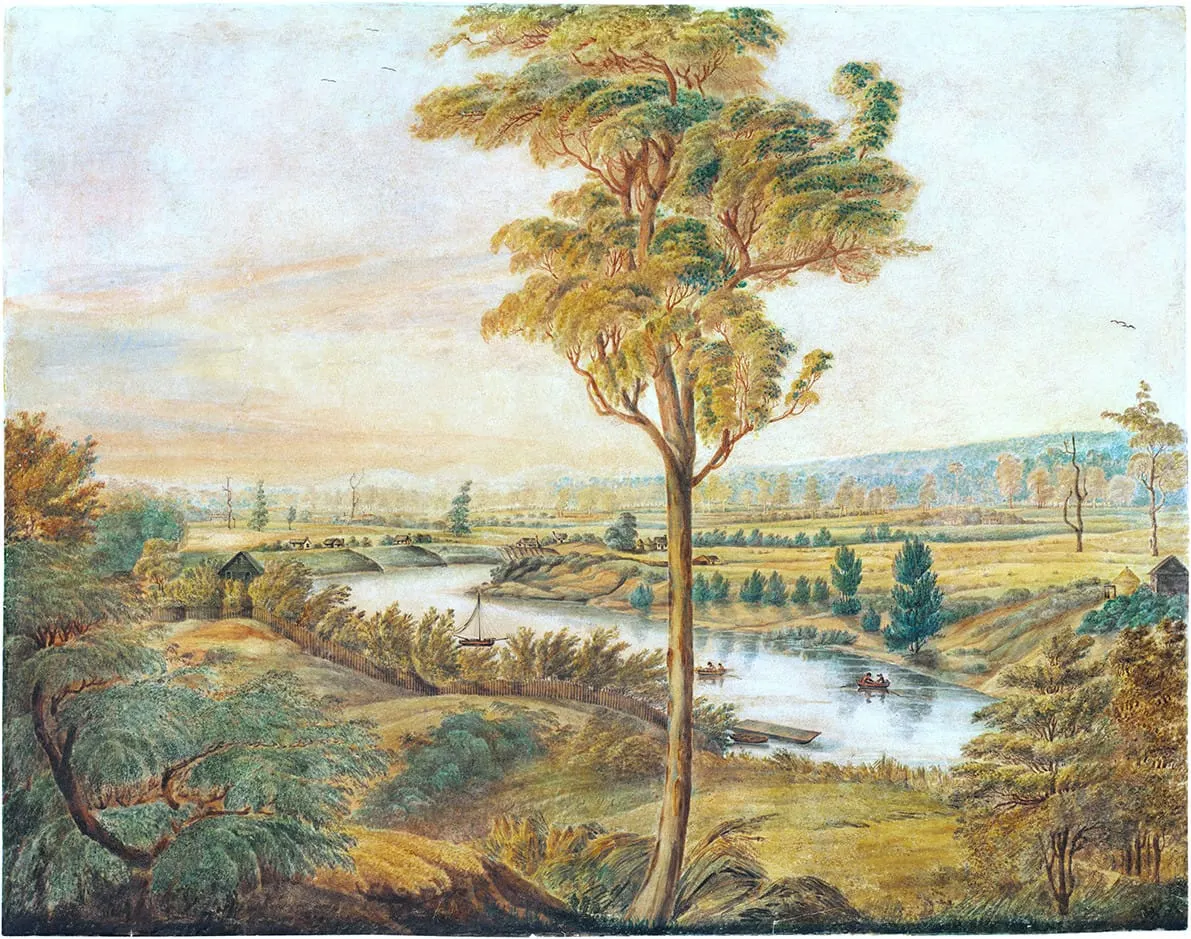
When British colonists entered the Hawkesbury-Nepean basin, they were not moving into an empty wilderness.
The river, its tributaries, wetlands and fertile floodplains formed part of an Aboriginal cultural and economic landscape that had been occupied and managed for thousands of years.
Most of the present-day Hawkesbury local government area is on Dharug Country, while Darkinjung Country extends into parts of the northern district.
Aboriginal families obtained fish, eels, shellfish, waterbirds, mammals and plant foods from the river system and its surrounding forests and grasslands. They moved through Country according to seasons, family responsibilities, ceremony and the availability of food.
Fire was used to care for Country, encourage new plant growth, maintain travelling routes and create suitable habitat for animals.
The productivity later recognised by British farmers was therefore not evidence of unused land. It was part of a living landscape with established custodians, laws and systems of land management.
The colony’s search for food
The British settlement established at Sydney Cove in January 1788 soon struggled to feed itself.
Its population dominated by convicts, marines and government officials depended heavily on provisions carried from Britain. Crops planted around Sydney performed poorly in shallow and unfamiliar soils, while farming knowledge, tools and experienced labour were limited.
Food shortages became one of the greatest threats to the survival of the penal colony.
Governor Arthur Phillip searched for more productive land, leading to the establishment of a government farm at Rose Hill, later renamed Parramatta. But the colony continued to face uncertain harvests and declining stores.
Attention eventually turned to the deep alluvial soils beside the Hawkesbury River.
Lieutenant-Governor Francis Grose opened the district to European agriculture in 1794, granting riverfront land around what are now Windsor, Richmond, Pitt Town and Wilberforce.
The results were comparatively rapid. Settlers planted maize, wheat and other crops in soil replenished by the river’s floods. Grain and vegetables were transported by boat down the Hawkesbury and along the coast to Sydney.
The Hawkesbury became one of the colony’s first dependable food-producing districts. Its harvests helped reduce the settlement’s reliance on imported provisions and supported its expanding convict and military population.
In that sense, the Hawkesbury basin played a crucial part in the survival and consolidation of Britain’s penal colony.
But the colony’s success came at an enormous cost to the people whose Country produced that food.
Survival for one population, dispossession for another
The same river flats that colonial authorities considered essential to feeding Sydney were central to Dharug life.
Land grants, fencing, crop cultivation and grazing restricted access to the river and displaced Aboriginal families from fishing places, campsites, hunting grounds and plant-food areas.
The destruction of local food sources placed further pressure on people already affected by introduced disease.
A devastating epidemic swept through Aboriginal communities around Sydney in 1789, before large-scale European settlement of the Hawkesbury began. Commonly identified as smallpox, the epidemic spread beyond Sydney and caused widespread deaths.
That timing is critical when interpreting colonial records. By the time officials and settlers began attempting to count Aboriginal people in the Hawkesbury and elsewhere, they may already have been observing populations drastically reduced by disease.
As settlers occupied more of the riverbanks from 1794, conflict intensified. Aboriginal resistance included taking crops and livestock, burning property and attempting to drive settlers from Country. Colonists and government forces responded with armed expeditions, shootings and killings.
These events formed part of what is now recognised as the Hawkesbury-Nepean frontier conflict.
The district therefore occupies a complicated place in Australian history. The Hawkesbury helped feed a British settlement that might otherwise have faced even greater hunger and possible failure. At the same time, agricultural expansion transferred the basin’s most productive land from its Traditional Custodians and undermined the food systems that had supported them for generations.
Numbers change the story
The new national population estimate does not establish exactly how many Dharug people lived in the Hawkesbury basin in 1788.
Researchers caution that the national figure cannot simply be divided or applied mechanically to particular regions. Local population density varied according to climate, water, food resources and patterns of movement.
However, the abundance of the Hawkesbury-Nepean system and its proven ability to support both Aboriginal communities and the growing colonial population makes the question of its original population especially important.
The study strengthens the argument that early colonial estimates may have recorded survivors rather than the population that existed when the British arrived.
Lead researcher Associate Professor Alan Williams said the findings demonstrated both the devastating impact of invasion and the remarkable survival and recovery of Aboriginal and Torres Strait Islander people.
For the Hawkesbury, that survival continues in Dharug families, culture, language and connections to Country.
The district’s colonial history is often told as a story of fertile soil, pioneering farmers and the river that fed Sydney. The new research does not erase that history, but it requires another part of the story to be given equal weight.
The land that helped the British penal colony survive was already someone’s Country. Its productivity sustained the newcomers because it had sustained First Nations people for thousands of years.
Sources: The national population findings were reported from research published in Nature Human Behaviour by the Australian Research Council Centre of Excellence for Indigenous and Environmental Histories and Futures. Historical context draws on colonial records and published histories of early agriculture and frontier conflict in the Hawkesbury-Nepean district. The study’s findings are summarised in The Guardian’s report. Hawkesbury City Council acknowledges the Dharug and Darkinjung peoples as the district’s Traditional Custodians.