Table of Contents
If you drove through the farmlands of Cornwallis earlier this month, you might have expected the usual Hawkesbury scene, tractors working rich soil, cattle grazing, and perhaps a Hercules aircraft banking toward RAAF Base Richmond. What you wouldn’t expect is the thunderous roar of a rocket engine.
But on March 2, that’s exactly what happened.
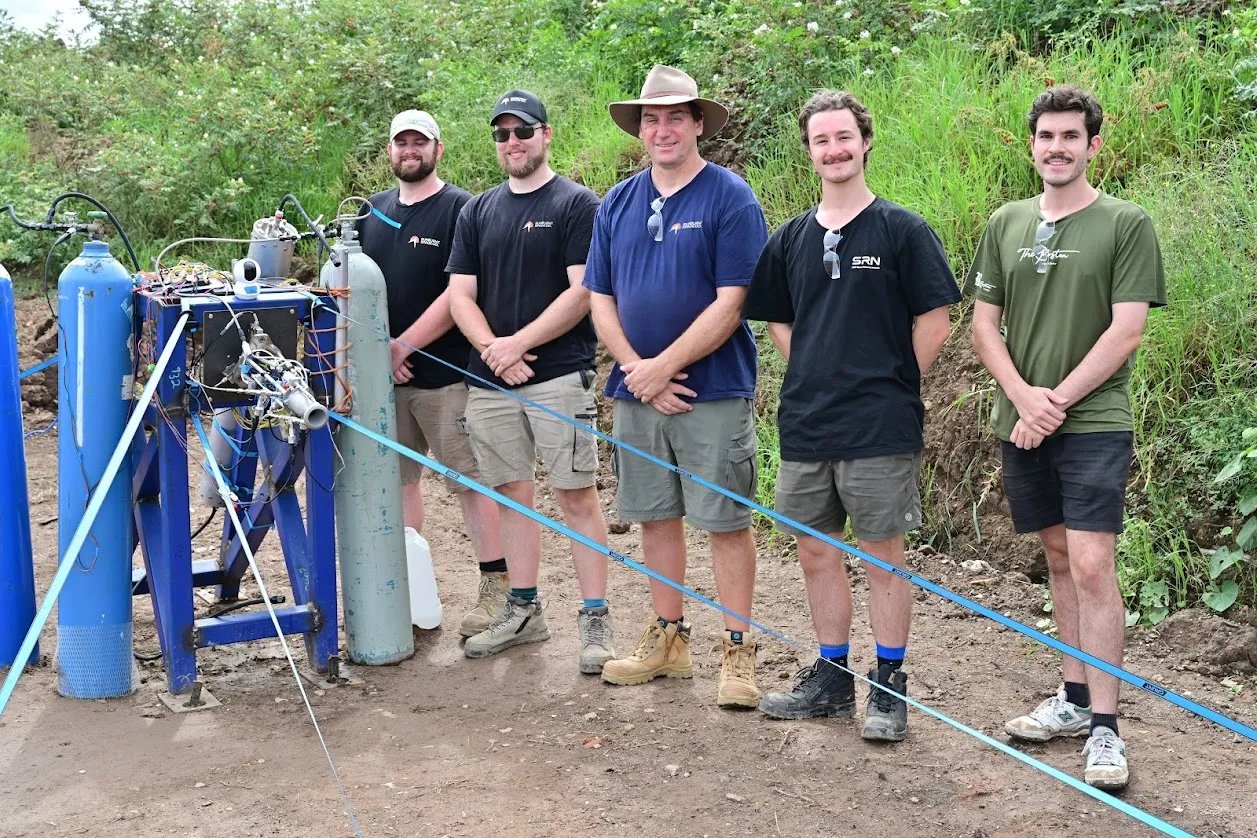
In a quiet paddock, a liquid-fuel rocket engine was fired as part of testing by Sunburnt Space Co., a fast-moving Australian aerospace startup. And at the centre of it all is a familiar local story, one that begins at Richmond High School.
Founder and CEO Brad Younger grew up in the Hawkesbury, spending his early years under the same open skies he is now determined to reach. After building a successful career across multiple ventures, Younger returned to a lifelong passion that first took hold at just 17: building rockets.
That passion has evolved into a company with global ambition and unexpectedly, it has brought the space industry to Cornwallis.
From Brookvale to the paddocks of Hawkesbury
Sunburnt Space is based in Brookvale on Sydney’s Northern Beaches, a strong location for engineering, but far from ideal for rocket testing.
Rocket engines, even relatively small ones, are extremely loud. An early test firing at the Brookvale workshop quickly proved the point. Within moments, neighbouring businesses, including a puppy preschool, were knocking on the door, concerned about the sudden blast of noise.
It was clear the company needed space.
Younger looked west back to the Hawkesbury.
In Cornwallis, he found what modern industry often struggles to secure: open land, practical conditions, and a community willing to collaborate. A local landowner stepped in, allowing testing on the property and even constructing a dirt berm to help redirect sound away from nearby homes.
It’s a simple solution, but a telling one. This wasn’t disruption, it was cooperation.
A century since it all began
This local innovation comes at a remarkable moment in history. March 2026 marks 100 years since American physicist Robert Goddard launched the world’s first liquid-fuelled rocket, a small, experimental craft that flew just 41 feet for a few seconds from a farm in Massachusetts.
At the time, it may have seemed modest. But that single flight proved that controlled liquid propulsion was possible, a breakthrough that laid the foundation for modern rocketry, satellites, and human spaceflight.
A century on, the same fundamental principles are still used in rockets today including the type now being tested in a Hawkesbury paddock. From a cabbage field in 1926 to Cornwallis in 2026, the thread of innovation is surprisingly direct.
What’s actually happening out there?
While the setting may look rural, the work being done is highly advanced.
The team is developing a liquid-fuel rocket engine using nitrous oxide and ethanol, a combination that reflects both performance and sustainability. Ethanol, often derived from agricultural by-products, creates an unexpected link between the Hawkesbury’s farming roots and cutting-edge aerospace technology.
These are not large-scale launches. The Cornwallis site is used for “static fire” testing where the engine is fixed in place while engineers measure performance, ignition, and stability.
It’s controlled, methodical work and a critical step before any rocket ever leaves the ground.
A different kind of space race
Sunburnt Space is not trying to compete with billion-dollar space programs or massive rockets seen on television.
Instead, the company is targeting a growing gap in the global market: affordable access to microgravity.
Microgravity conditions where gravity’s effects are minimal is essential for research in medicine, materials science, and advanced manufacturing. Currently, access is limited to brief parabolic flights or extremely expensive orbital missions.
Sunburnt Space aims to change that.
By developing smaller, efficient suborbital rockets, the company plans to offer regular, lower-cost flights that provide minutes of microgravity enough for meaningful scientific and commercial testing.
It’s what the company describes as the “missing middle” of the space economy.
Why this matters for the Hawkesbury
For decades, the Hawkesbury economy has been built on agriculture, small business, and defence. That identity remains strong but stories like this show how the region can evolve without losing its character.
The presence of a company like Sunburnt Space brings new opportunities:
- Skilled jobs and future career pathways
- Increased visibility for the region
- Inspiration for local students
- Potential flow-on benefits for local suppliers
For students at Richmond High where Younger once sat, the idea that rocket engines are being tested just down the road is powerful. It shows that participation in cutting-edge industries doesn’t have to begin overseas or in capital-city hubs.
It can start here.
Built with community in mind
Importantly, the work in Cornwallis has been approached with care.
Testing is controlled, and steps have been taken to minimise noise and disruption. RAAF Base Richmond has been made aware of the activity, and the rural location allows work that simply couldn’t happen in a dense urban setting.
This is a model of how advanced industry can coexist with established communities not by overriding them, but by working alongside them.
The next step: heading for space
The Cornwallis testing is not the end goal, it’s preparation.
Armed with data from these engine tests, Sunburnt Space is preparing for a major milestone: a test launch campaign at White Cliffs in western New South Wales.
The long-term ambition is clear, to eventually reach the Kármán line, 100 kilometres above Earth, widely recognised as the boundary of space.
For a startup, it’s a bold trajectory. But it is grounded in incremental progress, the kind that begins with small tests in places like Cornwallis.
A local story with global reach
Sunburnt Space is currently in its early investment phase, seeking support to scale operations and move toward commercial launches.
For the Hawkesbury, this represents more than a business opportunity. It’s a chance to be part of a broader shift, one where regional communities play a role in high-tech industries traditionally concentrated elsewhere.
Because this story is not just about rockets.
It’s about a local student who followed a passion, built something ambitious, and returned home not for nostalgia, but because the Hawkesbury offered exactly what innovation needs: space, practicality, and a willingness to have a go.
Looking up, staying grounded
As Sunburnt Space prepares for its next phase, the Hawkesbury has every reason to feel a sense of pride.
From the paddocks of Cornwallis to the edge of space, this is a journey that remains deeply local.
It shows that the future doesn’t always arrive in a city tower or a global headline. Sometimes it starts quietly in a Hawkesbury paddock, with a burst of flame and grows from there.
Sometimes, the path to the stars begins right here at home.