By Bob Gribbin
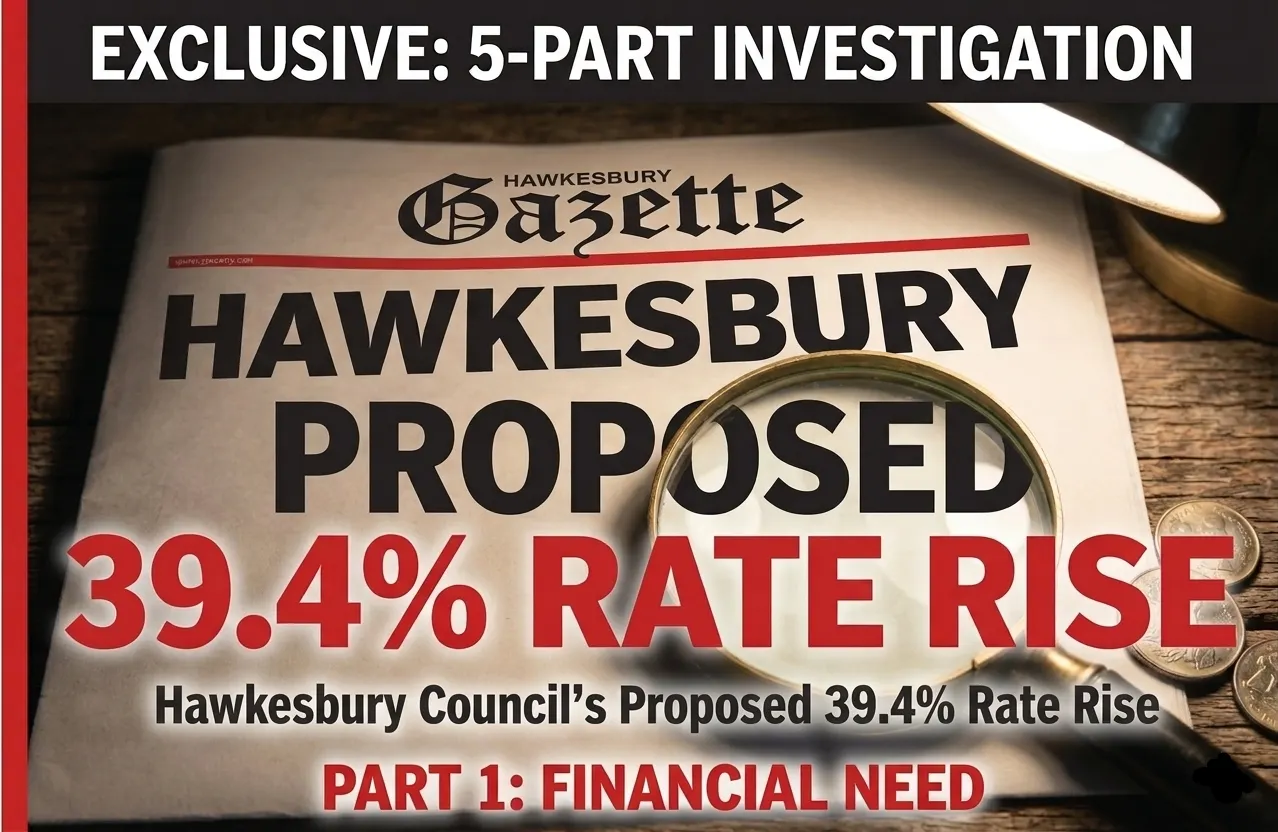
The Hawkesbury Gazette will run a five-part investigative series looking into
Hawkesbury City Council’s plan to raise rates by 8.66% annually over four years,
resulting in a total increase of 39.4%.
The series aims to provide residents with a clear, evidence-based understanding of
the proposal before the Independent Pricing and Regulatory Tribunal (IPART) makes its final decision due before the end of this financial year.
The Gazette’s analysis will evaluate the proposal against the official criteria
established by the NSW Office of Local Government (OLG), which assesses whether Councils are justified in requesting a Special Rate Variation (SRV).
The investigation also occurs in light of remarks made by Hon. Ron Hoenig MLC,
Minister for Local Government, who recently stated that the State Government would not interfere in Council affairs unless illegal activity is detected, and that ultimately residents are responsible for judging council performance at the ballot box.
Since that responsibility rests with voters, the Gazette believes that an informed
public debate is essential.
A Community Conversation About Council Governance
The Hawkesbury Gazette series will analyse the SRV proposal across five key areas
outlined by the OLG guidelines.
- Financial need
- Community awareness and engagement
- Impact on ratepayers
- Compliance with Integrated Planning and Reporting (IP&R) requirements
- Productivity improvements and cost containment
The series will also explore broader evidence presented in public submissions
indicating systemic issues in the council's financial management.
Each article will focus on a specific part of the proposal and present the available
data so residents can form their own conclusions.
Does the Council Show Genuine Financial Need?
The first article in the series examines the key question outlined in the OLG
guidelines: does the council genuinely require additional revenue to remain
financially sustainable?
The council’s application states there is currently a $99.1 million unfunded asset
renewal gap, which could rise to $170 million by 2035 if no additional revenue is
found.
Infrastructure pressures are widely acknowledged. The Hawkesbury local
government area spans a large geographic area, has aging infrastructure, and
regularly faces flooding and other disasters.
However, the evidence presented in a detailed submission to IPART suggests that
the issue may not be a lack of funding but rather the way existing funds are
managed.
The First Special Rate Rise
One of the main concerns is that this would be the second Special Rate Variation in
under ten years. In 2018, IPART approved a 9.5% annual increase for three years, resulting in a total increase of 31.29%.
The purpose of that increase was to improve financial sustainability, reduce the infrastructure backlog and fund operational and capital works.
Seven years later, the council is again seeking another extraordinary rate rise.
Critics point out that this prompts a clear question: So, what happened to the funding from the first SRV?
Infrastructure Backlog Has Increased
Data from council financial statements indicates that the infrastructure backlog ratio has deteriorated in recent years.
The backlog ratio is currently 2.95%, exceeding the benchmark of 2%, suggesting
assets that should have been renewed or repaired remain outstanding.
The ratio has risen from 2.82% the previous year, despite substantial capital
expenditure and large influxes of disaster recovery funding. This suggests the core issue might be prioritisation and asset management rather than a mere lack of revenue.
Rising Employee Costs
Another trend highlighted in financial data is the rise in employee expenses.
Between 2018 and 2025, employee expenses rose from $27.3 million to $39.4
million, representing a 44.3% increase.
During the same period, income from rates and charges rose by 39.7%. Critics claim that most of the extra revenue from the first SRV seems to have been
absorbed by rising operational costs rather than infrastructure upgrades.
Forecast Reliability Under Scrutiny
Another issue raised in the analysis concerns the reliability of the council’s financial projections.
The initial SRV was based on growth projections that anticipated new development in areas such as Glossodia and Oakville. However, those developments did not occur within the expected timeframe, resulting in a $3.3 million shortfall in forecast SRV revenue over the first three years.
The current SRV proposal again depends on long-term financial modelling and
population growth assumptions. Some observers argue that those projections should be independently verified before approving another rate increase.
The Debate Begins
The Gazette’s series does not aim to support or oppose the rate rise.
Instead, it aims to give residents the information needed to understand:
the financial arguments presented by the council
the concerns raised by ratepayers
the regulatory framework used to assess the proposal.
In the words of the Local Government Minister Ron Hoenig, the performance of
councils ultimately depends on the community that elects them. For that reason, the Gazette believes the Hawkesbury community deserves a thorough and transparent review of the evidence before any decision is made.
Coming Next
Part Two of the Gazette’s investigation will examine whether Hawkesbury City
Council has met the OLG requirement for community awareness and engagement,
including survey results and public submissions on the proposed rate increase.