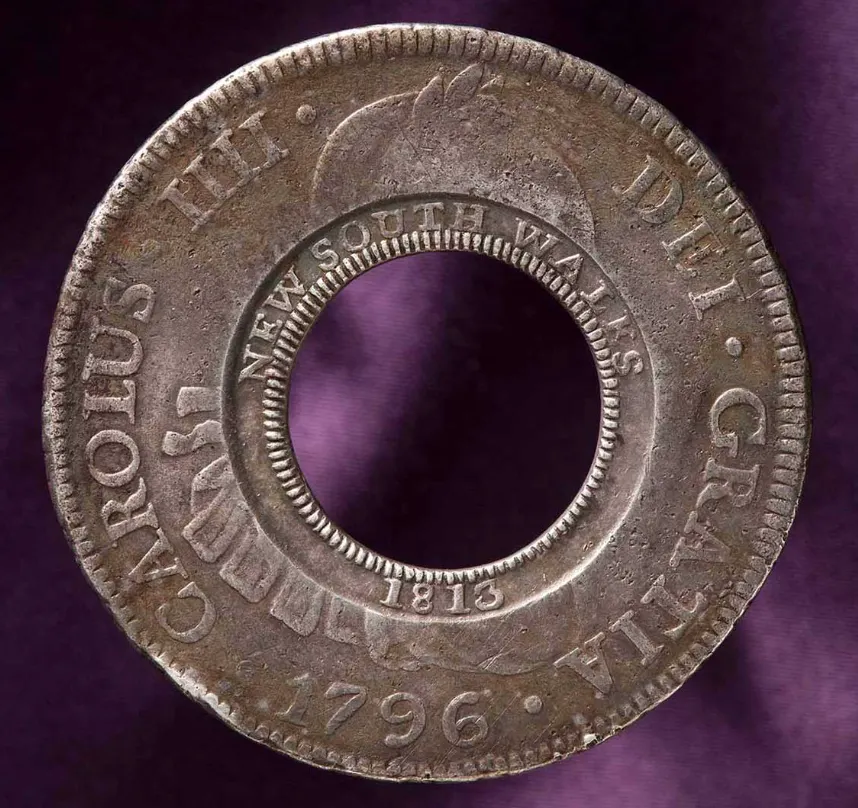
A silver coin created under Governor Lachlan Macquarie to help solve colonial NSW’s currency shortage is being offered at auction in Sydney with an estimated value of $200,000.
The rare holey dollar features in Noble Numismatics’ Sale 143, running from November 23 to 27, alongside examples of the smaller coins known as “dumps”. The estimate is an anticipated auction value, rather than a confirmed sale price.
For Hawkesbury readers, the coin offers another perspective on Macquarie’s legacy: alongside his role in shaping the district’s towns, his administration helped create a distinctive local currency.
Early colonial trade relied on a mixture of foreign coins, credit and barter. A shortage of reliable money made everyday transactions difficult.
Macquarie’s solution involved 40,000 Spanish silver dollars and a man whose skills had previously landed him on the wrong side of the law.
William Henshall, transported for forgery, was commissioned to cut the centre from each dollar and turn both pieces into NSW currency.
The outer silver ring became the holey dollar, worth five shillings. The centre became the dump, worth fifteen pence - one shilling and threepence.
The process increased the number of available coins while making them less useful outside NSW, helping retain money within the colony.
Although often associated with their introduction into circulation in 1814, the coins bear the date 1813.
The National Museum of Australia records that the first batch was delivered to Deputy Commissary-General David Allan on February 25, 1814. The Powerhouse similarly distinguishes their production in 1813 from their circulation the following year.
Today, surviving examples are sought by collectors for their rarity and their place in Australia’s monetary history.
Their appearance can also tell two stories at once: the original Spanish dollar from which each was made, and the NSW markings added to give it a new identity and value.
The auction house’s media release describes the featured holey dollar as an example of Australia’s first colonial coinage. Its $200,000 estimate applies to that particular specimen; it should not be taken as a standard value for all surviving holey dollars.
Other items highlighted in the sale include an Anglo-Saxon gold thrymsa dating from about AD630–650, an 1852 Adelaide gold pound and an 1856 Sydney Mint sovereign.
The release gives estimates of at least $25,000 for the thrymsa, $30,000 for the Adelaide pound and $9,000 for the sovereign.
Wrist and fob watches from the estate of Sydney historian and collector David Worland are also being offered.
For those more interested in history than bidding, the holey dollar remains a striking reminder of an improvised solution to a practical problem: when the colony needed more coins, Macquarie’s administration made two from one.
The Noble Numismatics website has the auction catalogue and sale information.