A successful school-based therapy program being trialled in Sydney is shining a light on a deeper issue facing Hawkesbury families: the critical link between access to child support services, childcare, and a parent's ability to participate in the workforce.
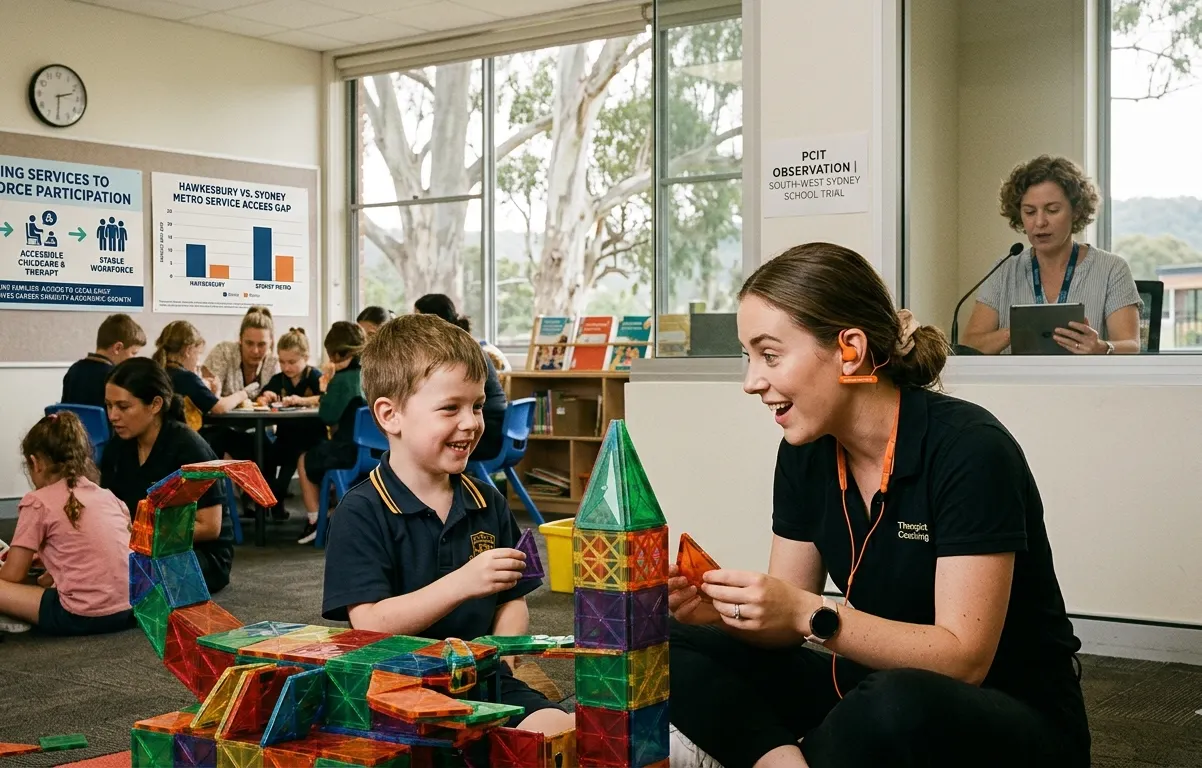
The program, known as Parent-Child Interaction Therapy (PCIT), is currently being delivered in south-western Sydney schools. It involves therapists coaching parents in real-time as they interact with their children in structured, monitored sessions.
Below is an extract from an article by the Sydney Morning Herald’s Kate Aubusson, published 12 April 2026:
A familiar sense of dread seized Erin Stevenson as she watched her six-year-old son, Micah, play happily with a giant scorpion they had built together from magnetic tiles in a brightly decorated playroom. For years, Micah had responded to his parents’ every mundane daily request with meltdowns, screaming, and yelling.
From putting on his shoes to leaving the house: “If it wasn’t Micah’s idea, he wouldn’t do it,” Stevenson said. “His emotions would get away from him, and he’d lash out physically... At times, we would have to sit him on our lap and immobilise him until it passed.”
So, when Stevenson told Micah he had to destroy his scorpion creation and pack it away, she braced for the "sting in the tail." It never came. Micah quietly did what Stevenson asked, and with tears welling in both their eyes, he climbed onto his mother’s lap for a hug. From behind the playroom’s one-way mirror, a therapist watched on, her voice guiding Stevenson through an earpiece.
“That’s the moment I knew what we were doing was effective,” Stevenson said.
Micah is one of 128 children and their families who have undergone this version of the "gold-standard" treatment for disruptive or aggressive behaviours. While the results have been significant—with nine in 10 families showing marked improvement—the model is not yet available in the Hawkesbury, where families face compounding pressures from limited childcare, service gaps, and long commutes.
When support isn’t local, work becomes harder
For many Hawkesbury parents, accessing behavioural support requires travelling outside the region, often during business hours. Combined with limited local childcare, this creates a precarious balancing act. Parents are frequently forced to reduce hours, take extended leave, or exit the workforce entirely. Without early support, even simple routines like the "school run" can become so overwhelming that consistent employment becomes impossible.
The hidden workforce issue
In regions like the Hawkesbury, workforce participation is inextricably tied to infrastructure—specifically childcare and family support. When these services are absent, the economic ripples are clear: household incomes drop, and local businesses struggle to retain staff. For working mothers in particular, the lack of accessible support can quietly stall career progression and long-term financial security.
Early intervention as economic infrastructure
The success of school-based programs highlights a shift in thinking: early intervention is an economic necessity, not just a healthcare goal. By providing local, accessible support, the community reduces long-term social costs and enables higher workforce participation.
As demand grows, the question remains: can models like PCIT be expanded into the Hawkesbury? For many local families, the issue isn't a lack of willingness to work—it’s a lack of the essential support systems required to make it possible.