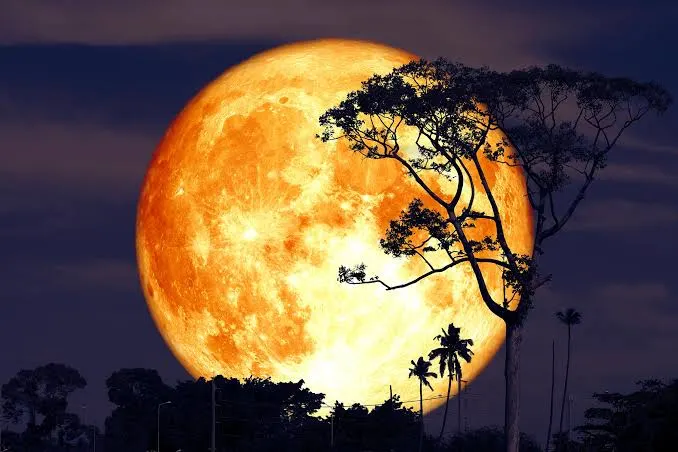
As the July full moon rises over the Hawkesbury tonight, many skywatchers will know it by its popular name the Buck Moon.
The full moon will rise over the eastern horizon at around 4:46pm on Wednesday, appearing almost full, before reaching its peak at 12:35am on Thursday, 30 July. If the weather cooperates, residents across the Hawkesbury will be treated to one of winter's most spectacular celestial displays.
The name "Buck Moon" originates from Indigenous peoples of North America and refers to the time of year when young male deer begin growing new antlers. It has become widely adopted through publications such as the Old Farmer's Almanac and is now commonly used around the world.
But for the Dharug people, the Traditional Custodians of much of the Hawkesbury, Western Sydney and the lower Blue Mountains, the Moon has long been understood in a very different way.
Rather than naming each month's full moon, Dharug people traditionally observed the Moon as part of a much larger calendar written in the landscape itself.
The phases of the Moon, the position of the stars, the flowering of plants, the behaviour of birds and animals, and changes in weather all worked together to signal the passing of the seasons and guide everyday life.
Reading Country
This time of year falls within the Dharug season known as Dagara, the cold and frosty season of winter.
Rather than being marked by dates on a calendar, Dagara is recognised by the signs that appear across Country.
Cold mornings bring heavy frosts to higher parts of the Hawkesbury, while the distinctive calls of the black cockatoo are traditionally understood as heralding approaching rain.
It is also a season of reflection, when people look to the wisdom of ancestors and continue observing the natural world as it prepares for spring.
For thousands of years these seasonal indicators helped guide when to travel, gather food, care for Country and prepare for changing weather.
More Than Just a Full Moon
Although many Australians now refer to July's full moon as the Buck Moon, the traditional Dharug understanding reminds us that the Moon was never viewed in isolation.
Instead, it formed one part of a sophisticated environmental knowledge system where every element of the landscape provided information.
The arrival of birds, flowering of native plants, movements of animals and changing weather patterns were all interconnected, creating a living calendar that enabled generations to live sustainably on Country.
Today that knowledge continues to be shared by Dharug Elders and cultural educators, offering a uniquely Australian perspective on the changing seasons.
Looking Up
Astronomers say this week's full moon will appear against the backdrop of the constellation Aquarius.
The best time to watch is shortly after moonrise when it first clears the eastern horizon and often takes on a golden or orange glow. The effect occurs because moonlight passes through a thicker layer of Earth's atmosphere before reaching our eyes.
The familiar illusion that makes the Moon appear much larger near the horizon is just that—an optical illusion created by the way our brains compare it with trees, hills and buildings.
For Hawkesbury residents, elevated locations such as Kurrajong Heights, Bilpin, Mount Tomah, Bowen Mountain and Mountain Lagoon offer some of the district's finest vantage points, while the Moon reflecting across the Hawkesbury River can also provide a memorable sight.
Whether you know it as the Buck Moon or simply the July full moon, this month's lunar display is also an opportunity to reflect on the much older traditions of the Dharug people, whose understanding of the night sky was always connected to the rhythms of Country rather than the pages of a calendar.
As winter begins its gradual transition towards spring, the Moon continues to remind us that nature has always been the first and most reliable timekeeper.