When Hawkesbury voters returned ten of their twelve councillors in 2024, they were buying experience. Two years later, that experience hasn't delivered. The council has raised rates without a plan to balance them, started projects it promised years ago but finished almost none, and spent much of its energy fighting its critics.
The first order of business in 2024 was electing a Mayor and Deputy Mayor for a two-year term. Cr Les Sheather took the mayoralty, his first time in either leadership role, with former Mayor Cr Sarah McMahon as his Deputy. Now, Cr Mary Lyons-Buckett, Mayor from 2016 to 2018, takes over, with Cr Nathan Zamprogno as Deputy. Cr Zamprogno, an experienced councillor, joins the leadership team for the first time. This is how I would grade the first half of the term, and the six tests I will use to grade the second.
The report card
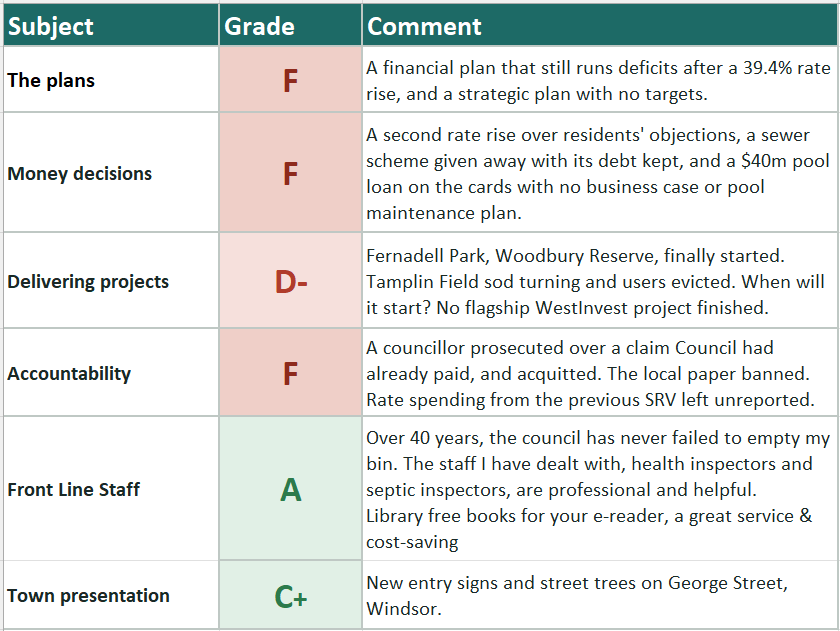
Grades run from A (excellent) to F (fail). They are my assessment, based on Council's own documents and the public record.
The plans don't add up
Council's Long Term Financial Plan 2026-2036 assumes the full 39.4% rate rise and still shows operating deficits of $6.5 million to $6.9 million per year from 2031/32. The plan itself warns that services may need to be cut anyway. Ratepayers were told the rate rise would put Council on a sustainable footing. According to Council's own numbers, it doesn't.
The Community Strategic Plan, Our Hawkesbury 2045, has the same weakness, just in a different form. Its economic section lists 13 indicators, including local jobs and the size of the local economy, but sets no targets for them. Penrith and The Hills both publish jobs and growth targets. By 2045, Hawkesbury residents will have no way to tell whether their plan worked.
The big money decisions went against ratepayers
This is the second special rate variation in less than ten years. The first, a 31.29% rise from 2018, was intended to address the infrastructure backlog. The backlog is larger now: 2.95% of asset value in 2024-25, compared with a 2% benchmark. Council's own survey found that 70% of residents preferred to keep the rate peg, and fewer than 5% of the 2,300 submissions supported the rise. Council applied anyway, and IPART approved the full increase in June 2026.
The Windsor Sewerage Scheme, including the McGraths Hill treatment plant, is being transferred to Sydney Water at no cost. Council wrote off $153 million in assets but retained the roughly $32 million debt stemming from the 2021 pipeline failure. Windsor sewer customers will repay that debt through a separate charge of $3,374.67 per property over ten years.
In April 2026, Council also committed in principle to borrowing about $40 million for the Richmond pool, before any business case was prepared. Repayments would be about $3.6 million per year for 20 years, exceeding the first year's income from the rate rise. Council is taking on optional debt while telling ratepayers it cannot afford to fix the roads.
Late starts, few finishes
Some long-promised projects have finally begun. Fernadell Park in Pitt Town broke ground in June 2025, 17 years after developers paid contributions in 2008. Work began at Woodbury Reserve, and Tamplin Field had its sod turned, both more than three years after WestInvest funding was announced in December 2022. At Tamplin, the synthetic track has been replaced with grass; the Hawkesbury Athletics Club has been moved off the ground to a field with no lights. Why not wait until daylight saving? Dog training has moved to Richmond Park. Of roughly $98 million in WestInvest grants, no flagship project is finished.
What has been completed is modest: a new parking lot at Colby Park, signs welcoming people to the Hawkesbury and thanking them as they leave, and street trees along George Street in Windsor. These are welcome, but they are small compared with what ratepayers were promised.
Council deserves credit in two areas. Flood recovery work on roads and bridges has continued throughout, with Council paying up front while awaiting state and federal reimbursement. Council also reports that its average development application assessment time fell from 175 days in July 2024 to under 70 days by late 2025. If that figure holds up under independent verification, local builders and families will be better off.
Council turned on its critics
In April 2025, Council paid Cr. Eddie Dogramaci's $4,109 equipment claim after recording its doubts in writing and after ICAC declined to investigate. Eight days later, Council officers met with police regarding the same claim. The fraud charge that followed was dismissed after a hearing at the Parramatta Local Court on 25 August 2026, resulting in a not-guilty verdict. Cr. Dogramaci was suspended from office while the case was running and says his defense cost him about $80,000. Council has not disclosed what the case cost the ratepayers.
Council also banned the Hawkesbury Gazette, which has covered this community since 1888, from attending its meetings and using its premises. The ban, signed by Mayor Sheather and the Acting General Manager, cites workplace health and safety.
Accountability for money has been no better. The departing General Manager is believed to have received approximately $340,000, plus roughly $200,000 in entitlements, weeks after a pay rise to $434,000. IPART found that Council never reported how it spent the proceeds from its previous SRV rate increase, even though the conditions of that increase required it to do so.
Six tests for 2028
The new leadership can change this. I will grade it at the end of the term based on six tests, each tied to a failure above.
1. Open the doors. Lift the Gazette ban and keep all Council meetings open to local media.
2. Account for the rate rise. Publish an annual, audited report showing how every dollar of the new increase was spent and what it built, starting with the report Council still owes on the 2022-23 increase.
3. Balance the books. Revise the Long-Term Financial Plan so it shows an operating surplus in every year, not just during the rate-rise phase-in.
4. Set targets. Provide a baseline and a target for every indicator in Our Hawkesbury 2045.
5. Plan for growth. Adopt an economic growth plan, as The Hills has, based on current data rather than the 2016 Census.
6. Finish what was started. Hand over Fernadell Park, Tamplin Field and Woodbury Reserve, and borrow nothing for the Richmond pool until a business case demonstrates the loan can be repaid.
I will report back on these six tests as the term draws to a close. The councillors are experienced. The next two years are their chance to prove it.
Sources
· Hawkesbury City Council: audited financial statements 2024-25; Long Term Financial Plan 2026-2036; Our Hawkesbury 2045; business papers, 14 April 2026 (Item 9.5.1).
· IPART, Hawkesbury City Council 2026-27 Special Variation, Final Report, June 2026.
· Penrith 2041+ Community Strategic Plan; The Hills Shire Economic Growth Plan (2023).
· NSW Online Registry, DPP v Dogramaci: Dismissed - Not Guilty after hearing, 25 August 2026.
· Hawkesbury Business Group media release on the Gazette ban, May 2026.