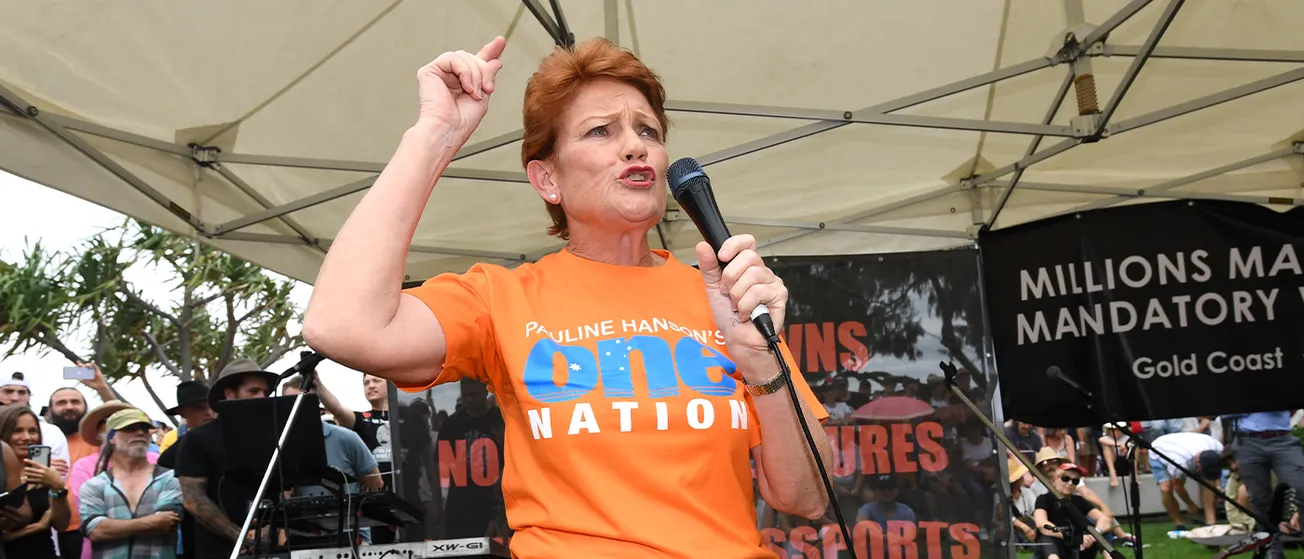
If recent polling is correct, Pauline Hanson's One Nation could be on the verge of its biggest breakthrough in nearly three decades winning both the State seat of Hawkesbury and the Federal seat of Macquarie. But before you start considering One Nation's vision for Australia, consider its past successes.
The Australian Financial Review recently published modelling suggesting One Nation could potentially win dozens of House of Representatives seats at the next federal election, with Macquarie among the electorates identified as vulnerable.
For supporters, it is an exciting prospect. For political historians, it raises a more difficult question. Can One Nation hold itself together long enough to benefit from its own success?
The party's electoral history suggests that may be a greater challenge than winning votes. According to analysis published by The Saturday Paper, prior to the 2025 federal and Western Australian elections, 37 people had served in federal and state parliaments under Pauline Hanson's banner. Twenty-seven of them failed to complete a single parliamentary term as members of One Nation.
That is a remarkable attrition rate. The pattern stretches back to One Nation's first major breakthrough in the Queensland Parliament in 1998, when 11 MPs were elected in what remains the party's greatest electoral success.
None remained in the party by the following election. Internal disputes, leadership conflicts, expulsions and resignations quickly tore the parliamentary team apart. Since then, similar stories have played out repeatedly across Australia.
In New South Wales, every parliamentarian who has served under the One Nation banner in the Legislative Council ultimately left the party before completing their term. Among them were former federal Labor leader Mark Latham, former Labor MP Tania Mihailuk and former One Nation MLC Rod Roberts.
By late 2024, One Nation had no parliamentary representation remaining in New South Wales despite voters having elected multiple members under its banner.
Western Australia tells a similar story. Five of the seven One Nation members elected to the state's upper house failed to complete their terms as members of the party.
South Australia, where One Nation recently recorded a stunning result, has already experienced similar instability in the past, with previous One Nation parliamentarians departing before completing their terms.
The recurring criticism from former members is remarkably consistent. Many describe a highly centralised structure built around Pauline Hanson and her inner circle, with disputes often ending in expulsions, resignations or defections.
Supporters argue that strong central control protects the party from factional takeovers. Critics argue it creates instability whenever elected members develop independent political ambitions. Whatever the explanation, the historical record is difficult to ignore.
For voters in Susan Templeman MP seat of Macquarie this presents a practical dilemma.
When people vote Labor, Liberal, National or Greens, they generally know that the person elected will remain a member of that party for most or all of their parliamentary term. With One Nation, history suggests that assumption cannot always be made.
The question becomes not simply whether voters support the party's policies, but whether they can be confident that the candidate they elect will still represent that party several years later. That issue is particularly relevant in Macquarie.
At the 2025 election, One Nation candidate Matthew Jacobson secured approximately 8.7 per cent of the primary vote, an improvement on previous performances but still well behind Labor and Liberal candidates.
Mr Jacobson remains relatively unknown to many voters compared with established local political figures. While One Nation's vote may continue to grow as dissatisfaction with the major parties increases, building a durable political organisation requires much more than attracting protest votes. It requires local branches, volunteers, fundraising networks, candidate recruitment, policy development and internal discipline.
History shows that political movements rarely jump directly from fringe status to becoming the Official Opposition. Even the Australian Labor Party, our oldest political party, spent years building support before achieving government.
The challenge facing One Nation is therefore twofold. First, it must convince voters to support it. Second, and perhaps more importantly, it must demonstrate that it can hold together the people those voters elect.
The next NSW election may provide an important test.
Polling can measure frustration. Winning elections measures organisation. Surviving success measures something harder still. For One Nation, that may prove the biggest challenge of all.
You could run this as a boxed sidebar accompanying the main analysis piece:
SIDEBAR: Who has One Nation run in Macquarie?
Matthew Jacobson (2025)
One Nation's most recent candidate in Macquarie was Matthew Jacobson, who secured 9,587 first preference votes, representing 8.74 per cent of the electorate at the 2025 Federal Election. This was an increase of 3.56 percentage points on the party's 2022 result.
Jacobson described himself during the campaign as a recently retired Australian soldier, former school principal and business owner. Originally from the United States, he migrated to Australia more than 30 years ago and became an Australian citizen.
His campaign attracted some attention in the Blue Mountains following a dispute over election signage with the Blue Mountains City Council.
Despite the improvement in One Nation's vote, Jacobson remained well behind Labor's Susan Templeman and Liberal candidate Mike Creed.
Tony Pettitt (2022)
At the 2022 Federal Election, One Nation's candidate was Tony Pettitt.
Pettitt received 4,955 first preference votes, or 5.19 per cent of the electorate. )
Public information about Pettitt was limited during the campaign. Contemporary election guides noted that he had not publicly announced his candidacy before nominations closed and had maintained a relatively low public profile.
In 2025, One Nation itself referred to Pettitt as a "ghost candidate" and noted that he reportedly resided in Tasmania rather than the Macquarie electorate.
How Does One Nation Select Candidates?
Unlike the major parties, which generally use local branch votes and delegate conferences to choose candidates, One Nation operates under a highly centralised structure.
Candidate applications are submitted through the party organisation and are subject to approval by the party's executive. The party constitution gives significant authority to the national leadership, including founder Pauline Hanson, over candidate endorsement and party administration.
Supporters argue this prevents factional takeovers and ensures candidates align with party values. Critics, including a number of former One Nation MPs and MLCs, argue the process concentrates too much power in the hands of the party leadership and contributes to the high number of parliamentary defections and resignations that have characterised the party's history.
The question for Macquarie voters is not simply who One Nation selects next, but whether that candidate remains part of the party if elected.
History suggests that is not always guaranteed.