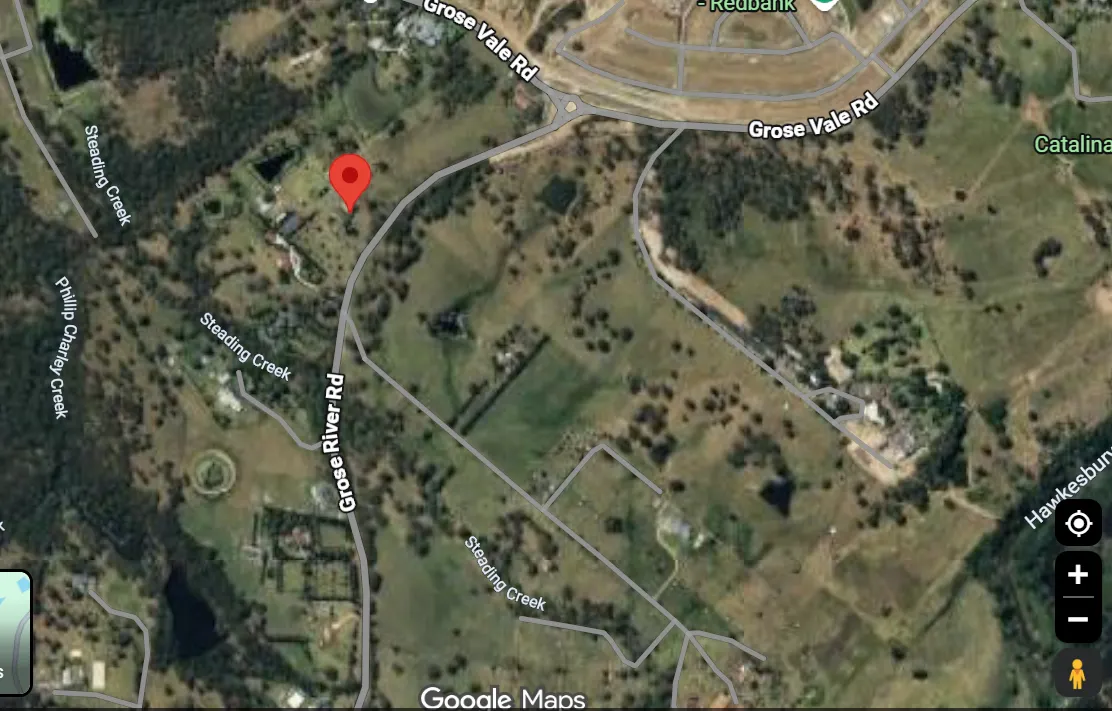
A Sydney family is asking the NSW Government to support the transformation of a former thoroughbred horse stud at Grose Wold into a new residential community containing as many as 735 homes.
The Kavanagh family, working with property developer Seed Projects, has submitted a planning proposal covering the historic Belmont Park property Grose River Road Grose Wold.
The approximately 121-hectare property sits on the western side of the Hawkesbury River and was once part of the Australian thoroughbred-breeding interests of Dubai ruler Sheikh Mohammed bin Rashid Al Maktoum.
According to property records reported by the Daily Telegraph, the Kavanagh family purchased Belmont Park from the Sheikh’s racing interests for $12.28 million in November 2015.
The Sheikh’s company had acquired the property in 2008 as part of a series of purchases from interests associated with billionaire racehorse owner and breeder Bob Ingham.
Now, the expansive horse property could become one of the largest new residential developments proposed outside the Hawkesbury’s established urban centres.
Hundreds of houses, townhouses and apartments
The current Belmont Park Estate concept proposes a mix of 443 freestanding houses, 232 medium-density townhouses and 60 apartments.
Together, they would provide a maximum of 735 dwellings.
The plans also contemplate a central neighbourhood hub containing retail and community facilities. This could include local shops, a café, restaurant and service-based businesses intended to serve the new residents.
A series of one-hectare “production” or agricultural small lots has also been proposed.
Historic farm buildings dating from about 1896 would reportedly be retained and adapted for artisan food-and-drink businesses, potentially connecting the residential development with the Hawkesbury’s agricultural and tourism industries.
The proponents say Belmont Park presents an opportunity to provide housing for the next generation of Hawkesbury residents, including the children and grandchildren of existing families, first-home buyers and essential workers.
They have described the concept as a flood-resilient, comparatively affordable and well-designed community.
However, it remains unclear whether any of the proposed homes would be formally designated and protected as affordable housing, or whether “affordable” is being used more generally to describe the intended price of the homes.
Planning panel finds insufficient strategic merit
The proposal has not been approved.
The Hawkesbury Local Planning Panel considered the latest proposal on June 18, 2026, but did not support it proceeding.
The panel’s central concern was whether the proposal possessed sufficient “strategic merit”.
That test goes well beyond whether houses can physically be constructed on the property.
It asks whether Grose Wold is an appropriate location for urban-scale residential expansion and whether the proposal is consistent with state and local planning strategies.
Relevant considerations include the Hawkesbury Local Strategic Planning Statement, Council’s housing strategy, metropolitan and district planning policies, the land’s rural zoning and the effect of such a development on Grose Wold’s rural landscape and character.
Road capacity, public transport, sewerage, drinking water, schools, health services, bushfire risk, biodiversity and the cumulative impact of hundreds of additional homes must also be considered.
Flooding and evacuation capacity are likely to attract particularly close attention.
The proponents argue that the proposed residential areas are on elevated land that is not impeded by flooding, despite the property adjoining the Hawkesbury River.
However, establishing that homes would not themselves be inundated is different from demonstrating that hundreds of households could safely evacuate through the wider Hawkesbury road network during a major regional flood.
The development could potentially accommodate well over 1,500 people, depending on household sizes. This would place additional demand on roads and services beyond the boundaries of Belmont Park itself.
State Government review sought
Following the local planning panel’s decision, Seed Projects lodged a rezoning review with the NSW Government.
The review application was reportedly made on the basis that Hawkesbury City Council had not indicated its support for the proposal within 90 days of its submission.
A rezoning review is a mechanism available under the NSW planning system when a council does not support a planning proposal or has not decided whether to support it within the prescribed period.
It allows a proponent to ask state planning authorities to independently consider whether the proposal has sufficient strategic and site-specific merit to proceed.
Despite suggestions that the developers have “bypassed” Council, the review is part of the formal NSW planning process.
It does not mean that the State Government has approved 735 homes at Belmont Park.
The Department of Planning will first assess whether the proposal demonstrates sufficient strategic merit. If the review is unsuccessful, the rezoning proposal may go no further.
If the State supports the review, the proposal could advance to the gateway assessment process. That would ordinarily require further technical investigations and consultation before a final decision was made about changing the land’s planning controls.
Any eventual rezoning would not amount to approval to begin construction.
The developer would need to submit one or more development applications addressing subdivision design, roads, drainage, environmental impacts, servicing, bushfire protection, heritage, public facilities and other detailed matters.
Earlier proposal withdrawn
This is not the first attempt to secure residential development at Belmont Park.
Council records show an earlier planning proposal, identified as LEP001/24, was listed for consideration at Hawkesbury City Council’s meeting on June 11, 2024.
That proposal covered the same Grose River Road properties but was withdrawn before Council determined it.
Earlier public reporting referred to a development containing approximately 899 homes. The current concept has apparently been revised and reduced to a maximum of 735 dwellings.
The proponents may argue that the reduction and redesign respond to concerns raised about the earlier proposal.
Opponents are likely to argue that the fundamental strategic question remains unchanged: whether a large new residential settlement should be established on rural land outside the Hawkesbury’s existing towns and urban-release areas.
Housing supply versus strategic planning
The proposal arrives as the NSW Government continues to place pressure on councils to facilitate more housing.
The proponents say Belmont Park could help house first-home buyers, essential workers and younger residents who might otherwise be priced out of the Hawkesbury.
The strategic planning question, however, is not simply whether the Hawkesbury needs more homes. It is whether hundreds of homes should be concentrated at this particular location and whether the necessary roads, evacuation routes, public transport and community infrastructure can be provided.
The State Government will also need to consider whether approving the rezoning could establish a precedent for further urban development on rural properties west of the Hawkesbury River.
Among the questions yet to be publicly answered are:
- Which roads would be used by Belmont Park residents during a major Hawkesbury-Nepean flood evacuation?
- What effect would the development have on Grose River Road and surrounding intersections?
- How would sewerage, drinking water and stormwater infrastructure be delivered?
- Who would pay for necessary road and community infrastructure upgrades?
- What public transport would be available to residents?
- What additional demand would be placed on local schools, health services and emergency services?
- Would any homes be secured as affordable housing through enforceable planning conditions?
- What biodiversity, Aboriginal cultural heritage and European heritage investigations have been completed?
- What agricultural purpose would the proposed one-hectare production lots serve?
- What infrastructure contributions or planning agreement has been offered by the landowners?
- Would Council remain the planning authority if the rezoning review succeeds?
The Department of Planning’s determination of the rezoning review will decide whether the proposal has enough merit to move to the next stage.