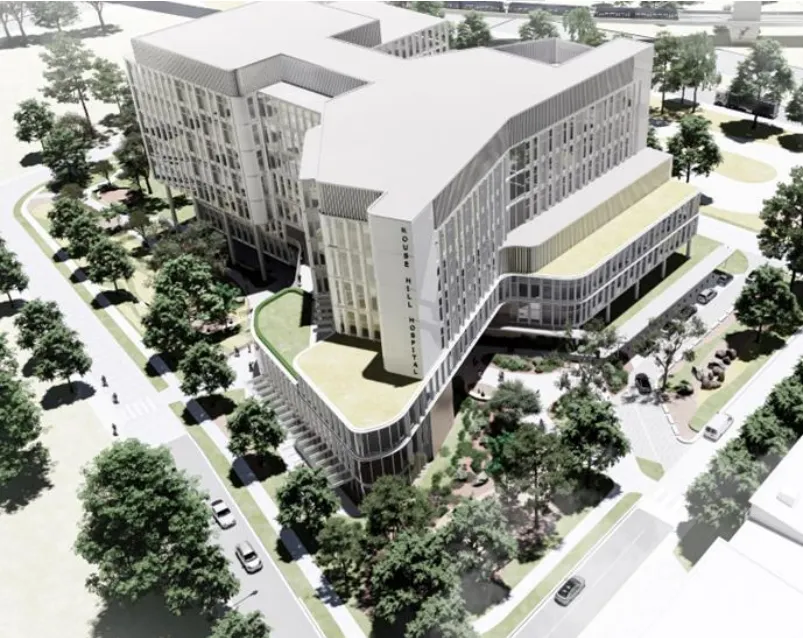
The construction of the new $910 million Rouse Hill Hospital has officially moved into its major works phase, signalling a transformation in healthcare delivery for the booming North West and Hawkesbury regions. The delivery of this hospital is a major milestone for the community, which was promised three times by the former Liberal National Government but never delivered.
Funding for the hospital includes a $120 million contribution from the Commonwealth Government. The rest — $790 million — comes from the NSW State Government.
The project didn't start at $910 million. The NSW Government originally announced a $700 million investment in the project, describing it as the first major public hospital built in western Sydney in more than 40 years. The total then grew when maternity services were added. The Federal Government committed $120 million towards birthing services, followed by an additional $90 million from the Minns Labor Government to fund birthing rooms, a maternity inpatient unit and additional staffing areas — bringing the total to $910 million.
As ground breaks on the project, the facility is being hailed by the NSW Government as a cornerstone of the state’s medical future, promising to deliver a "smart hospital" equipped with an emergency department, maternity services, and comprehensive pediatric zones. However, as the multi-storey structure begins to take shape near the Rouse Hill Town Centre, the excitement is being tempered by significant concerns regarding regional infrastructure and the sheer scale of the population it is intended to serve.
For families in the Hills and Hawkesbury, the hospital’s primary appeal lies in the reduction of critical travel times. Currently, residents are often forced to endure long commutes to Nepean, Blacktown, or Westmead Hospitals during medical emergencies.
Member for Castle Hill, Mark Hodges MP, has been a vocal proponent of the project, advocating that the construction of the hospital is a vital necessity, emphasising that as the population continues to grow, healthcare services must keep pace to ensure residents can access world-class care on their doorstep.
Mr Hodges MP stated:
"The delivery of this hospital is vital for our community. We need to ensure that as our population grows, our healthcare services keep pace so that residents can access world-class care right on their doorstep." (Source: Official Community Update/NSW Parliament Hansard)
This sentiment is echoed across the neighbouring Hawkesbury, where the facility is expected to provide essential relief for a community that has long felt the pressure of geographical isolation from major medical hubs.
Member for Riverstone Warren Kirby:
"This is a huge moment for our community. People here have backed this hospital for years, and now we can finally see it becoming a reality."
"It means mums don't have to travel across Sydney to give birth, and families can get emergency care close to where they live." (17 February 2026)
Yet, the project is not without its detractors, who argue that the hospital’s arrival may exacerbate existing regional strains. Member for Hawkesbury, Robyn Preston MP, has been a leading voice in highlighting the potential for a "perfect storm" of logistical issues. While welcoming the addition of the facility, Ms Preston has warned that the project must be supported by significant road infrastructure upgrades to be truly effective.
Robyn Preston MP, Member for Hawkesbury, noted the strategic importance while highlighting the need for connectivity:
"A new hospital at Rouse Hill is a welcome addition for the region, but it must be supported by the road infrastructure to get people there. Our Hawkesbury residents shouldn't be trapped in gridlock when trying to access emergency care at this new site." (Source: Robyn Preston MP Newsroom/Community Feedback Sessions)
She noted that Hawkesbury residents should not face a traffic blockade when attempting to access emergency care, pointing to the already heavily congested Windsor Road corridor as a primary concern. The Hills Shire Council has also raised questions regarding whether the hospital’s initial bed capacity will be sufficient to meet the needs of the 300,000 people expected to reside in the catchment area by the end of the decade.
Residents and road users are already frustrated over traffic congestion on Windsor Road and Old Windsor Road through Rouse Hill, with a Hills Shire Council study finding average peak hour speeds have dropped to just 21.8km/h — ten per cent slower than a year ago. While the Australian and NSW Governments have committed $220 million to widen Windsor Road at Rouse Hill, including dedicated bus lanes and intersection upgrades, the project remains in early design stages with no construction timeline confirmed. A further $20 million has been set aside for a planning study on Old Windsor Road - but again, no construction funding has followed.
Hills Shire Mayor Dr Michelle Byrne says the traffic situation will only worsen:
"What's it going to be like when more than 11,000 apartments are built between Kellyville and Bella Vista station?" she said. "What's it going to be like when Rouse Hill Hospital is built? It is absurd in the extreme that it takes longer to get from Gables to Norwest in the morning than it does to get from Mosman to Norwest in the same period."
As the NSW Government pushes forward with the build, the success of the Rouse Hill Hospital will likely be measured not just by the quality of its clinical care, but by how well the surrounding infrastructure can handle the weight of a rapidly changing landscape.
Beyond the immediate healthcare benefits, the construction of the Hospital is expected to provide a substantial economic boost, creating thousands of jobs during the build and establishing a permanent medical workforce in the region. However, local residents living on the hospital’s fringe have expressed anxieties over the shift from a semi-rural landscape to a high-density medical precinct. Concerns regarding increased ambulance noise, helicopter flight paths, and the loss of local green space have featured prominently in community feedback.
For those in the Hawkesbury, the benefits are two-fold. It offers a closer alternative to Nepean Hospital for residents in the North Richmond and Oakville corridors. However, local representatives have raised concerns that the new hospital must not result in a "downgrade" or neglect of the existing Hawkesbury District Health Service.