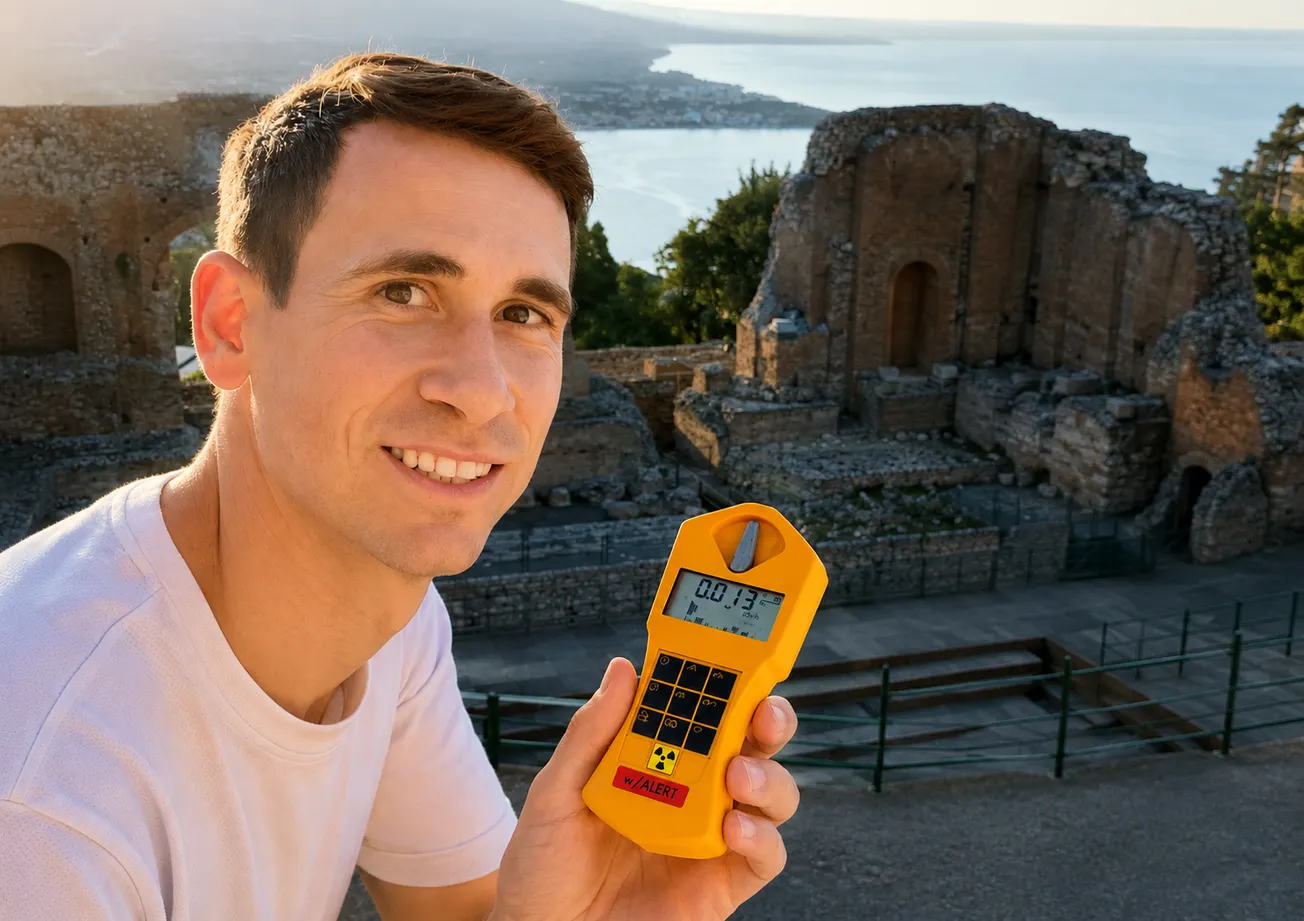
It is National Science Week, and for Hawkesbury self-described nerd Jeff Ferrara, that was apparently all the excuse he needed to buy a handheld radiation detector.
Jeff has been checking readings at different locations around the Hawkesbury, waiting for the detector to beep and reveal something interesting.
So far, however, his most notable discovery has not been an abandoned mine, an unusual rock formation or a mysterious radioactive site.
It has been a red brick wall.
Scientifically speaking, that is not especially surprising.
The Australian Radiation Protection and Nuclear Safety Agency says naturally occurring radioactive materials, including uranium, thorium and potassium-40, are present in rocks and soil. Small measurable amounts can therefore also occur in ordinary building materials.
Masonry buildings made from materials such as brick, cement and concrete can produce slightly higher background readings than timber buildings. ARPANSA says the resulting radiation doses are small and are not considered a health concern.
Jeff’s brick wall may not need evacuation tape, but it has provided a useful National Science Week lesson.
Gamma rays are a form of electromagnetic radiation, in the same broad family as visible light, radio waves and X-rays. They have far more energy than visible light or radio waves and can penetrate deeply into matter. Strong gamma sources therefore require substantial shielding, such as thick concrete or lead.
Radiation, however, is not confined to nuclear reactors or science-fiction movies. It is around us all the time.
Australians are continuously exposed to natural background radiation from rocks and soil, cosmic radiation from space, radon and naturally occurring radioactive elements in food, water and everyday materials. ARPANSA estimates that Australians receive an average dose of about 1.7 millisieverts each year from natural sources.
University of Sydney researchers have also produced Sydney’s first detailed ground-based map of natural gamma radiation. Published in 2026, the study used portable gamma-ray spectrometers across parts of metropolitan Sydney and found that radiation patterns largely followed the underlying geology. The levels recorded were within normal natural-background ranges.
For Jeff, though, National Science Week is less about dose calculations and more about curiosity.
That interest began early. As a teenager, he wrote computer code to help his father’s car-alarm business. What started with code and alarms developed into a lifelong enthusiasm for technology, gadgets and solving problems.
Jeff is now a father of two young children, whom he affectionately describes as the next generation of nerds.
His detector has added another sound to the household collection of rattles, bells and musical toys:
Beep … beep … beep.
Children learn curiosity partly by watching adults being curious. A parent who stops to ask why a brick wall produces a higher detector reading is demonstrating something at the heart of science: notice the unexpected, ask a question, investigate and try to understand the answer.
Jeff’s children may not yet appreciate potassium-40, uranium decay chains or background gamma radiation. But they are growing up seeing that discovering how the world works can be fun.
Jeff’s informal Hawkesbury radiation survey is continuing.
For now, the red brick wall holds the record. But the rest of the Hawkesbury region is still waiting to be tested.