When Hawkesbury City Council sought approval for a cumulative 39.41 per cent increase in rates over four years, the public debate largely focused on roads, infrastructure backlogs and the impact on household budgets.
But according to an independent review commissioned by the Hawkesbury Gazette, another significant cost facing some residents may have received far less attention during the process.
The issue is the Hawkesbury Sewerage Scheme.
Retired IBM Senior Consultant and business analyst Bob Gribbin argues that IPART's assessment did not fully examine the combined financial impact of the Special Rate Variation and sewer-related charges, potentially understating the total burden facing affected households.
More Than Just Rates
For many residents, rates are only one component of their annual council bill.
Properties connected to, or expected to connect to, sewer infrastructure may also face sewer service charges and infrastructure contributions.
While the Special Rate Variation attracted considerable public attention, Mr Gribbin argues that the cumulative impact of multiple council charges was not modelled in a way that clearly demonstrated the financial consequences for individual communities.
His report suggests that residents in areas affected by sewer expansion projects could experience significantly greater increases in overall council-related costs than the Special Rate Variation figures alone suggest.
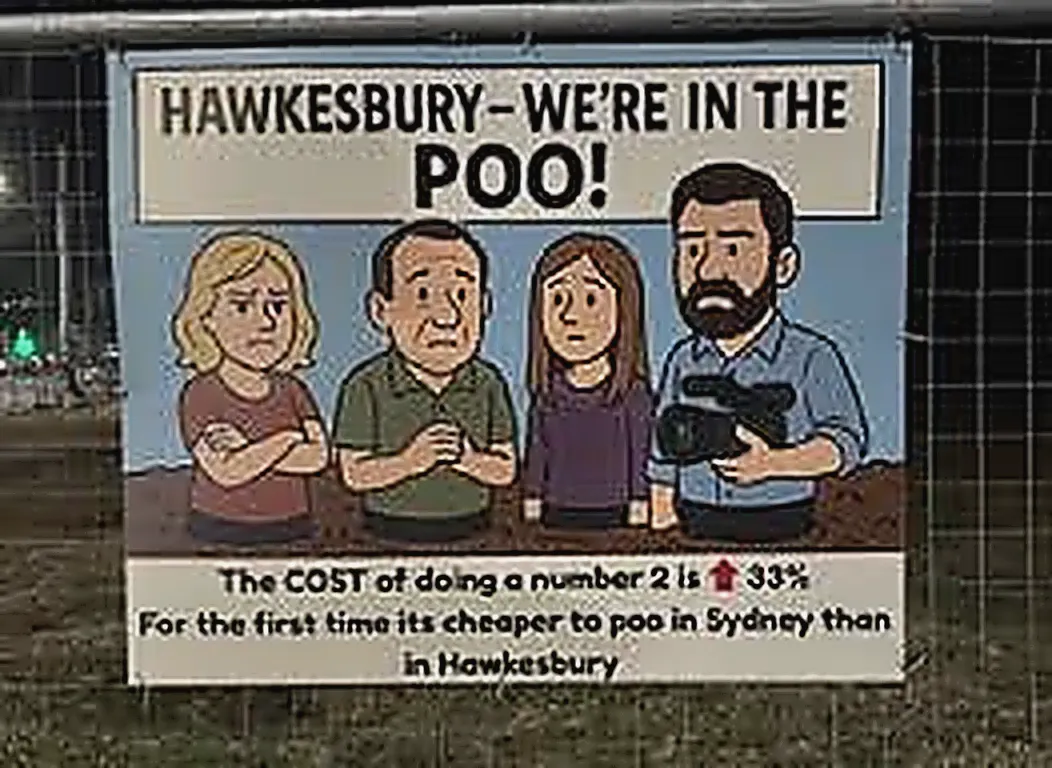
Hawkesbury Council accumulated a debt of $20million while fixing a cracked sewage pipe. The debt appears to be the result of council entering into a "do and charge contract" and then engaging in a failed Supreme Court action regarding this contract.
This debt is being serviced by approximatley 8,500 ratepayer in the Windsor Sewage Scheme catchment where they must pay an annual infrastructure charge of $344.84 to repay historical borrowing associated with the scheme, while ownership and operation of the network passes to Sydney Water.
The Capacity-to-Pay Question
One matter IPART considers when assessing any Special Rate Variation is residents' capacity to absorb additional costs.
The Tribunal examines household income data, pensioner populations, socio-economic indicators and the potential financial impact on the community.
However, Mr Gribbin argues that broad averages may not fully capture the experience of households facing multiple increases from different council charging mechanisms.
A pensioner in one suburb may experience only the rate increase.
A resident in another area may face rate increases, sewer charges and infrastructure contributions simultaneously.
The question raised by the report is whether these cumulative impacts were sufficiently visible within the assessment process.
Infrastructure Comes at a Cost
Few dispute that sewer infrastructure is important.
Reliable sewer services improve public health and environmental outcomes, and support future development.
The challenge lies in determining how those costs are distributed and whether residents fully understand the financial implications.
As infrastructure networks expand, the associated costs can extend well beyond the initial construction phase through ongoing maintenance, operation and renewal requirements.
Those costs ultimately fall on existing users, future users or ratepayers generally.
The Bigger Debate
The broader issue raised by the report is not whether sewer infrastructure should be provided.
It is whether the full financial picture is presented when major funding decisions are made.
When residents hear that rates will increase by 39.41 per cent over four years, many naturally assume that figure represents the total impact of Council's funding strategy.
Mr Gribbin's review suggests the reality may be more complex, particularly for communities affected by sewer infrastructure projects.
The report asks whether future Special Rate Variation assessments should include more detailed modelling of the combined effect of rates, sewer charges and other council fees on different categories of households.
Questions for IPART
The Hawkesbury Gazette has asked IPART:
- Did the assessment consider the combined impact of Special Rate Variations and sewer-related charges on affected households?
- Were suburb-level or community-level impacts modelled?
- How does IPART assess capacity to pay where residents face multiple council charges beyond ordinary rates?
- Should future assessments provide a clearer picture of the total financial impact of council funding strategies on households?
As Hawkesbury embarks on another period of significant rate increases, the debate may not simply be about roads, infrastructure and financial sustainability.
It may also be about whether residents are shown the complete picture of what those improvements will ultimately cost.
Download the Report
The Hawkesbury Gazette commissioned retired IBM Senior Consultant and Hawkesbury ratepayer Bob Gribbin to undertake an independent review of IPART's determination.His report, Matters Raised in My Submission That IPART's Final Report Did Not Address, is available for download from the Hawkesbury Gazette website and provides a detailed analysis of issues he believes warrant further public discussion.
Mr Gribbin spent decades in senior consulting, governance and systems analysis roles with IBM, assessing organisational performance, financial systems and business transformation projects.
His report, Matters Raised in My Submission That IPART's Final Report Did Not Address, is available for download from the Hawkesbury Gazette website.
Readers are encouraged to review the report and draw their own conclusions regarding the figures, assumptions and reasoning underpinning the Special Rate Variation approval.
Readers are encouraged to review the report and draw their own conclusions regarding the assumptions, forecasts and accountability measures underpinning Hawkesbury's Special Rate Variation.
Related stories
Did IPART ask the right questions before approving the Council rate rise?
Can Council be trusted with more money?
Cost of Council staff payrise Outpace 39.41% Rate Increase.
Can Ratepayers Trust the Numbers?
Did IPART Get Its Maths Wrong?