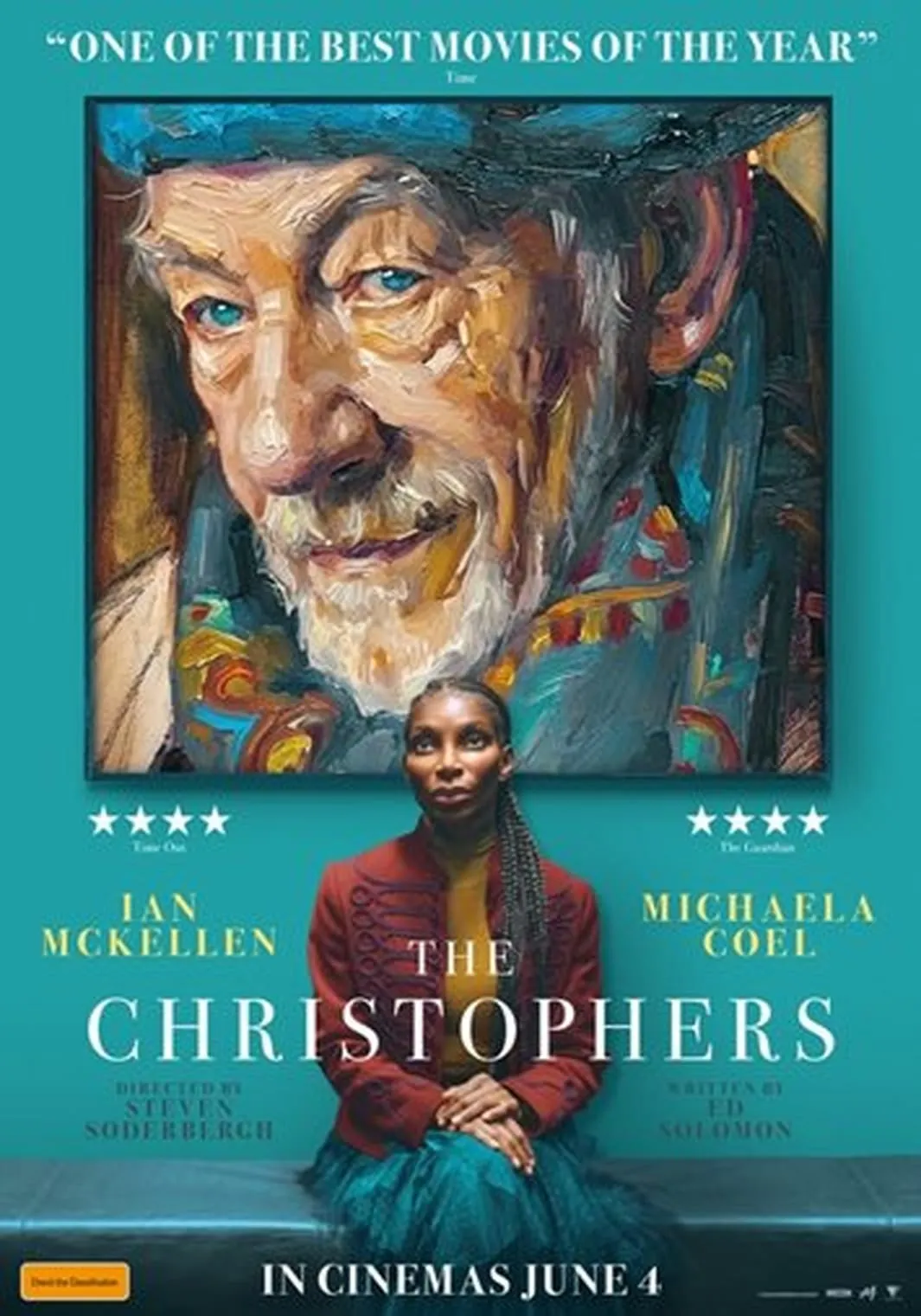
There's a particular pleasure in watching a film that keeps you pleasantly off-balance, one that appears to be one thing before quietly, confidently becoming something else entirely. Steven Soderbergh's The Christophers is exactly that kind of film: just when you think you have a handle on where it's going, it pivots in another, altogether surprising direction. It is, in the best possible way, a film that refuses to be summarised at a dinner party.
The premise is darkly comic: the estranged children of a once-famous painter hire a skilled art forger to secretly complete his unfinished works, setting off a tense and unexpected collision between deception, legacy, and artistic truth. Julian Sklar - played with magnificent, weathered eccentricity by Ian McKellen - is an elderly London-based painter whose reputation has faded as he has aged. In the 1990s, he produced two celebrated series of paintings. A third series has sat incomplete for years. His adult children, played by James Corden and Jessica Gunning, see an opportunity. They hire Lori, an art restorer and former forger played by Michaela Coel, to pose as a prospective assistant in order to access the unfinished canvases they believe will make for a worthwhile inheritance.
It sounds like an Ocean's film set in the art world. It is not. Or rather, it starts as one, before the architecture shifts beneath your feet. Like Soderbergh's underrated No Sudden Move (2021), The Christophers begins with an elaborate scheme but gradually unfolds into a narrative about something far more than mere theft.
What makes the film soar is the central dynamic between McKellen and Coel. Their scenes together possess a quiet electricity, the kind that only emerges when two performers of rare calibre are given material worthy of them. Deadline has called it "an unusually emotional film for Soderbergh," and McKellen and Coel's tête-à-tête makes for a quintessentially funny and engrossing centrepiece. Coel, in particular, is extraordinary sharp, guarded, and then, in the film's later passages, disarmingly tender. McKellen reminds us, once again, that he is simply one of the finest screen actors alive.
The film feels like Soderbergh's most personal work in years, exploring the art of being someone else, a theme that describes both Lori and Julian, and perhaps Soderbergh himself, who continues to resist categorisation across a filmography of remarkable range. He shoots under his customary pseudonyms (Peter Andrews as cinematographer, Mary Ann Bernard as editor), maintaining his characteristic formal precision while allowing more warmth than usual to seep through the frame.
Corden and Gunning are reliably entertaining as the scheming siblings, mercenary and faintly ridiculous, though the film wisely keeps them as foils rather than protagonists. This is, at its heart, a two-hander about art, identity, and what it means to truly see another person's work.
Slight? Occasionally. Perfect? Nearly. The Christophers is the rare film that earns its ending, a graceful, unhurried conclusion that lands with the quiet force of something true.