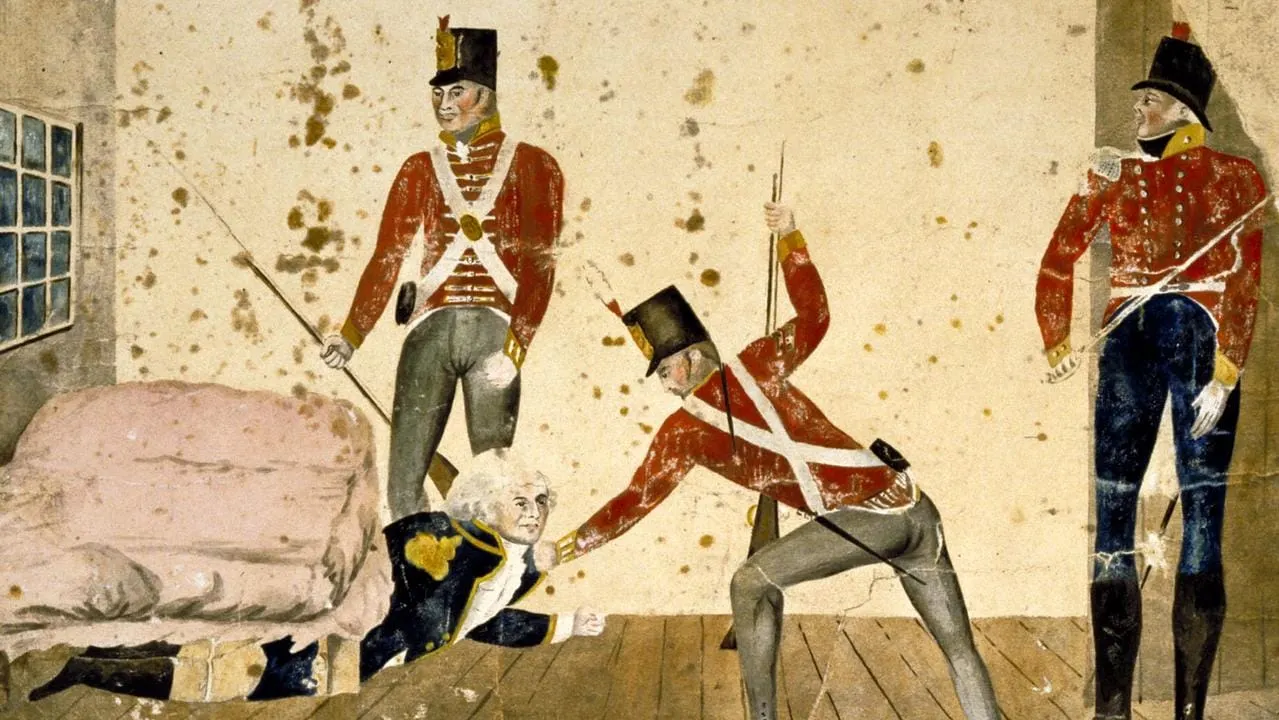
When people think of the Rum Rebellion, they often picture the dramatic arrest of Governor William Bligh in Sydney in 1808. Yet few realise that some of the strongest resistance to the rebellion occurred not in Sydney, but right here in the Hawkesbury.
The story of the Rum Corps and the Hawkesbury is one of power, politics, farming and survival. It is also a reminder that from the earliest days of European settlement, the Hawkesbury was far more than a quiet farming district. It was one of the most important regions in the colony and played a crucial role in shaping Australia's early history.
Feeding a Colony
By the early 1790s, the fledgling colony at Sydney Cove was struggling. Crops repeatedly failed, supplies from Britain were unreliable, and starvation was a genuine threat.
Everything changed when settlers discovered the rich alluvial soils along the Hawkesbury River.
In 1794, Lieutenant-Governor Francis Grose began issuing land grants to settlers along the fertile river flats. Many of the recipients were emancipated convicts seeking a new start. Others were soldiers and officers connected to the New South Wales Corps.
Within a few years, the Hawkesbury had become known as the "Granary of the Colony", producing wheat, maize and vegetables that helped sustain Sydney and Parramatta.
Without the Hawkesbury, historians believe the colony may not have survived.
Enter the Rum Corps
The New South Wales Corps had arrived in the colony in 1790 to replace the Marines.
Over time, its officers became enormously powerful. Because official currency was scarce, rum became a common medium of exchange throughout the colony. Officers of the Corps controlled much of the import and distribution of alcohol and quickly became wealthy through trade, land ownership and access to convict labour.
The Corps soon became known throughout the colony as the "Rum Corps".
Many settlers resented their growing influence.
The Corps' officers acquired large landholdings and became deeply involved in commerce, often exercising influence that extended well beyond military affairs.
The Hawkesbury became one of the regions where that influence was most visible.
A District of Independent Farmers
Unlike Sydney, the Hawkesbury was dominated by small landholders and farming families.
Many settlers had earned their freedom after serving sentences and were determined to build independent lives.
As a result, the district developed a strong culture of self-reliance and suspicion toward wealthy elites and powerful officials.
This independence would become important when political tensions within the colony exploded.
The Rum Rebellion
In January 1808, officers of the New South Wales Corps arrested Governor William Bligh and effectively seized control of the colony.
The event became known as the Rum Rebellion and remains the only successful military coup in Australian history.
While the rebellion was orchestrated in Sydney, support for the coup was far from universal.
Many Hawkesbury settlers viewed the rebellion with concern.
Historical records show that numerous farmers and local residents remained loyal to Bligh and opposed the growing power of the Corps.
Petitions supporting the Governor circulated through the district, and the Hawkesbury became one of the most significant centres of resistance to the rebel administration.
For many local farmers, the conflict was not simply about personalities. It was about who controlled the future of the colony.
Conflict and Frontier Expansion
The Rum Corps also played a significant role in another defining chapter of Hawkesbury history.
As European settlement expanded along the river system, traditional lands of the Dharug people were occupied by farms and settlements.
The resulting conflict became known as the Hawkesbury-Nepean Wars, one of the most significant theatres of Australia's Frontier Wars.
The New South Wales Corps was repeatedly deployed to the district as violence escalated between settlers and Aboriginal communities resisting dispossession.
These events remain an important and often difficult part of the Hawkesbury's shared history.
A Legacy That Remains
Today, traces of this extraordinary period remain visible throughout the district.
The farms first established during the 1790s helped create an agricultural tradition that continues more than 230 years later.
Many roads, townships and historic buildings throughout Windsor, Richmond, Pitt Town and Wilberforce can trace their origins back to the era when the Hawkesbury was feeding the colony and shaping its political future.
The story of the Rum Corps is often told as a Sydney story, centred on governors, military officers and political intrigue.
But the Hawkesbury's role was just as important.
It was here that ordinary settlers demonstrated their independence. It was here that some of the colony's earliest farmers challenged powerful interests. And it was here that one of Australia's first rural communities helped determine the course of colonial history.
The Hawkesbury was not merely a witness to the colony's formative years. It was one of the places where Australia's future was fought over, cultivated and ultimately forged.
You could add the following section near the end of the story:
A Living Reminder in Windsor
One of the most visible reminders of the Rum Corps' connection to the Hawkesbury can still be found in Windsor today.
The building now operating as the historic Crowne Plaza Hawkesbury Valley hotel occupies the site of the former Hawkesbury Agricultural College and includes a replica of the original New South Wales Corps barracks. The replica was constructed as part of the site's redevelopment and serves as a reminder of the military presence that once helped shape the early colony.
Many visitors are unaware that the elegant colonial-style building and grounds reflect a period when military officers of the New South Wales Corps wielded enormous influence over the colony's economy, land ownership and governance.
Located only a short distance from some of the earliest Hawkesbury settlements, the barracks replica provides a tangible link to the era of the Rum Corps, the Rum Rebellion and the formative years of European settlement in the district.
For history enthusiasts, it offers a fascinating reminder that the stories of the Rum Corps are not confined to Sydney. Some of the most significant chapters of that history unfolded along the banks of the Hawkesbury River, where settlers, soldiers and governors all competed to shape the future of the young colony.
Further information podcast: How did rum play a role in the early years of the colony of NSW https://www.abc.net.au/listen/programs/nightlife/rum/102054702