NEWS & ANALYSIS
Lawyers acting for Hawkesbury Gazette publisher Kooryn Sheaves and the newspaper wrote to Hawkesbury City Council requesting withdrawal of its five-month-old exclusion notice or face possible NSW Supreme Court proceedings.
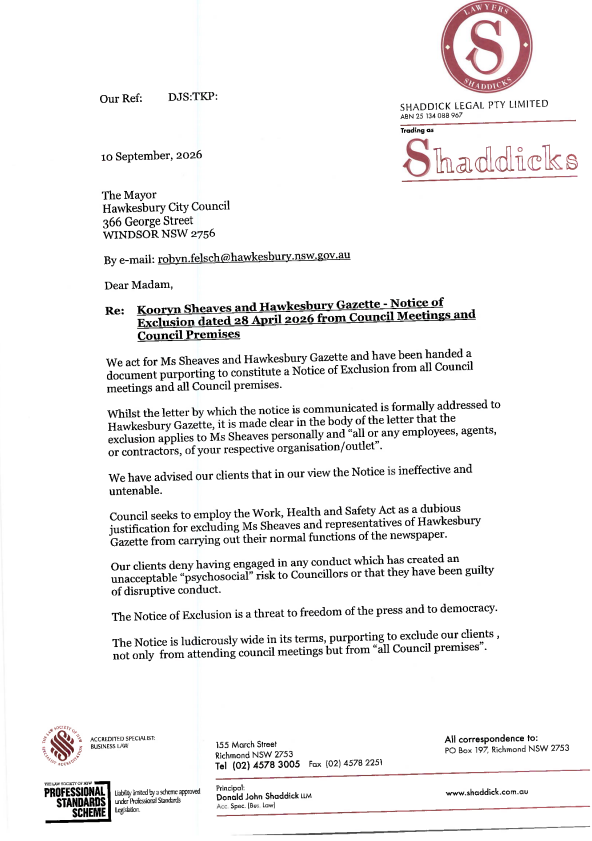
The letter dated September 10 and addressed to Hawkesbury’s newly elected Mayor, Cr Mary Lyons-Buckett, argues that Council’s notice is “ineffective and untenable” and uses workplace health and safety legislation as a “dubious justification” for preventing the Gazette from performing its normal journalistic functions.
Shaddicks Lawyers says its clients deny engaging in disruptive conduct or conduct creating an unacceptable psychosocial risk to councillors or Council employees.
“The Notice of Exclusion is a threat to freedom of the press and to democracy,” the firm states.
The lawyers describe the notice as extraordinarily wide because it purports to exclude Ms Sheaves and all Gazette employees, agents and contractors from every Council meeting and Council premises.
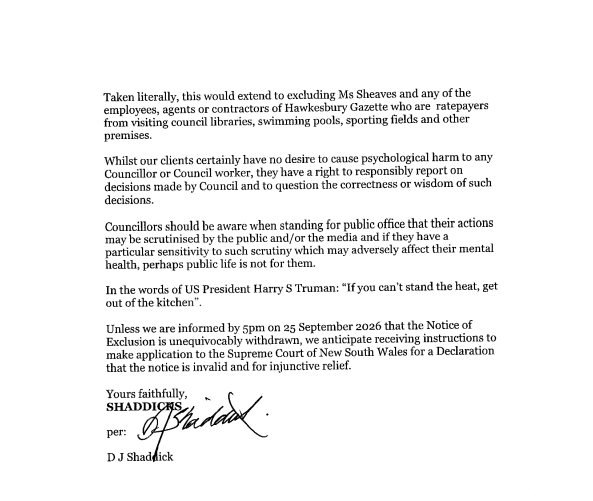
Taken literally, they argue, the notice could prevent Gazette representatives who are also Hawkesbury ratepayers from accessing Council libraries, swimming pools, sporting fields and other public facilities.
The letter says that unless Council confirms by 5pm on September 25 that the exclusion notice has been unequivocally withdrawn, the Gazette anticipates instructing its lawyers to seek a Supreme Court declaration that the notice is invalid, together with injunctive relief.
On 24 September Mayor Councillor Mary Lyons-Buckett said Council would welcome “meaningful and constructive dialogue” with the Hawkesbury Gazette to resolve the ban. Council issued a media release today stating:
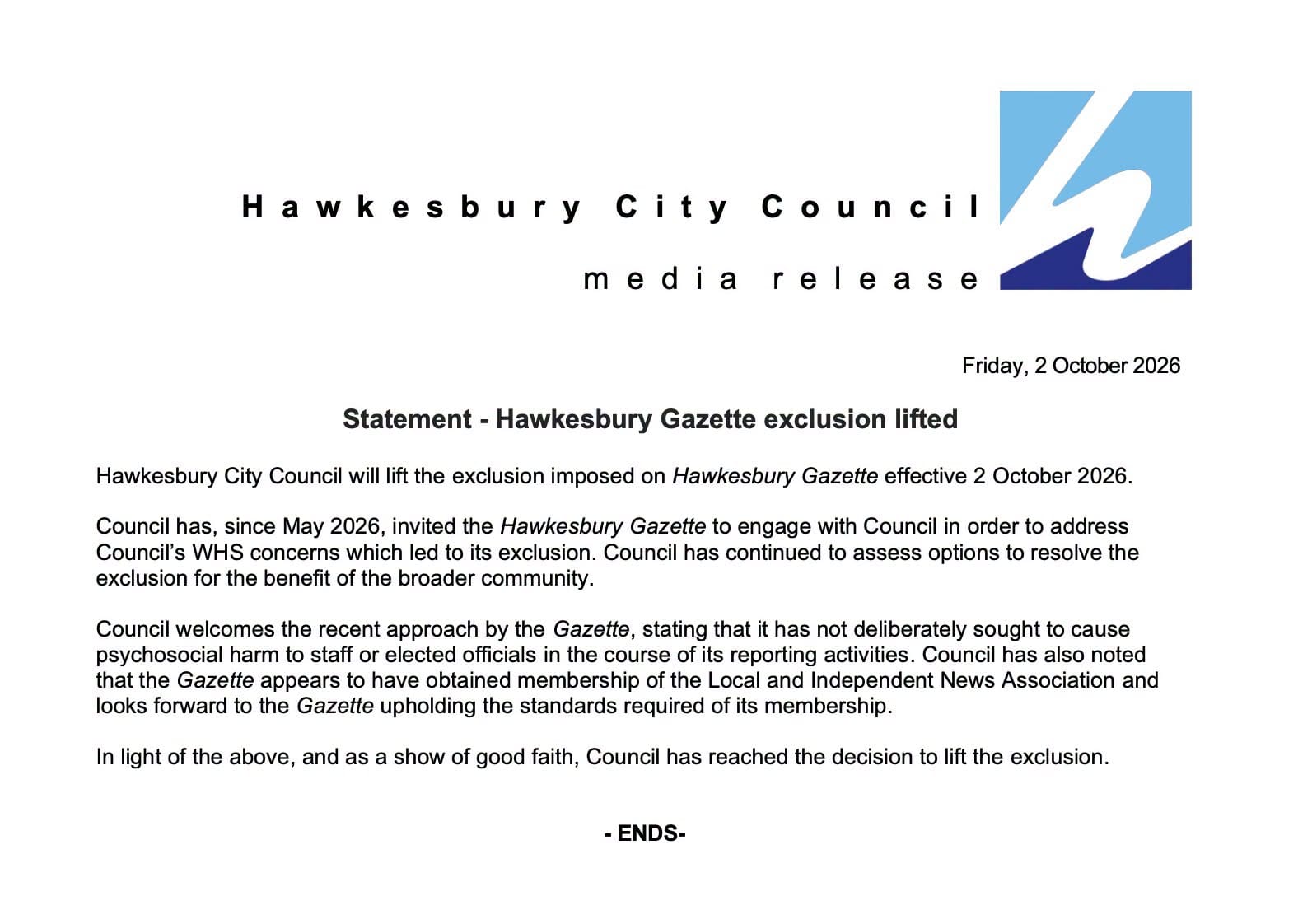
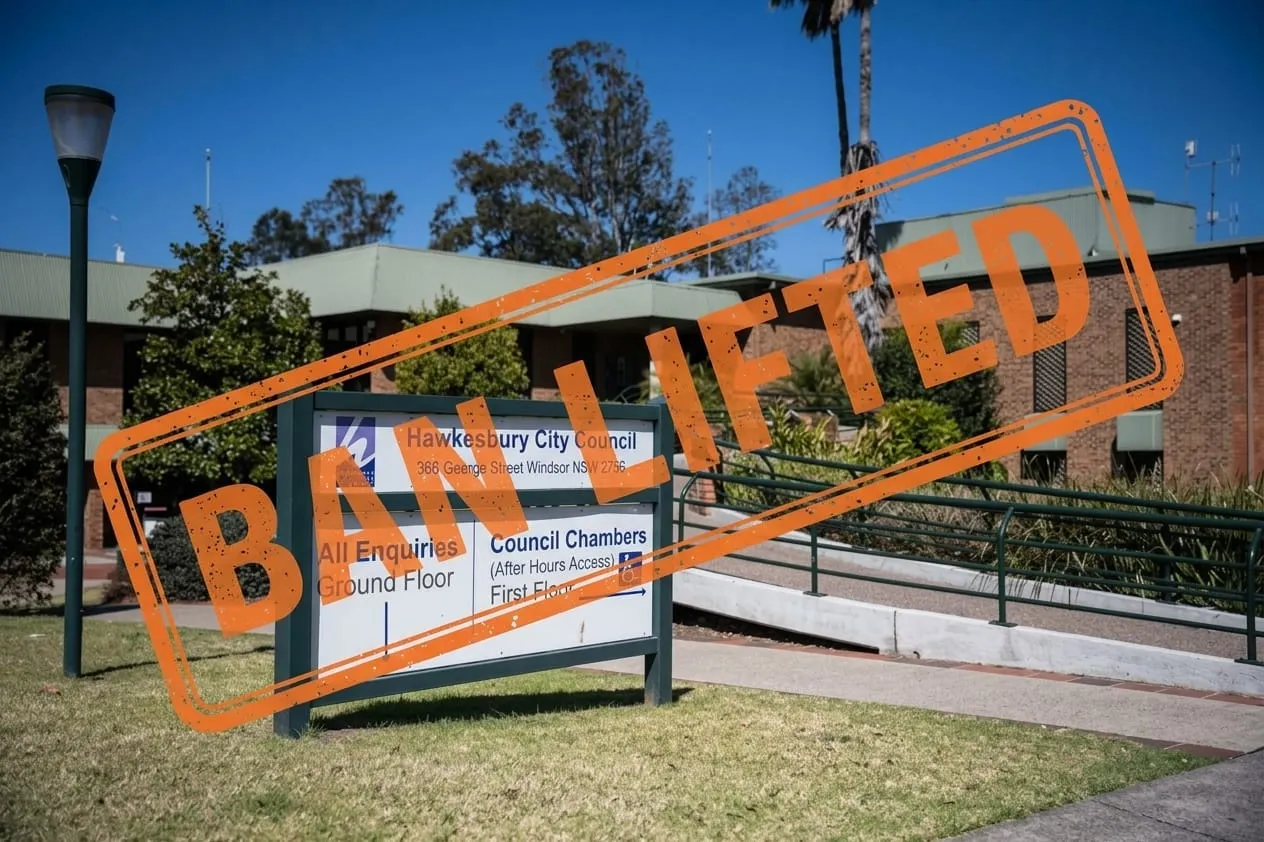
"Hawkesbury City Council will lift the exclusion imposed on Hawkesbury Gazette effective 2 October 2026."
Ban followed questions over $340,000 payout to GM
Council imposed the ban three days after the Gazette published a story questioning the circumstances surrounding an approximately $340,000 payment to departing general manager Elizabeth Richardson.
The Gazette’s article, “$340K Payout to Departed GM Sparks Questions”, published on April 25, reported that Council had entered into a deed of agreement to pay departing General Manager Richardson 38 weeks’ salary. The Gazette calculated the amount at approximately $340,000; neither Council nor Ms Richardson has disputed that estimate. The 38-week payment matches the provision in the general manager’s contract that applies if a general manager is removed from the position.
The Gazette reported that Council had approved the payment through a late-night Mayoral Minute in the early hours of April 15, at the end of an ordinary Council meeting that began at 6pm and continued beyond 1am. At the end of the meeting the mayor announced that the General Manager had resigned.
Ms Richardson’s contract was due to expire in May 2027. When it was renewed, she received a three-year term rather than the possible five years. Since then, she was reportedly seeking other employment. She finished work at Hawkesbury Council on 17 April and commenced employment as a Director at the NSW Office of Sport two weeks later.
The article asked whether Ms Richardson had resigned voluntarily or entered a negotiated separation with Council, what contractual or legal basis supported the payment and whether lower-cost alternatives had been considered.
It also questioned what legal advice was provided to councillors before the decision and whether councillors received adequate supporting documentation.
The Gazette reported allegations that claims of defamation, misogynistic coverage and sexual harassment were raised during the midnight meeting of Councillors considering the Mayoral Minute to discuss Ms Richardson's resignation. The article made clear that those claims had not been independently established and argued that serious workplace allegations would ordinarily require evidence gathering and formal investigation.
The story concluded that the community was entitled to clear answers about the expenditure of public money and whether the decision had been made through an evidence-based process.
Three days later, on April 28, then Mayor Cr Les Sheather and Acting General Manager Will Barton signed exclusion notices against the Hawkesbury Gazette and Hawkesbury Radio.
The proximity of the story and the exclusion notice form part of the broader context surrounding the dispute. However, timing alone does not establish that the payout story caused or influenced the ban, and Council has not publicly stated that the article was the reason for issuing the notice.
How Council justified the ban
Council said it had formed the view that representatives of the outlets had engaged in behaviour creating an unacceptable health and safety risk to councillors and employees.
It referred to disruptive conduct, harassment, social-media activity and reporting it considered incorrect or defamatory.
The Gazette rejected those allegations and repeatedly asked Council to identify the incidents and evidence relied upon.
Mr Barton subsequently described the measure publicly as preventative. No specific incident involving the Gazette was identified as the event that triggered the exclusion.
The ban prevented Gazette representatives from entering public Council meetings, approaching councillors and officials in person or observing activity within the chamber beyond what could be seen through Council’s livestream.
Council maintained that meetings remained publicly accessible online. The Gazette’s position has been that watching a webcast is not equivalent to the access provided to other journalists and members of the public attending in person.
Councillors divided
On May 12, councillors considered a motion moved by Cr Mike Creed and seconded by Cr Nathan Zamprogno stating that the chamber dissented from banning any media organisation and that no such ban should be imposed.
The motion was defeated, with Crs Creed and Zamprogno voting for it and Crs Amanda Kotlash, Sarah McMahon, Jill Reardon, Peter Ryan and Paul Veigel voting against it.
Crs Sheather, Shane Djuric, Mary Lyons-Buckett and Danielle Wheeler left the chamber after declaring interests and did not vote.
The official minutes record that Cr Lyons-Buckett declared significant and less-than-significant non-pecuniary interests because the matter concerned the Gazette, to which she has a family connection, and Hawkesbury Radio, with which she had previous affiliations.
At the same meeting, however, Cr Lyons-Buckett moved a separate motion requiring Council to hold an externally facilitated workshop reviewing its media policy.
That resolution called for specific attention to “definitions”, contemporary media practices, confidential information and emerging technologies. Cr Lyons-Buckett declared a less-than-significant interest in that item but remained in the chamber, participated in the debate and voted.
Critics, including Cr Zamprogno, warned that reviewing definitions could place Council in the position of deciding which organisations qualified as legitimate media. Cr Zamprogno argued that it was not the function of a Council media policy to “vet, or define who qualifies as a media organisation”.
Supporters said the changing media environment, including online publications, podcasts, social media and citizen journalism required Council’s policy to be reviewed.
Contradictory positions confront new Mayor
Those two positions now place Cr Lyons-Buckett in a difficult position as Mayor.
She excluded herself from voting on the motion that could have rejected the Gazette’s ban because of her connection to the publication. However, she remained in the chamber and championed a related media-policy review that included consideration of definitions which could influence how Council recognises and deals with media organisations.
The distinction may be that the first motion directly concerned the two banned outlets, while the second was framed as a general policy review. Nevertheless, the different treatment of the two matters creates an appearance of inconsistency that the new Mayor may now need to explain.
Cr Lyons-Buckett was elected Mayor on September 8, defeating Cr Sheather by eight votes to four. Just two days later, the lawyers’ letter placed the unresolved dispute before her.
She now faces a choice between maintaining an exclusion introduced under her predecessor, negotiating a resolution, or allowing the dispute to proceed towards possible court action.
Minister calls position “not sustainable”
The legal warning follows direct criticism from NSW Local Government Minister Ron Hoenig during a parliamentary Budget Estimates hearing on September 2.
Mr Hoenig described Council’s attempt to exclude journalists as “just not sustainable” and inconsistent with open-meeting requirements.
“As a democratic institution, council has to be publicly accountable for its actions,” the Minister said.
He told the hearing that the Office of Local Government would examine events at Hawkesbury Council with greater scepticism and pursue the media-ban issue with greater urgency.
Office of Local Government Deputy Secretary Brett Whitworth PSM also told the hearing that he had written to Council and advised that banning media was not an appropriate approach in the context of freedom of political communication.
Mr Whitworth said he had not followed the matter through because he believed the situation had resolved itself. However, while Council lifted Hawkesbury Radio’s exclusion on July 1, the ban applying to the Gazette remained in force.
Council’s responsibilities
Hawkesbury City Council has a legal obligation to manage risks to the physical and psychological health of councillors, employees and others within its workplaces. The Gazette does not dispute that responsibility.
The central question is whether excluding an entire media organisation including its employees, agents and contractors from Council meetings and premises is a lawful, reasonable and proportionate way of meeting that obligation.
That question is particularly significant because Council has not publicly identified a specific incident involving the Gazette that prompted the exclusion. Then Acting General Manager Will Barton instead described the measure as preventative.
Importantly, during the May 12 Council meeting, Cr Mike Creed revealed that alleged councillor-on-councillor bullying had led him to thoughts of self-harm.
Mr Barton did not consider the disclosure to be a critical workplace incident requiring referral by Council.
In correspondence provided to the Gazette, Mr Barton advised that any person who believed a referral was warranted could make a report directly to SafeWork NSW.
"If Hawkesbury Radio believes Council has failed to comply with its work health and safety obligations, it remains open to Hawkesbury Radio, and any other person(s) who reasonably believes the same, to refer the matter directly to SafeWork NSW, the appropriate regulatory authority, for independent assessment."
The Gazette subsequently made the referral, prompting an email dated 16 June from SafeWork NSW stating:
"This is a courtesy email to let you know I have been assigned to look into the concerns you raised regarding psychosocial health and safety in relation to Hawkesbury City Council...I will keep you informed as the matter progresses. "
The investigation is ongoing.
Against that background, the Gazette’s lawyers question whether Council has applied its workplace health and safety responsibilities consistently: imposing a sweeping exclusion on a media organisation without publicly identifying a triggering incident, while declining to refer a councillor’s disclosure of bullying and thoughts of self-harm.
NSW Supreme Court action
Shaddicks Lawyers argued that the exclusion improperly prevents journalists from reporting on Council decisions and questioning their correctness or wisdom. The firm maintains that workplace health and safety obligations do not justify the breadth of the notice.
Mayor Mary Lyons-Buckett said Council would welcome “meaningful and constructive dialogue” with the Hawkesbury Gazette to resolve the ban, pointing to discussions with Hawkesbury Radio that preceded the lifting of its exclusion on 1 July.
Sometime after 28 April notice banning the media outlets from Council premises and before 1 July 2026, Hawkesbury Radio removed The Common Point by Sparky Sean from its broadcast schedule. 'Sparky Sean' Carroll was the only radio commentator to regularly attend Council meetings.
The mayor’s response is attached and reiterates general claims it made about the Gazette in its exclusion notice. It also makes a claim of a "...repeat invitation to the Hawkesbury Gazette to work with Council to reach a positive resolution in the interests of the Hawkesbury community."
"This is the first time the Gazette has received an invitation to sit down and discuss Council concerns and we welcome it." says Kooryn Sheaves Gazette publisher and the mayor’s sister-in-law.
"Sharing a pot of tea, talking over problems so everyone can understand the different perspectives is an excellent starting point to coming up with solutions that improve outcomes for our community."
The Gazette replied to the Mayor’s response with a suggestion of a meeting of representatives from both parties at the offices of Shaddick Lawyers at Council’s earliest convenience and is awaiting a response.
Disclosure
Cr Mary Lyons-Buckett is the sister-in-law of Hawkesbury Gazette publisher Kooryn Sheaves. The Gazette publishes this disclosure because the relationship is relevant to the matters discussed in this report.
The Gazette and its publisher are directly affected by the exclusion notice and are the clients named in the lawyers’ letter. This report has therefore distinguished the assertions made by the Gazette’s lawyers from facts independently established.
No court has ruled on the validity of the exclusion notice. The timing between the April 25 payout story and the April 28 ban does not, by itself, establish that the two events were causally connected.
Shaddick Legal letter is attached for reference.
Hawkesbury City Council Media Release.