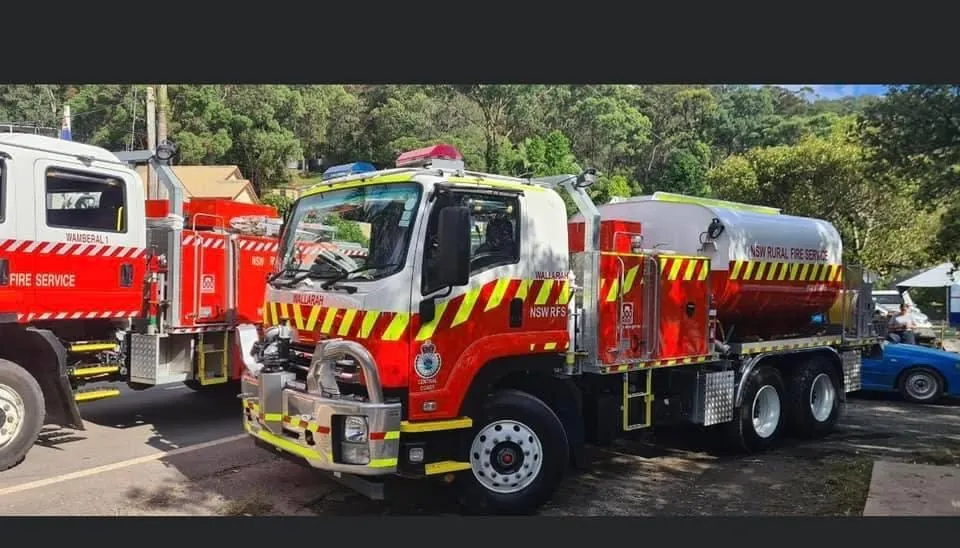
As another bushfire season approaches, questions are increasingly being raised about the safety limits of NSW Rural Fire Service tankers and whether overloaded appliances could place volunteer firefighters and communities at unnecessary risk.
The issue centres on the weight carried by modern fire appliances, particularly Category 1 tankers commonly used throughout the Hawkesbury, Blue Mountains and regional New South Wales.
While the public often sees fire trucks simply as rugged emergency vehicles, modern bushfire tankers are highly specialised heavy vehicles carrying thousands of litres of water, pumps, hoses, crew protection systems, chainsaws, fuel, medical equipment, communications systems and firefighting crews, all operating in some of the harshest terrain and most dangerous conditions imaginable.
Experts say the margin between a legally compliant vehicle and an overloaded one can sometimes be much smaller than many people realise.
The Weight Problem
A fully loaded Category 1 tanker can weigh up to 13 to 15 tonnes once water, equipment and crew are onboard.
Water alone may account for between 3,000 and 4,000 kilograms, while firefighting equipment, burnover protection systems, breathing apparatus and operational gear add several more tonnes.
Modern firefighting protective clothing and breathing equipment also significantly increase individual crew weight loads compared to previous decades.
When additional campaign fire equipment is added during major incidents — including overnight gear, spare hose, generators, chainsaws, fuel containers and food supplies and appliances can approach critical load thresholds.
Importantly, the issue is not only total vehicle weight.
Heavy vehicle regulations also impose limits on front axle loading, rear axle loading, braking capacity, tyre ratings and rollover stability.
A tanker may technically remain below its overall Gross Vehicle Mass (GVM) while still exceeding axle load limits, particularly on rear axles carrying water tanks and equipment compartments.
Why It Matters During Bushfires
For Hawkesbury communities regularly threatened by major bushfires, the issue is not theoretical.
Fire tankers routinely operate on narrow mountain roads, steep terrain, fire trails, damaged surfaces and smoke-obscured escape routes.
Under these conditions, excess weight can directly affect braking distances, steering control, rollover risk, off-road stability, tyre reliability and escape capability during burnovers.
Bushfire tankers already carry a high centre of gravity because of the large volumes of water they transport. Additional weight or poor load distribution can increase the likelihood of rollovers, particularly during emergency manoeuvres.
Overloaded vehicles place increased strain on tyres, suspension systems, wheel bearings, and braking components.
Mechanical failures during active bushfires can quickly become life-threatening.
Burnover Survival and Crew Protection
One of the most serious concerns involves firefighter survival during burnovers — situations where fire overtakes a tanker and crews are forced to shelter inside the vehicle.
Modern NSW RFS appliances are fitted with crew protection systems including water spray systems, radiant heat shielding and cabin protection technologies.
Firefighters rely on the vehicle remaining mechanically operable and stable under extreme conditions.
However if appliances are overloaded or operating beyond engineered limits, the risks during a burnover event may increase.
Work Health and Safety Obligations
The issue also raises broader Work Health and Safety questions.
Under Australian WHS legislation, agencies have a legal obligation to eliminate or minimise foreseeable risks to workers “so far as is reasonably practicable.”
That includes risks associated with vehicle operation, heavy equipment, crew transport, fatigue and mechanical safety.
Increasingly, bushfire inquiries and coronial investigations across Australia have examined whether emergency services adequately identified and managed systemic risks rather than simply focusing on individual decisions made during emergencies.
Questions are also being asked about whether incidents involving overloaded appliances, near misses or mechanical failures should trigger mandatory “dangerous incident” reporting obligations under WHS laws.
What Is Being Done?
NSW RFS and other Australian fire agencies have progressively introduced measures designed to reduce loading risks.
These include:
- standardised appliance designs,
- certified seating and seatbelt requirements,
- engineering compliance testing,
- fleet management systems,
- heavy vehicle driver training,
- and standardised equipment inventories.
Modern appliances are generally engineered around approved crew numbers and operational loadouts.
Operational policies now also prohibit many historical practices such as transporting excess personnel or unsecured equipment.
Some appliances undergo weighbridge testing and engineering reviews during commissioning and fleet assessments.
However, concerns remain that operational realities during prolonged campaign fires may exceed “standard” assumptions used during engineering certification.
Over time, local brigades can also accumulate additional equipment and modifications that alter vehicle loading characteristics.
A Growing Issue for Rural Communities
The issue is particularly important in regions like the Hawkesbury and Blue Mountains, where bushfire operations often occur in extremely difficult terrain and under rapidly changing fire conditions.
Volunteer firefighters in these areas routinely spend long hours on active firegrounds while carrying heavy personal protective equipment and operating in dangerous environments.
For many residents, the safety of the firefighters protecting their communities is becoming an increasingly important public discussion.
The issue also highlights broader challenges facing emergency services as climate change drives more frequent, prolonged and intense bushfire events.
As bushfires become larger and more complex, the operational demands placed on firefighting appliances and the people inside them continue to grow.
For many in the Hawkesbury, the question is no longer simply whether enough trucks are available during emergencies, but whether the systems surrounding those vehicles are keeping pace with Work Health and Safety requirements.
The Gazette is following this story. Questions have been put to NSW RFS regarding trucks used by Hawkesbury Fire Control and the response will be published.