By Bob Gribbin
This is the third article in the Hawkesbury Gazette's investigation into the proposed Special Rate Variation sought by Hawkesbury City Council.
In Part One, we examined whether the council had demonstrated genuine financial need. Part Two explored whether the community was properly informed and engaged in the consultation process.
Part Three examines the direct financial impact on ratepayers, which constitutes Criterion 3 under the guidelines used by the NSW Office of Local Government and assessed by the Independent Pricing and Regulatory Tribunal (IPART).
The main question under this criterion is whether the proposed increase imposes an unreasonable burden on residents and businesses.
Two Rate Rises in a Decade
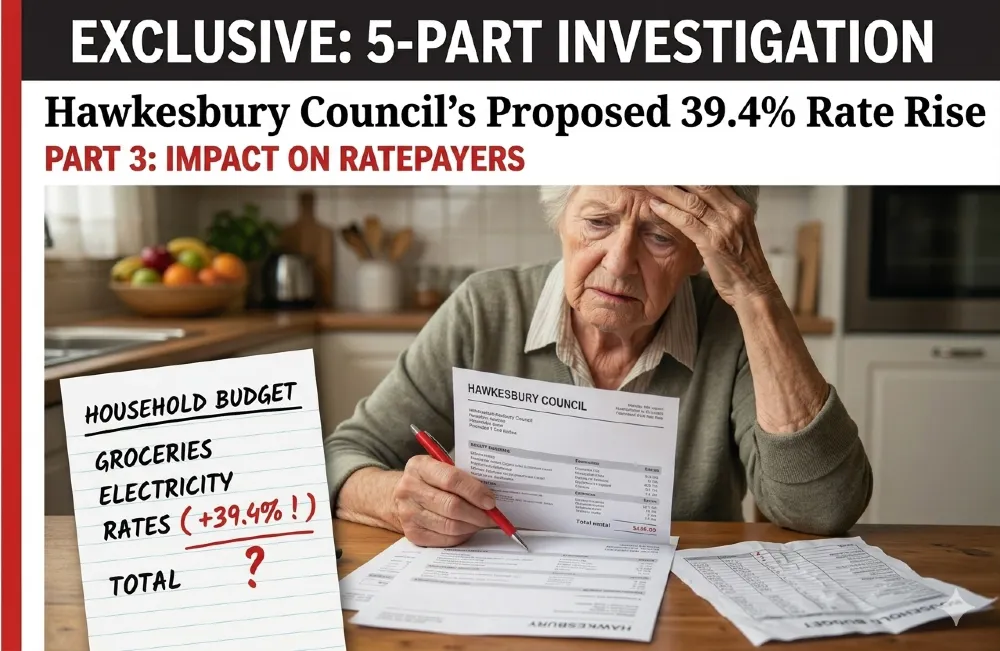
If approved, the current proposal would see rates rise by 8.66% annually over four years, culminating in a total increase of 39.4%. However, the full impact becomes clearer when the proposal is viewed alongside the earlier Special Rate Variation approved in 2018.
That earlier increase raised rates by 31.29% over three years. Together, the two rate rises would mean Hawkesbury residents have experienced an increase of about 83% above what the standard rate peg alone would have caused over ten years.
For many households already facing higher living costs, this prompts questions about affordability.
What the Increase Means for the Average Household
Council modelling indicates the projected path for the typical residential ratepayer.
| Year | With SRV | Without SRV | Additional Cost |
|---|---|---|---|
| 2025–26 | $1,688 | $1,688 | — |
| 2026–27 | $1,834 | $1,740 | $94 |
| 2027–28 | $1,993 | $1,793 | $200 |
| 2028–29 | $2,166 | $1,838 | $328 |
| 2029–30 | $2,353 | $1,883 | $470 |
By the fourth year of the proposal, the average household would be paying $665 more annually than today and $470 more than under the standard rate peg alone.
For businesses, the increase is considerably greater, especially in higher rate brackets.
Not All Suburbs Are Affected Equally
One of the complexities of the Hawkesbury rating system is that rates are primarily based on land values. This means the financial impact differs greatly across suburbs.
Data cited in the analysis shows that some areas already face very high rate bills relative to income levels. For example, Oakville residents might face annual rates nearing $7,000 under the proposed SRV, while Bligh Park residents would pay around $1,858 according to the same proposal.
This disparity happens because land values in certain areas have risen considerably due to nearby development, even though residents' incomes may not have increased at the same rate. The issue particularly affects retirees and long-term residents on fixed incomes.
Capacity to Pay
The council commissioned a capacity-to-pay analysis, which concluded that the Hawkesbury has an overall "moderate capacity to pay."
However, the study also found notable differences within the local government area. According to the analysis, the Richmond–Windsor area, which has the largest population, also exhibits the greatest financial vulnerability due to lower household incomes, greater proportions of renters, and higher levels of financial stress.
The same analysis also notes that if the SRV proceeds, Hawkesbury's average residential rates would shift towards the higher end of the spectrum among metropolitan and fringe councils.
The Sewer Divestment Issue
The council has argued that transferring the Windsor sewerage system to Sydney Water will help offset some of the SRV's costs. Under this arrangement, roughly 25% of ratepayers could save between $200 and $300 annually.
However, the analysis reviewed by the Gazette suggests that these savings may be partly offset by a new sewer infrastructure charge being introduced to repay debt incurred during the Windsor sewer pipeline failure.
If that happens, the net benefit to households might be less than originally indicated.
Existing Rate Payment Issues
The council's own financial data also shows that its outstanding rates ratio is already above the NSW benchmark. Outstanding rates occur when ratepayers cannot or do not pay their rates on time.
While the council has partly attributed this to disruptions caused by floods and natural disasters, the figure also raises questions about the financial pressures already confronting some households.
Critics argue that a further 39.4% increase could lead more residents to struggle to meet rate payments.
A Community Already Under Pressure
The financial debate over the proposed SRV is unfolding amid a broader cost-of-living environment in which many households are already facing rising costs for energy, insurance, mortgages, and rent.
For some residents, the proposed increase might be manageable. For others — especially pensioners and households on fixed incomes — it may pose a substantial additional burden.
Under the OLG guidelines, IPART must consider these impacts when determining whether the proposed increase is reasonable.
The Bigger Question
The debate ultimately revolves around balancing two competing realities. On one hand, the Hawkesbury faces substantial infrastructure needs and covers a large geographic area. Conversely, the proposed rate hike would add extra financial strain on thousands of households throughout the region.
As Local Government Minister Ron Hoenig has noted, the final say on council performance rests with residents themselves. Understanding the true financial impact of council decisions has therefore become a vital aspect of the local democratic process.
Coming Up Next
Part Four of the Gazette's investigation will assess whether the council's planning documents — including its long-term financial plan and delivery program — meet the requirements of the Integrated Planning and Reporting framework used to justify the proposed rate rise.